- Type
- Sea Vegetables
- Difficulty
- Hard
- Season
- Spring·Summer
- Sowing
- From nursery stock
Kelp
Saccharina japonica
Glutamate, alginate, mannitol · the seaweed under every stock
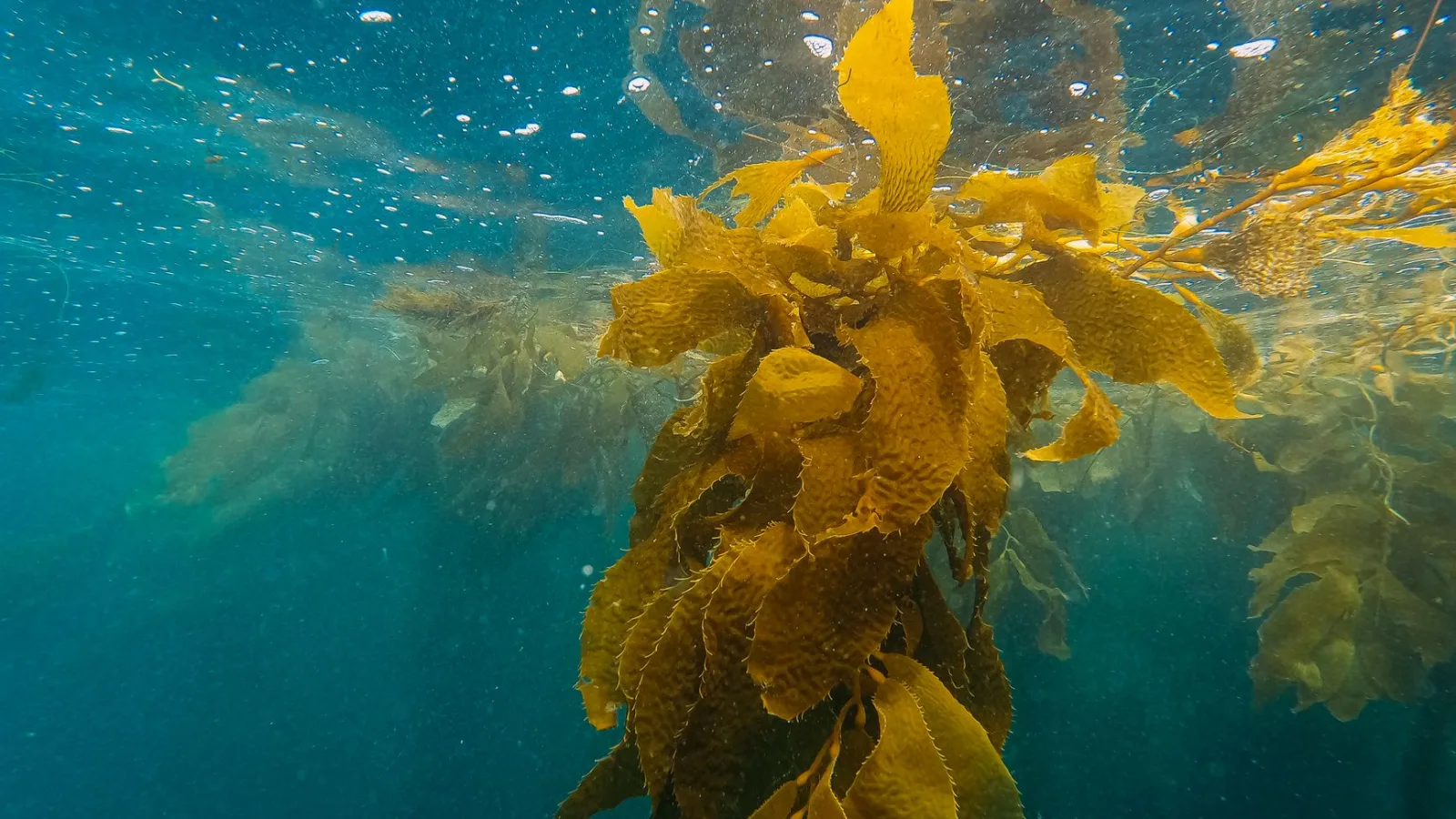
Kelp is a brown alga of cold seas. It is the base of stock, and the fact that glutamate, the savoury compound, was isolated from kelp broth and took its name there belongs to the history of food science. What reaches the table today is mostly farmed: seeded lines go into the sea in autumn and come up between May and July of the following year, before the water warms, to be dried in the sun. The white bloom on the surface is not mould but mannitol, a sugar alcohol, so scrubbing it off under water takes flavour with it. Wipe it lightly with a damp cloth, and for stock steep it in cold water and lift it out just before the boil. Boiled hard, it releases slippery mucilage and bitterness. The Donguibogam lists it in the Vegetable section as 昆布, recording a cold nature, a salty taste and no toxicity. It says the plant comes from the eastern sea, and adds that things from the sea are used only after the salt has been washed off.
Year-Round Calendar
- 1
- 2
- 3
- 4
- 5
- 6
- 7
- 8
- 9
- 10
- 11
- 12
- 10
- 11
- 5
- 6
- 7
Where It Grows
-
Main producer
Accounts for most of world production. The Shandong and Liaoning coasts are the center, and Fujian grows it too, using winter water temperatures. Harvest May, June, July
- 5
- 6
- 7
-
Main producer
Farming is centered on Wando and Goheung in South Jeolla and the Gijang coast in Busan. Lines go down in autumn and are lifted in early summer the following year. Harvest May, June, July
- 5
- 6
- 7
-
Main producer
Centered on the Hokkaido coast, where wild kelp growing on rock makes up a large share. Harvest July, August, September
- 7
- 8
- 9
Its home is the cold water of the northwest Pacific, across Korea, Hokkaido in Japan, and northern China. Stock carried over from Japan in the early twentieth century took hold along the Shandong coast, and that was the beginning of large-scale Chinese cultivation; most of the production now comes from China. What Japan calls kombu is a mix of several species — ma-kombu, rishiri-kombu and others — so it does not line up exactly with the range of this one species.
- Optimum water temp.
- 5~15℃
- Range
- 0~20℃
- Hardiness
- Not applicable
- Day length
- Not applicable
What sets the growing season is water temperature, not air temperature. Seed stock goes down into the sea in autumn as the water cools, the plants lengthen through a winter and spring of 5~15℃, and once early summer climbs past 20℃ they melt away from the tips. Only where the water is clear enough for sunlight to reach down and a current runs through does the frond lay down any thickness.
In Korea Coastal areas
Farming is centered on Wando and Goheung in South Jeolla, Gijang in Busan, and the South Gyeongsang coast. Lines carrying the seed stock go down into the sea in autumn and are lifted the following year in May to July, before the water warms. The Yellow Sea is too turbid, and its summer water too warm, to serve as farming ground.
How to grow
- Light
- It grows where light reaches down through clear water. This is not a crop planted in a bed
- Soil and depth
- It puts no roots into soil. A holdfast grips rock or a farming line, and the plant lives on what is dissolved in the water
- Spacing
- On a farm the lines are spaced so water moves between them. Crowded lines give thin blades and invite disease
- Watering
- It grows in cold water. The crop has to come up before summer warms the sea, or the blades break down
- Feeding
- Nothing is fed. Instead, choose blades of a deep blackish brown, thick, with the white bloom evenly settled. Sheets faded to red are old
- Harvest
- May to July, lifted with the lines before the water warms and dried in the sun. The white bloom settles on the surface as it dries
What makes the difference. For stock, steep it in cold water for about half an hour, bring it up in the same water, and lift it out just before the boil. Shred the lifted kelp and braise or dress it
Why this one is harder. It is farmed on lines in the open sea, not something an individual handles in a plot. Buying well and keeping it properly dried is the whole of what happens at home
Common problems
- Mould You will see The sheet goes damp and green or black staining spreads What to do Tell it apart from the white bloom. The bloom is mannitol; a sheet with coloured staining goes in the bin
- Damp You will see What was stiff turns limp and no longer snaps when folded What to do Seal it in a container with a desiccant and keep it somewhere cool and dark. Never open the bag over a steaming pan
- Pantry insects You will see Small larvae or webbing inside the bag What to do Discard that bag and check the other dried goods on the same shelf
This page describes how a crop is grown and used. It does not claim health effects for any food, nor is it intended to prevent or treat disease. Component and study notes are references only and do not mean the same result occurs in people. Consult a medical professional about health concerns.
Health Benefits
The old record — gonpo (昆布). The Donguibogam lists kelp in the Vegetable section as 昆布. It records a cold nature, a salty taste and no toxicity. It says the plant comes from the eastern sea, and adds the note that things from the sea are used only after the salt has been washed off. This is a historical medical record and differs from how it is judged today.
Where glutamate was found. That glutamate, the savoury compound, was isolated from kelp broth and took its name there belongs to the history of food science. Kelp is still treated as a material rich in it. This is a record about taste compounds.
Alginate and mannitol. Alginate has been isolated as the polysaccharide building the cell wall of brown algae, and the white bloom on dried blades is mannitol, a sugar alcohol. It is easily mistaken for mould but is something else. This is a compositional record.
Concentrating iodine. Brown algae concentrate iodine dissolved in seawater, so levels run high. The same work reports wide variation with species, growing waters and how far the blade was dried. This is a compositional record.
Nutrition
- Glutamate (released into the stock) — the amino acid behind savoury taste
- Alginate (builds the cell wall of brown algae) — the polysaccharide that turns slippery when soaked
- Mannitol (the white bloom on the surface) — a sugar alcohol with a mild sweetness
- Iodine (gathered from seawater) — a mineral common in seaweeds
Glutamate and stock Glutamate, the savoury compound, was isolated from kelp broth and took its name there. Kelp is still treated as a material rich in it. Steeped in cold water for half an hour and then brought slowly to heat, it gives its flavour up gradually; lifted out just before the boil, the taste stays and the mucilage largely does not.
Alginate and fucoidan Alginate has been isolated as the polysaccharide building the cell wall of brown algae, and the mucilaginous polysaccharide fucoidan is reported alongside it. Boiled long, kelp turns a stock slippery, and that is these polysaccharides coming out. This entry stays with the compositional record.
The white bloom The white powder that settles on dried kelp is not mould but mannitol, a sugar alcohol. It carries a mild sweetness, so scrubbing it off under water takes flavour with it. Wipe it lightly with a damp cloth and stop there. Coloured staining is another matter, and that piece goes in the bin.
Iodine Brown algae concentrate iodine dissolved in seawater, so levels run high. The same work reports wide variation with species, growing waters and how far the blade was dried. Anyone advised to control their iodine intake should settle the amount with their medical team.
Pairings
○ Anchovy and shiitake — Glutamate from kelp, inosinate from anchovy and guanylate from dried shiitake are three different savoury compounds. Used together they build a deeper stock than any alone. Lift the kelp out just before the boil and let the rest go on simmering. Shiitake
○ Rice and braises — A palm-sized piece laid on rice as it cooks lends a quiet sweetness. Kelp lifted from a stock should be shredded and braised in soy sauce rather than thrown away. Added to simmered black beans it softens the salt.
○ Wraps and vinegared dishes — Salted kelp is soaked to draw out the salt and used as a wrap. Blanched and dressed with vinegared chilli paste, its slippery grain comes into its own. The thinner the blade, the shorter the blanching.
△ Boiling it hard — Boiled long, kelp releases slippery mucilage and bitterness. Steep it in cold water for about half an hour, bring it up in the same water, and lift it out just before the boil. If a stock has already turned slippery, take the kelp out and finish as it is.
△ Scrubbing off the white bloom — The white powder on the surface is not mould but mannitol, a sugar. Scrubbing it off under water takes flavour with it, so wipe lightly with a damp cloth and stop there. Green or black staining is a different matter, and that sheet should be discarded.
△ When iodine intake has to be controlled — Kelp is high in iodine. If you have been advised to control your iodine intake, settle the amount with your medical team before eating it. Large amounts daily over long periods, or drinking a strong kelp infusion in place of water, is not advisable.
Varieties
- Saccharina japonica (species) — Almost all Korean farmed kelp is this species. A thick, broad blade
- Dried kelp (form) — Dried whole. The commonest form, used for stock
- Salted kelp (form) — Cured in salt, for wraps and dressed dishes. Soak in water to draw the salt out
- Shredded and snack-cut kelp (form) — Cut into strips or squares for braising and for frying as twigak
Source: Donguibogam, Vegetable Section 昆布 · Korean Food Composition Table