- Type
- Herbs & Aromatics
- Difficulty
- Easy
- Season
- Summer
- Sowing
- From seed
Hollyhock
Alcea rosea
Mucilage polysaccharides · the tall summer biennial that lines a wall
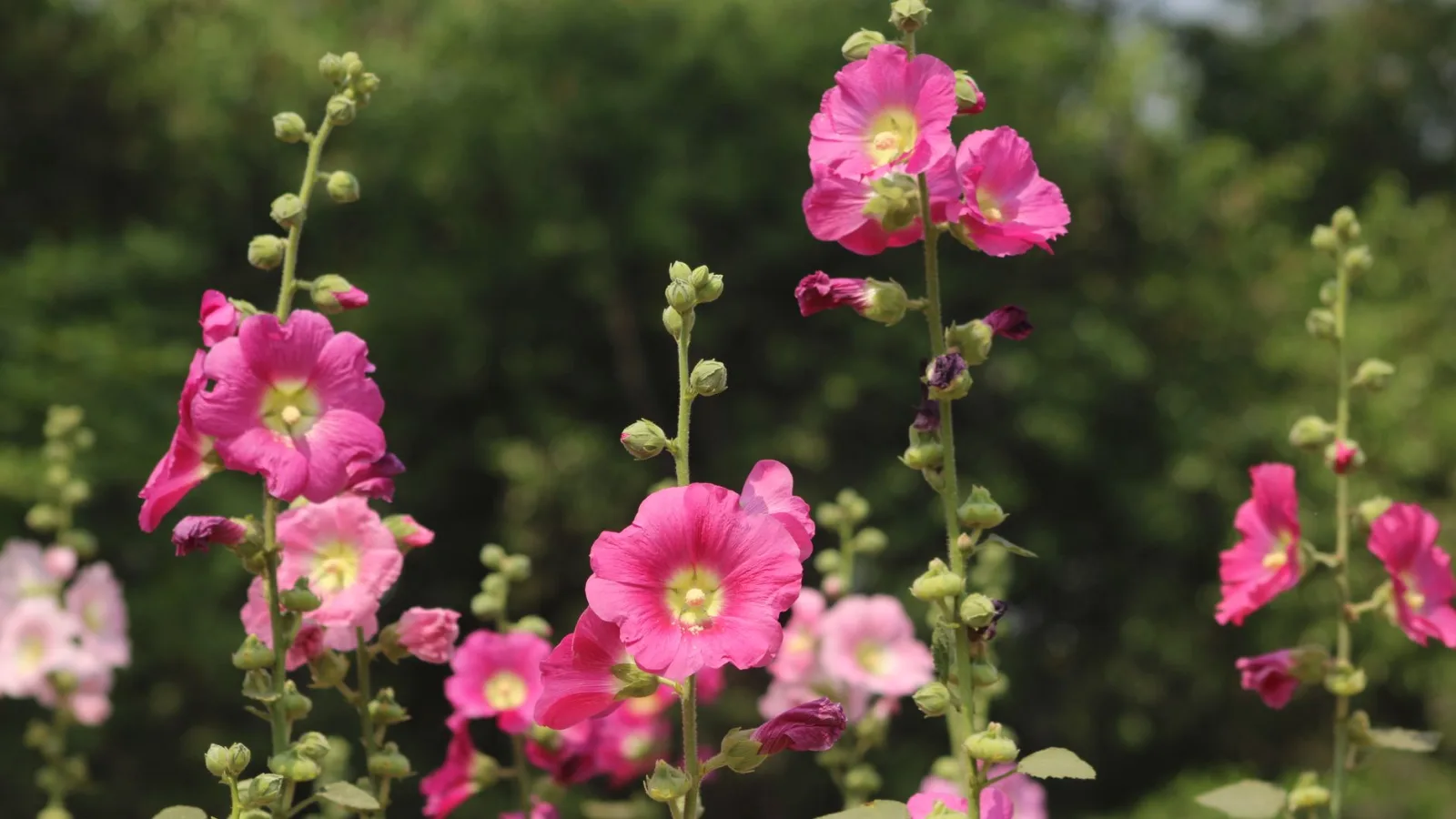
Hollyhock grows taller than a person and lines up along walls through the summer. It belongs to the mallow family, so young leaves are blanched and dressed, and the flowers are dried for tea. Leaf and flower carry mucilage, which is why blanching leaves that slippery texture behind, exactly as it does with mallow. The Vegetable section of the Donguibogam enters the red-flowered kind as 紅蜀葵 and records an old Korean phrase for it meaning the mallow that opens a red flower. The entry explains the name, that the seed came from the lands of Rong and Shu, and describes the plant as mallow-like with flowers in five colours resembling those of the rose of Sharon. Its nature is set down as cold, its taste as sweet, with no toxicity, and the text notes that the red single-flowered kind was gathered through the seasons. Sown in spring or late summer, it makes only leaf the first year and sends up flower stalks the following June or July. It stands tall enough to blow over, so a stake is best put in at planting time.
Year-Round Calendar
- 1
- 2
- 3
- 4
- 5
- 6
- 7
- 8
- 9
- 10
- 11
- 12
- 4
- 8
- 6
- 7
Where It Grows
- Origin Its origin is placed in the southwest, around Sichuan, and the old name *shukui* (蜀葵 — "Shu mallow") likewise points to that region.
- Wild population Several wild species of *Alcea*, the genus to which hollyhock belongs, survive in the mountains of Anatolia. They are distinct species from hollyhock (*Alcea rosea*) itself.
- Major producer It has long been planted along walls and in flower beds, and it self-seeds from fallen seed.
Hollyhock is thought to have originated in southwestern China, reaching European gardens by way of West Asia around the 15th century; today it is planted in flower beds throughout the temperate world. As an ornamental it has no country-by-country production statistics, so the list above is not a ranking. The centre of wild-species diversity within the genus *Alcea* itself lies in the mountains of West and Central Asia.
- Optimum
- 15~25℃
- Range
- 5~30℃
- Hardiness
- Hardy
A biennial or short-lived perennial. In its first year it puts out only leaves, hugging the ground through winter, and sends up a flower stalk the following year. It stands cold well, but if water pools during the summer monsoon the base of the plant turns soft and rots, and because the plant is tall it topples easily in wind.
Harvested 1–2 years after planting. Because it is a biennial, in the year it is sown — in spring or late summer — it puts out only leaves, and it flowers in June or July of the following year. The month of sowing and the month of flowering do not fall in the same year.
In Korea Nationwide
Planted in flower beds and along walls nationwide. Its root runs straight down, so it needs deep soil, and sites where water pools during the monsoon should be avoided.
How to grow
- Light
- Six hours of sun or more. In shade the flower stalks run thin and blow over easily
- Soil and depth
- Free-draining soil at least 30cm deep. The root drives straight down, so a shallow pot will not do
- Spacing
- 40 to 50cm between plants. It is tall and broad-leaved, and crowding spoils the lower leaves
- Watering
- Once rooted it largely carries itself on rainfall. Standing water in the rainy season rots the base, so raise the bed
- Feeding
- Compost at planting, then one top dressing as growth restarts the following spring. Overfeeding softens the stems and they blow over sooner
- Harvest
- Take young leaves from the outside in spring, before the flower stalk rises. Pick flowers in June and July, on the morning of a clear day
What makes the difference. It reaches one and a half to two metres and catches the wind. Stake it at planting and tie it again once the stalk is half up
Why this one is harder. As a biennial it makes only leaf in its first year and no flower. For flowers every year, sow across two seasons, or thin the self-sown seedlings and settle them where you want them
Common problems
- Rust You will see Dense orange pustules on the leaf undersides, leaves drying off What to do The commonest disease of the mallow family. Take affected leaves off the plot, strip the lower leaves for airflow, and water at the base rather than over the foliage
- Aphids You will see Colonies on stalk tips and new leaves, turning sticky What to do Wash them off with a jet of water; if they return, use an egg-yolk oil spray. On plants whose leaves you will eat, strip them by hand
- Slugs You will see Holes in young leaves overnight, with silver trails What to do Pick them off in the evening and ring the plant with diatomaceous earth or coffee grounds
This page describes how a crop is grown and used. It does not claim health effects for any food, nor is it intended to prevent or treat disease. Component and study notes are references only and do not mean the same result occurs in people. Consult a medical professional about health concerns.
Health Benefits
The old record — hongchokgyu (紅蜀葵). The Donguibogam lists it in the Vegetable section as 紅蜀葵 and records an old Korean phrase for it meaning the mallow that opens a red flower. Its nature is set down as cold, its taste as sweet, with no toxicity. The entry explains the name, that the seed came from the lands of Rong and Shu, and says the plant grows everywhere, resembles mallow, and bears flowers in five colours like those of the rose of Sharon. It also notes that the red single-flowered kind was gathered through the seasons. What an old medical text wrote differs from how it is judged today.
Mucilage of the mallow family. Compositional analysis confirms mucilaginous polysaccharides in the leaves, flowers and roots of mallow-family plants. That is the source of the slippery texture left after blanching. This is an analysis of composition.
Flower colour and anthocyanins. Pigment analysis confirms that the colour of the dark-flowered lines comes from anthocyanins, and reports that the shade shifts with acidity. This is a record of how the pigment behaves.
Nutrition
- Mucilage (polysaccharides) (present in leaves, flowers and root) — the source of the slippery texture typical of the mallow family
- Anthocyanins (the pigment of the dark-flowered lines) — the pigment that colours the petals red
- Flavonoids (present in leaves and flowers) — compounds reported across the mallow family
Mucilage of the mallow family Hollyhock is a mallow, and its leaves and flowers hold mucilaginous polysaccharides. That is where the slippery texture after blanching comes from, and a brewed cup carries a faint body of the same kind. Discard the blanching water and rinse cold, or the texture sits too heavy.
Anthocyanins in the flower The near-black lines carry anthocyanins densely. Brewed in hot water the colour comes straight out, and a squeeze of lemon tips it toward red. This is a record of how the pigment behaves.
Preparing the young leaves What gets eaten is the young leaf, taken before the flower stalk rises. Larger leaves stiffen, their hairs coarsen, and blanching will not soften them. Blanch briefly, rinse in cold water, squeeze out the moisture and dress.
Drying the flowers Pick flowers on the morning of a clear day, fully open, and spread them in the shade. Direct sun bleaches the colour, and anything sealed away short of bone dry will mould. Once fully dry, store them in a sealed container somewhere cool.
Pairings
○ Doenjang and perilla oil — dressed young leaves — Squeeze the blanched leaves hard and dress them with doenjang and perilla oil. The mucilage makes the seasoning cling, so keep it light. A little garlic takes the green edge off.
○ Dried for tea — Pour boiling water over shade-dried petals, cover, and leave about three minutes. The dark lines give a deep colour. Left longer, an astringent note comes forward.
○ Lemon juice — A few drops of lemon juice tip the brew toward a clearer red. It uses the way anthocyanins shift colour with acidity.
△ Do not eat from treated seed — Some flower seed is sold coated in a red or blue powder, a seed-dressing fungicide. Leaves from plants grown from that seed are not treated as food. To harvest leaves for the table, get untreated seed or use seed you saved yourself.
△ The coarse hairs on stem and leaf — Hollyhock stems and leaves are set with coarse hairs, and handling them bare-armed for long can leave the skin itchy or red. Wear gloves and long sleeves when stripping leaves or cutting stalks, and wash your hands afterwards.
△ Do not dig the root and brew it — The Donguibogam handled root and stem as medicine, but this entry goes only as far as eating the young leaves and flowers. Do not dig the root and decoct it on the strength of the old record. If you are pregnant or taking medication, keep even the flower tea to a modest amount.
Varieties
- Red single-flowered line (seed) — The single flower the Donguibogam describes as gathered. Sets seed reliably
- Double-flowered line (seed) — Petals packed in layers, showier in the bed. Sets less seed
- Near-black line (seed) — A purple so deep it reads as black. Heavy in anthocyanins
Source: Donguibogam, Vegetable Section 紅蜀葵 · Rural Development Administration (Nongsaro)