- Type
- Trees & Vines
- Difficulty
- Hard
- Season
- Fall
- Sowing
- Plant a sapling
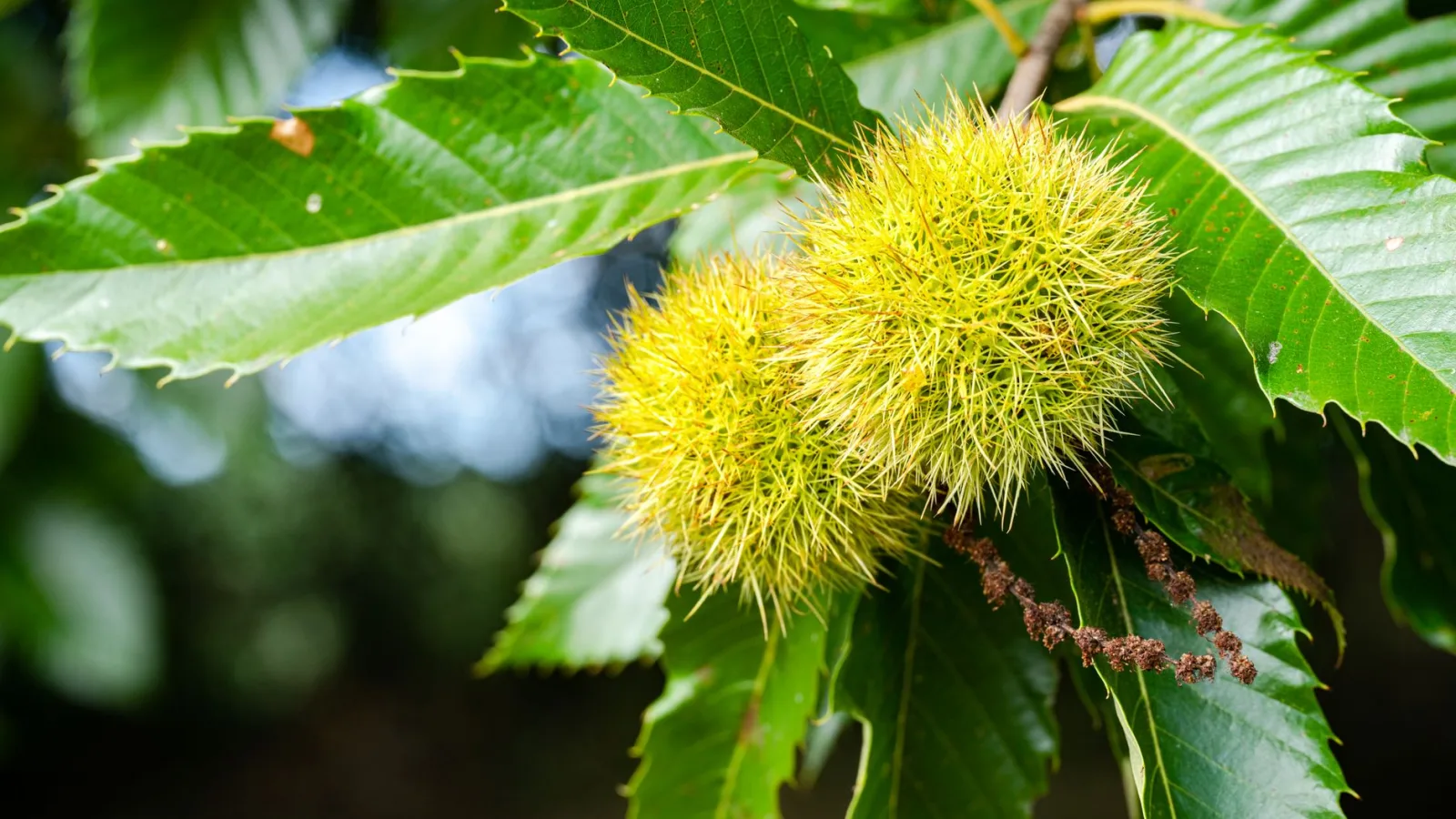
Chestnut
Castanea crenata
Vitamin C and starch, on a tree no pot will hold
Chestnuts come from a tree in the oak family, and although they get filed under nuts, their composition is closer to a grain. Low in fat, high in starch, and unusually for a nut, they carry vitamin C. The Donguibogam records them as 栗子 and ranks the chestnut first among fruits, going as far as roasting instructions: bury raw chestnuts in hot ash until the sap runs, but stop short of cooking them all the way through.
Year-Round Calendar
- 1
- 2
- 3
- 4
- 5
- 6
- 7
- 8
- 9
- 10
- 11
- 12
- 3
- 11
- 9
- 10
Where It Grows
-
Main producer
It accounts for more than 80 percent of world production. The crop is the Chinese chestnut (Castanea mollissima) from Hebei and Shandong — a different species from the chestnut covered in this entry. Harvest September, October
- 9
- 10
-
Origin
Together with Japan, it is the native home of the chestnut (Castanea crenata), and it remains one of the world's leading producers today. Gongju and Buyeo in South Chungcheong and Gwangyang in South Jeolla are well-known growing areas. Harvest September, October
- 9
- 10
- Origin Together with Korea, it is a native home of the same species. Ibaraki and Kumamoto are its growing areas.
-
Major producer
European chestnuts (Castanea sativa) are harvested in the growing areas along the Black Sea coast and the Aegean. It is a different species. Harvest September, October, November
- 9
- 10
- 11
-
Major producer
The harvest comes from European chestnut woods in the Apennine mountains. Again, a different species. Harvest September, October
- 9
- 10
- Major producer These are European chestnuts from the growing areas of Galicia and Andalusia.
When shading the growers onto a single map, the species need to be kept apart. The chestnut covered in this entry (Castanea crenata) is native to Korea and Japan; China's chestnut is the Chinese chestnut (C. mollissima), and the chestnut of Europe and Türkiye is the European chestnut (C. sativa) — all distinct species. International statistics count these three under the single heading of "chestnuts," so the rankings alone make it look as though one species has spread across the world. The American chestnut (C. dentata), native to North America, was all but wiped out by chestnut blight in the early 20th century and is not included among the producing areas.
- Optimum
- 16~24℃
- Range
- 5~30℃
- Hardiness
- Hardy
- Day length
- Not applicable
This is a temperate tree of mountain foothills, suited to an annual mean temperature of 10–14℃ and generous summer rain. It tolerates winter cold, but when prolonged rain falls in June, while the tree is in flower, pollination suffers and fewer nuts set. It prefers slightly acidic, well-drained soil on hillsides. Flowering is triggered not by day length but by spring temperatures once the tree's winter chilling has been met.
Harvested 3–6 years after planting. Grafted saplings begin to bear three to four years after planting; trees grown from seed take six to seven years. The planting months (March and November) and the gathering months (September–October) do not fall in the same year. The trees set few nuts with their own pollen, so a tree of a different variety needs to stand nearby.
In Korea Nationwide
Trees are planted on well-drained hillsides. Well-known areas include Gongju and Buyeo in South Chungcheong; Gwangyang and Suncheon in South Jeolla; and Hadong and Sancheong in South Gyeongsang. In September–October, the burs split open on their own, fall, and are gathered from the ground.
How to grow
- Light
- For open ground.
- Soil and depth
- For open ground.
- Spacing
- For open ground.
- Watering
- Water deeply once a week through summer drought for the first two years.
- Feeding
- Compost around the drip line in February, with a second split application in June.
- Harvest
- Gather in September and October, once the burs split open and drop on their own.
What makes the difference. Growing your own is out of reach, so learn to buy well instead. Choose shells with a gloss, heavy in the hand, and free of small holes, which are exit wounds from chestnut weevils.
Why this one is harder. It reaches 10 to 15 m at maturity, and you need a second cultivar nearby before it will fruit.
Common problems
- Chestnut weevil You will see Shells look fine until you split one and find a larva and frass inside What to do Soak nuts in 30 °C water for 30 minutes right after harvest, or move them into cold storage
- Chestnut gall wasp You will see Round galls form where spring buds should be and shoots stop growing What to do Plant resistant cultivars. Cut out and burn galled branches
This page describes how a crop is grown and used. It does not claim health effects for any food, nor is it intended to prevent or treat disease. Component and study notes are references only and do not mean the same result occurs in people. Consult a medical professional about health concerns.
Health Benefits
What the old text says. Chestnut appears in the Donguibogam's fruit section as yulja, recorded as warm in nature, salty in taste, and free of toxicity. The entry ranks the chestnut first among fruits. This is a record from a seventeenth-century medical text, not a modern medical judgement.
What is known today - a composition unlike other nuts. Chestnuts run about 2 percent fat, low for a nut, and carry over 30 g of starch per 100 g raw, which puts the composition closer to a grain. Raw chestnuts also hold roughly 25 mg of vitamin C per 100 g, a figure rarely seen in nuts. Composition is as far as the current evidence goes.
Nutrition
- Starch (Over 30 g per 100 g raw) — An energy source on a par with grain
- Vitamin C (About 25 mg per 100 g raw) — Unusual for a nut
A nut low in fat Walnuts and pine nuts sit in the 60 percent fat range; chestnuts come in around 2 percent. In its place is starch, over 30 g per 100 g raw, which puts the profile nearer to potato or sweet potato. Weight for weight the calories run about a third of other nuts.
Vitamin C in a nut Raw chestnuts hold roughly 25 mg of vitamin C per 100 g, a figure you rarely see in nuts. The thick shell preserves a fair amount of it after harvest. Vitamin C is heat-sensitive though, so long boiling or roasting takes much of it out.
Pairings
○ Braised chicken or beef — Cooked in a braise, the starch soaks up the sauce and takes on its sweetness. A protein dish gains a carbohydrate and the pot becomes a meal on its own.
○ Glutinous rice and jujube — Yakbap, steamed with glutinous rice, jujube, and chestnut, is a layering of starches. The crumbly chestnut plays against the stickiness of the rice. Jujube
△ If you have a latex allergy — Chestnut sits alongside avocado, banana, and kiwi as a classic cross-reacting food in latex-fruit syndrome. There are documented cases of people with natural rubber latex allergy reacting to chestnut with an itchy or swollen mouth. If that applies to you, start with a small amount, and stop and seek medical advice if a reaction appears.
△ Large amounts at once — With that much starch and fiber, overdoing it leads to bloating and gas. The Donguibogam put it as cooked chestnuts blocking the qi and raw ones stirring it, which amounts to a warning against excess either way.
Varieties
- Daebo (Sapling) — Korea's most planted variety. Large nuts that keep well.
- Okgwang (Sapling) — Sweet enough to eat raw. Medium-sized nuts.
Source: Donguibogam, Fruit Section (栗子) · Rural Development Administration (nongsaro.go.kr) · National Institute of Forest Science