- Type
- Leafy Greens
- Difficulty
- Easy
- Season
- Spring·Summer
- Sowing
- From seed
Black Nightshade
Solanum nigrum
Glycoalkaloids and anthocyanins · black berries from a plant that seeds itself
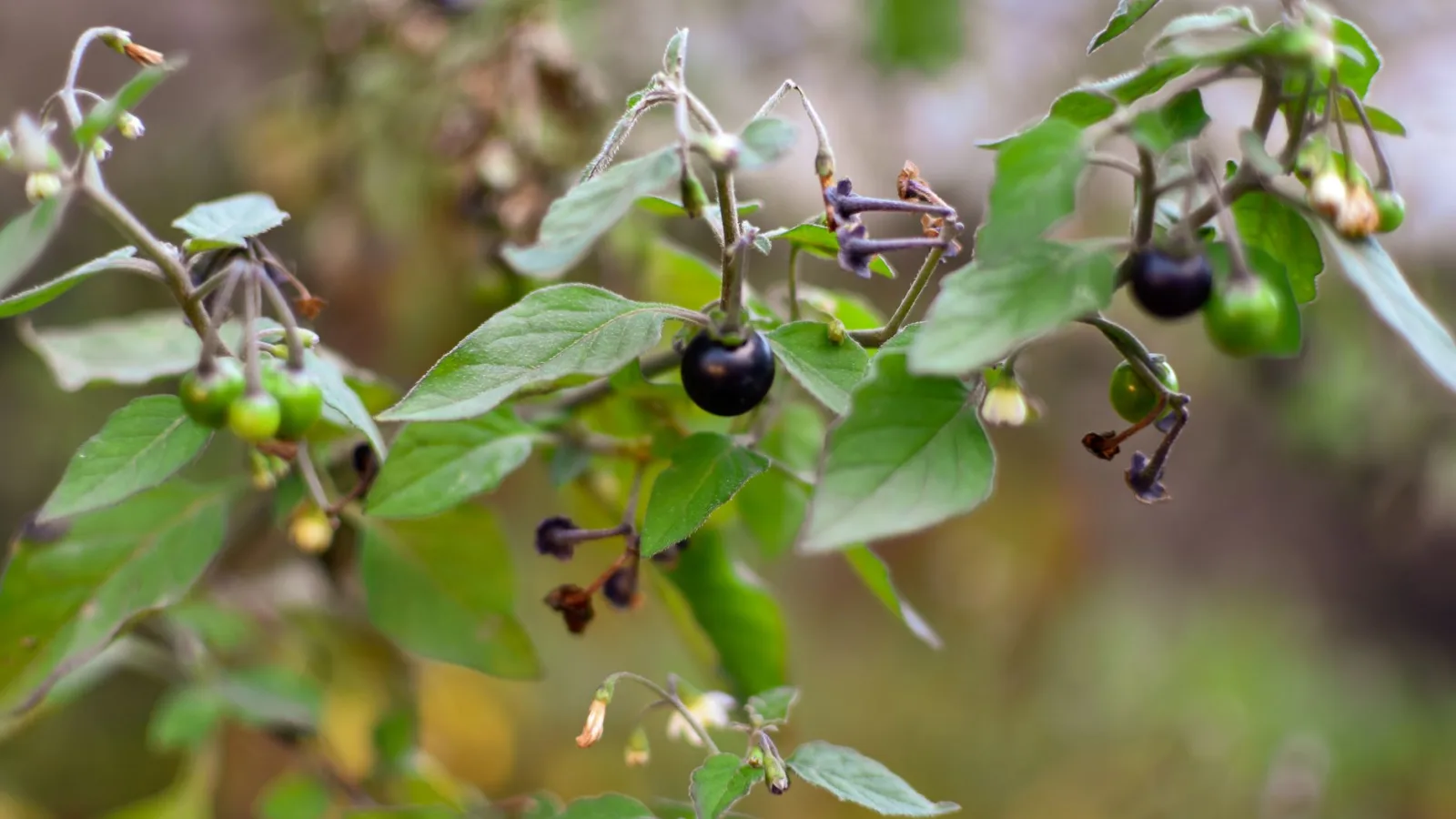
Black nightshade is an annual that comes up on its own along field margins, on waste ground and at the foot of walls. The young spring shoots are blanched and dressed as a namul, and the berries are picked once they have gone completely black in late summer. The leaves are round, the flowers white, and the fruit starts green and darkens as it ripens. The Donguibogam lists it in the Vegetable section as 龍葵 and records the old Korean name as gamajoi, attaching a flat caution: it is fit to be boiled and eaten, but not fit to be eaten raw. That caution sits alongside what compositional analysis says today — the leaves and the unripe green berries carry steroidal glycoalkaloids such as solamargine and solasonine, levels fall as the fruit blackens, and some of it leaches into blanching water. So the shoots are always blanched and rinsed, and only fully black berries are picked. The seed drops where it stands, which is why one corner of a plot yields the plant year after year with nobody sowing it.
Year-Round Calendar
- 1
- 2
- 3
- 4
- 5
- 6
- 7
- 8
- 9
- 10
- 11
- 12
- 4
- 5
- 5
- 6
- 8
- 9
Where It Grows
- Wild population Known here as longkui, it is common on the banks between fields and in vacant lots. The young shoots are picked and eaten as greens.
- Wild population Called makoi, its leaves and black-ripened berries are eaten as a vegetable. It is common along field margins and roadsides.
-
Wild population
It comes up on its own across the country — on field banks, at the foot of walls, and in roadside vacant lots. Harvest May, June, August, September
- 5
- 6
- 8
- 9
It appears to be native to Eurasia and is now a weed found across the temperate and subtropical parts of every continent except Antarctica. There are no commercial cultivation statistics, and most of what is eaten is picked from self-sown plants, so growing regions cannot be ranked by output. The "nightshades" grown as leaf vegetables in Africa — Solanum scabrum, S. villosum and others — are different species from black nightshade, so they are not shaded on the same map.
- Optimum
- 20~30℃
- Range
- 12~35℃
- Hardiness
- Not hardy
An annual herb, it grows in sunny open ground. The first frost kills that year's plants, and the next year new ones come up from the seed they dropped. Not particular about soil or water, it has spread widely from the temperate zone to the tropics.
In Korea Nationwide
It comes up on its own across the country, on field banks, at the foot of walls, and in roadside vacant lots. Because the seed drops by itself and sprouts everywhere the following year, there are no designated growing areas.
How to grow
- Light
- Full sun. It grows in part shade too, but the fruit ripens late there
- Soil and depth
- Not fussy. It comes up in the dry soil of a field edge or the margin of a border
- Spacing
- 30cm between plants. Thin the crowded patches where it has seeded itself
- Watering
- Once rooted it carries itself on rainfall. In a pot, water when the surface dries
- Feeding
- No feeding. Rich ground pushes leggy stems and sets less fruit
- Harvest
- Shoots in May and June, cut at the base while they are still finger-length and soft. Berries in August and September, only the fully black, soft ones. Leave anything still green
What makes the difference. Blanch picked shoots in boiling water, rinse in cold and discard the blanching water. They are never eaten raw
Why this one is harder. The seed drops and the plant comes up all around the following year. If that is unwelcome, cut the flower stalks before the fruit blackens
Common problems
- Aphids You will see Colonies on the shoot tips and curling leaves What to do Wash them off with a jet of water; if they keep coming back, use an egg-yolk oil spray
- Twenty-eight-spotted ladybird You will see Leaves grazed to a lace, veins left standing What to do It moves between nightshade crops, so keep the plant away from potato and aubergine. Turn the leaves and pick off the larvae
- Spider mites You will see Leaves go rough and fine pale speckling covers the undersides What to do Spray water hard onto the leaf undersides and avoid hot, dry corners
This page describes how a crop is grown and used. It does not claim health effects for any food, nor is it intended to prevent or treat disease. Component and study notes are references only and do not mean the same result occurs in people. Consult a medical professional about health concerns.
Health Benefits
The old record — yonggyu (龍葵). The Donguibogam lists the plant in the Vegetable section as 龍葵 and records the old Korean name as gamajoi. It gives a cold nature, a bitter taste and no toxicity. It says the plant grows everywhere, that the leaves are round and the flowers white, and that the fruit is the size of a buckthorn berry, green when raw and black once ripe. It adds the caution that the plant is fit to be boiled and eaten but not fit to be eaten raw. This is a historical medical record and differs from modern medical judgment.
Glycoalkaloid analyses in the genus Solanum. Steroidal glycoalkaloids such as solamargine and solasonine have been isolated from Solanum species in repeated analyses. The same work reports the highest levels in leaves and unripe green fruit, falling as the fruit blackens. These are compositional analyses and have nothing to do with preventing or treating disease.
Pigment of the ripe fruit. Anthocyanin pigments are identified in the fully blackened fruit. Colour therefore serves as the index of ripeness, which is where the compositional record and the picking rule meet.
Nutrition
- Glycoalkaloids (solamargine, solasonine) (in the leaves and unripe green berries) — steroidal alkaloid glycosides reported across the nightshade family
- Anthocyanins (pigment of the ripe black berry) — the pigment behind the black fruit colour
- Polyphenols (in the leaves and fruit) — a group of phenolic compounds widespread in plants
It has to be blanched The young shoots are blanched and rinsed before dressing. The Donguibogam set the same rule down: fit to be boiled and eaten, not fit to be eaten raw. Blanch in boiling water, rinse in cold, and throw the blanching water away. Dressing it raw or giving it only a light salting is not the way it is handled.
Glycoalkaloids of the nightshade family Black nightshade belongs to the same family as aubergine and potato, and steroidal glycoalkaloids such as solamargine and solasonine are reported in its leaves and unripe green berries. Analyses report the levels falling as the fruit turns black, and some of the content leaches into blanching water. Reading the colour at picking time is therefore the first step of preparation. This entry stays with the compositional record.
Pigment of the ripe berry The colour of a fully black berry comes from anthocyanin pigments. A berry that only looks dark is closer to purple-green, so press with a fingertip and take only the ones that give and run with juice. This is not a fruit anyone eats by the bowl; it was picked a handful at a time during fieldwork.
Young shoots and hardened stems Once flowering starts the stems harden and the leaves coarsen, and the plant leaves the namul basket. The window is while the shoots are still finger-length and soft. Late side shoots can stay tender into summer, but hardened stems are left alone.
Pairings
○ Doenjang and perilla oil — Blanched shoots are dressed with doenjang and a spoon of perilla oil. The salt of the paste and the fat of the oil settle the faint bitterness. Add only a little finely minced garlic.
○ Soy sauce and toasted sesame — Dressed lightly with soy sauce and toasted sesame, the vegetable itself stays in front. Shake the shoots dry rather than wringing them out, or the leaves clump. Eat it the day it is dressed.
○ The berries on their own — Ripe berries are rinsed and eaten as they are. The sweetness is faint and the seeds are tiny, so eating them whole works better than blending them. Sort out anything still showing green.
△ Never eaten raw — The shoots are not eaten raw. The Donguibogam itself records that the plant is fit to be boiled but not fit to be eaten raw. Blanch in boiling water, rinse in cold, and discard the blanching water. Salads and quick-dressed raw preparations are not used for this plant.
△ Unripe green berries — Berries still showing green are neither picked nor eaten. The family glycoalkaloids concentrate in unripe fruit, and a large quantity brings stomach pain and vomiting. Take only berries that are fully black and soft, and where children use the plot, strip the green fruit in advance.
△ Confusion with climbing nightshade and horsenettle — The plants that cause trouble when picking spring shoots are Solanum lyratum, a perennial vine whose berries ripen red, and Solanum carolinense, whose stems and leaf veins carry stiff prickles. Neither is used as a namul. Black nightshade has no prickles, lives a single year, and ripens black. If you are not certain, do not pick.
Varieties
- Black nightshade (seed) — The common plant of field edges and waste ground. The ripe fruit is black
- American black nightshade (seed) — A naturalized species from North America. It grows mixed in with the native plant
- Yellow-fruited nightshade (seed) — A species whose fruit stops at yellow or orange rather than blackening
Source: Donguibogam, Vegetable Section 龍葵 · Korea National Arboretum, Korea Biodiversity Information System