- Type
- Leafy Greens
- Difficulty
- Hard
- Season
- Spring
- Sowing
- Transplant
Asparagus
Asparagus officinalis
Folate and asparagine in tender spring spears
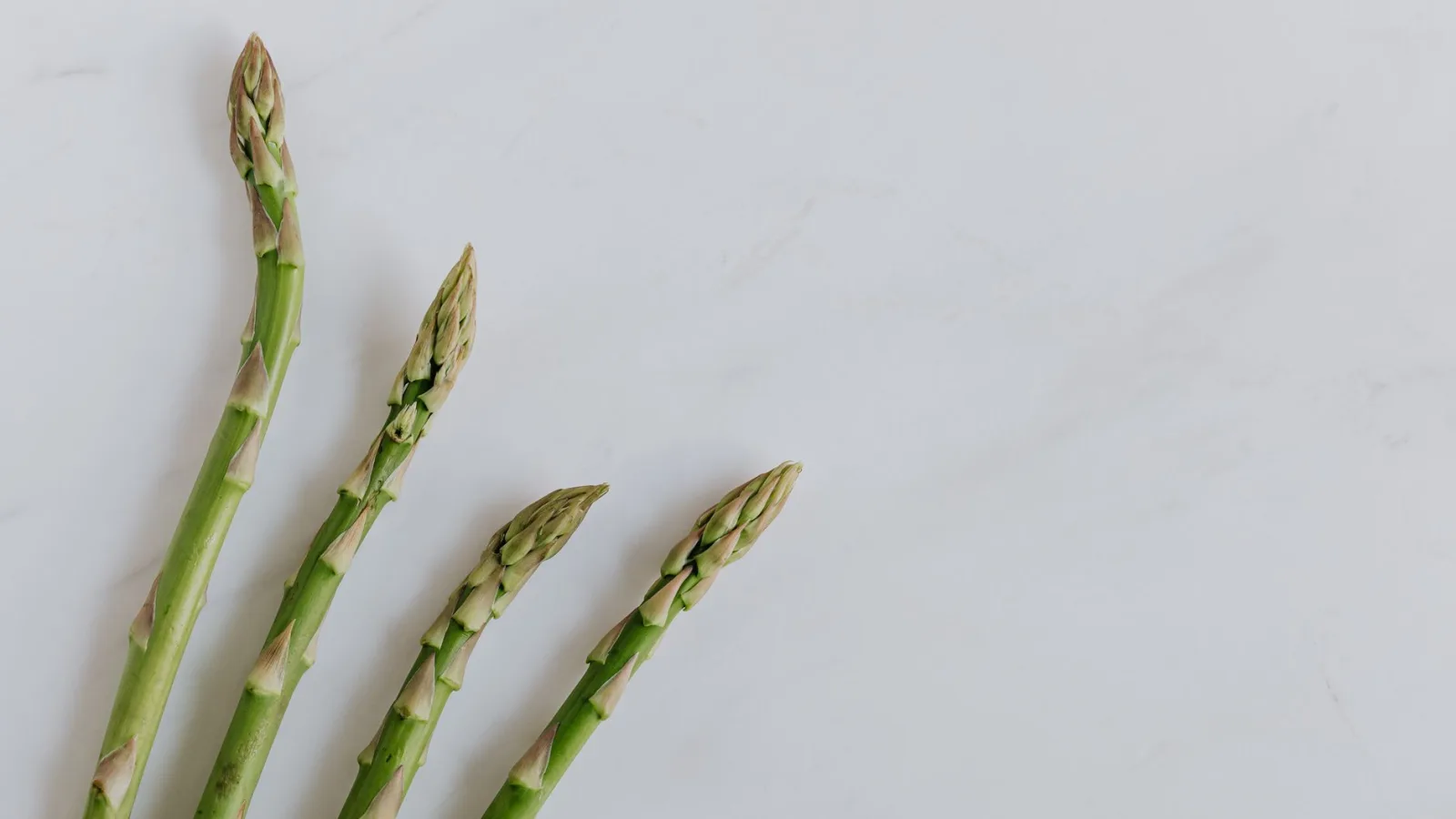
Asparagus is a perennial vegetable grown for the young spears that push up in spring, and once a planting is established it produces for many years. The spears are not cut in the planting year, though: leave them standing for the first two years so the crown can settle in, and begin cutting in April and May from the spring two to three years after planting. The spears carry folate, the amino acid asparagine, and the flavonoid rutin, and they're best blanched or grilled. The spears are the only part that is eaten: the red berries that form on female plants contain saponins and are not food, so in a garden where children come and go it is safer to pick them off before they ripen. One more thing worth noting: asparagus shares a genus with cheonmun-dong (Asparagus cochinchinensis), a plant used in traditional Korean herbal medicine, but it is a different species. It's more accurate not to assume that edible asparagus carries the same medicinal effects attributed to cheonmun-dong.
Year-Round Calendar
- 1
- 2
- 3
- 4
- 5
- 6
- 7
- 8
- 9
- 10
- 11
- 12
- 3
- 4
- 4
- 5
Where It Grows
- Main producer It accounts for more than 80 percent of world production.
- Main producer It is the world's largest exporter, growing the crop on irrigated land in its coastal desert. With no winter, harvesting continues virtually year-round.
- Major producer Production centers on Caborca in Sonora, which serves the North American market from winter through spring.
-
Major producer
The focus is white asparagus, grown by mounding soil over the spears. By custom, the season opens in April and ends on June 24, St. John's Day. Harvest April, May, June
- 4
- 5
- 6
- Major producer Veneto and Emilia-Romagna are the growing regions.
- Major producer Navarre is known for its white asparagus.
Asparagus is native to the eastern Mediterranean and Western Asia; since no single country can be pinpointed, we have not given it an origin row. Long cultivated in Europe, the crop spread to China and Peru in the 20th century, and today China leads in production while Peru leads in exports. Peru, in the Southern Hemisphere, supplies it year-round, while Europe's harvest is concentrated in a single spring season, so the two streams trade places in the market.
- Optimum
- 16~24℃
- Range
- 10~30℃
- Hardiness
- Hardy
For spears to come up in spring, the plant needs a winter period in which the top growth dies back and the roots rest. Spears begin to emerge once the soil temperature passes 10℃ and grow fastest at 16–24℃. The plant tolerates summer heat, but its roots rot in spots where water collects.
Harvested 2–3 years after planting. Plants are set out in their permanent bed in March–April, and no spears are cut for the first two years so the roots can establish. Harvesting begins in the spring (April–May) of the second or third year from planting, and continues every year in the same spot for more than ten years thereafter.
In Korea Nationwide
It is grown on a small scale in South Jeolla, South Gyeongsang, and Gangwon. The top growth dies back in winter and the plant regrows from its roots; once established, the same field is harvested for more than ten years.
How to grow
- Light
- Somewhere sunny
- Soil and depth
- 40cm deep or more with good drainage. It stays in the same ground for over ten years
- Spacing
- 40cm
- Watering
- Steady
- Feeding
- Twice a year, spring and autumn
- Harvest
- From the third spring. Cut the spears at the base as they come
What makes the difference. Take nothing for the first two years and let it build its crown. That is what buys you the following decade
Why this one is harder. Three years before a crop, and it holds the ground for a very long time
This page describes how a crop is grown and used. It does not claim health effects for any food, nor is it intended to prevent or treat disease. Component and study notes are references only and do not mean the same result occurs in people. Consult a medical professional about health concerns.
Health Benefits
Folate: what is established. Compositional analysis confirms that asparagus carries a comparatively high level of folate (vitamin B9), and it is established that folate is a nutrient used in cell division and the formation of red blood cells. It does not follow that eating this vegetable changes the course of any particular disease.
Asparagine and rutin: what can be said now. The amino acid asparagine was first isolated from this plant and took its name from it, and the flavonoid rutin is reported alongside it. Studies in people are scarce, so what can be said at present stops at the composition.
A different species from the herb cheonmun-dong. Cheonmun-dong (Asparagus cochinchinensis), used in traditional Korean herbal medicine, is a different species within the same genus. Records and studies concerning cheonmun-dong cannot be carried across to edible asparagus.
Nutrition
- Folate (Vitamin B9) — A water-soluble vitamin plentiful in the young spears
- Asparagine and rutin (Amino acid and flavonoid) — Asparagine is the compound that took its name from this plant
Folate Asparagus is a vegetable rich in folate (vitamin B9), a nutrient required for cell division and blood formation. It is especially plentiful in the spring shoots.
Asparagine & rutin It contains asparagine, the amino acid from which the name derives, together with the flavonoid rutin. Rutin is a polyphenol whose antioxidant activity is measured in the laboratory, but nothing has settled what changes in a person who eats the vegetable.
Pairings
○ Olive oil (grilled) — Brushing the spears with oil and grilling them brings out their sweetness and aroma.
○ Bacon and eggs — Wrapped in bacon or served alongside eggs, it makes a satisfying breakfast.
○ Blanched in salads — A quick blanch keeps the spears crisp and adds a crunchy texture to salads.
△ Do not eat the red berries — Female plants set red berries in autumn that contain saponins and cause stomach pain and vomiting. They are glossy and easy for a child to pick. Asparagus stays in one bed for years, so berry years will come — remove them before a child reaches them. Only the spring shoots are food.
△ Asparagus allergy — Some people get itching or hives on the hands when trimming spears. Wear gloves the first season, and seek care at once if lips swell or breathing tightens.
Varieties
- Mary Washington (Seed) — An old seed-grown line, cheap and easy to find, but spears vary in thickness.
- All-male hybrid lines (Transplant) — Sets almost no berries, so nothing self-seeds, and spears come up thick and even.
- Purple-spear lines (Transplant) — Purple, tender spears that turn green when cooked. Crowns are rare in Korea.
- White asparagus (Transplant) — Not a separate variety: soil is heaped over rising spears to keep light out.
Source: Rural Development Administration (Nongsaro)