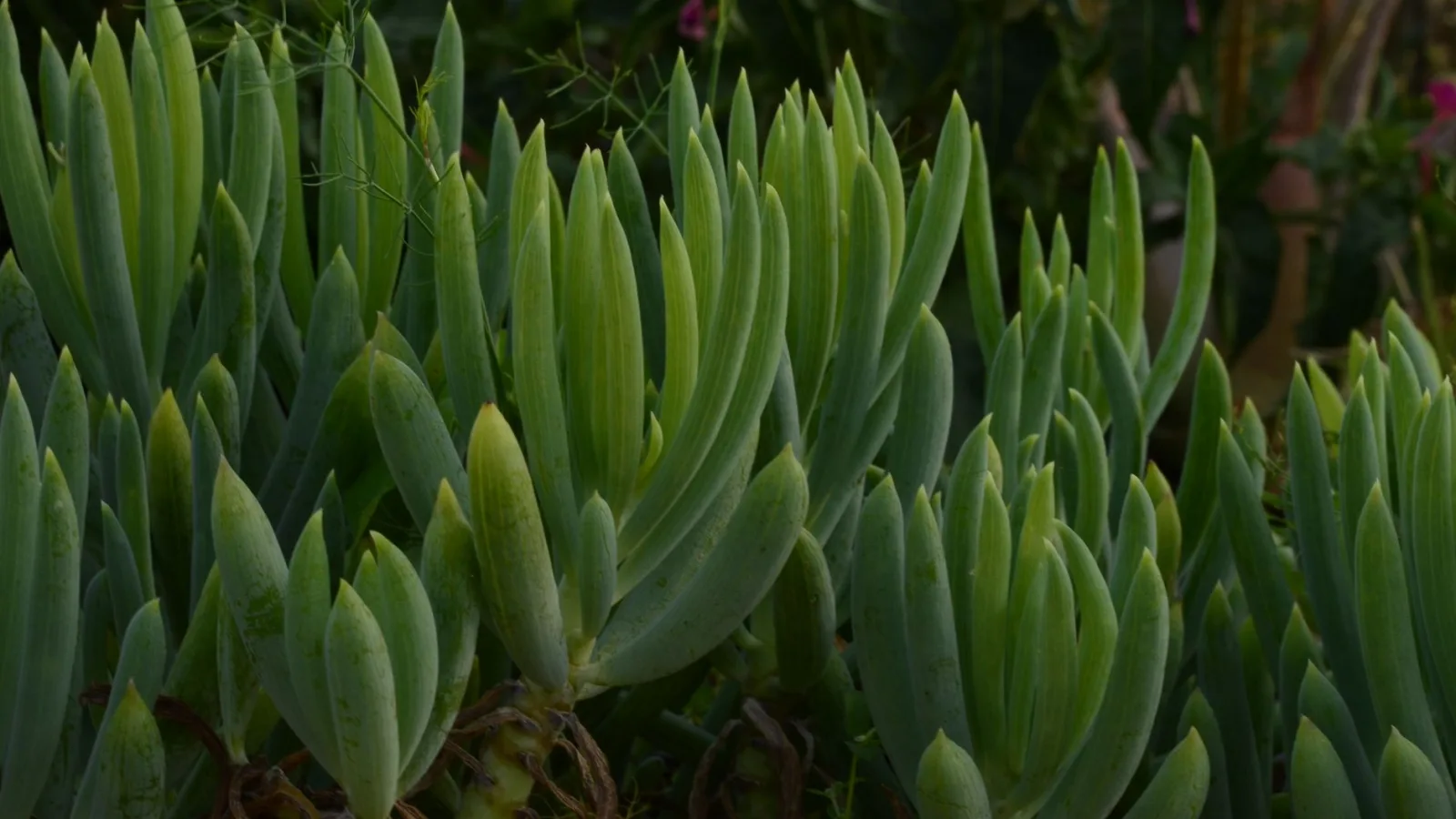
Come October, work a homi (the traditional Korean hand hoe) gently through the bed where you buried oak logs in spring. Long, slender tubers will turn up in rows, anywhere from 10 to 20 of them. The seed tubers you planted in March or April have spent more than half a year underground and multiplied this much. In the Northern Hemisphere, this is the season to dig gastrodia.
A Leafless Plant That Feeds on Fungal Threads
Gastrodia (Gastrodia elata) is called cheonma in Korean and tianma in Chinese. It is a perennial in the orchid family. It has no leaves and no chlorophyll, so it can't make its own food. Instead, it draws nutrients underground from the mycelium of honey fungi (Armillaria). Ecological research has confirmed this relationship. That's why growers first inoculate oak logs with the fungus and then bury the seed tubers next to them. At flowering time, the plant sends up just one leafless reddish stalk, straight up. People long ago saw this and named it jeokjeon (赤箭), which means "red arrow."
The tubers respond to soil temperature and moisture more than to air temperature. They swell best when the soil is 20–25°C, and they stop growing below 15°C or above 28°C. They're hardy enough to spend the winter in the ground. Standing water is the real danger, though, because the oak logs buried with them rot first. Pick a well-drained spot. In the Northern Hemisphere, bury the fungal spawn and seed tubers in March–April and harvest in October–November. China is the main producer, and it's also widely farmed in Korea. In Japan it grows wild.
What's Inside the Tuber
Several research teams have isolated phenolic compounds from gastrodia tubers and reported on them, including gastrodin and 4-hydroxybenzyl alcohol. Gastrodin is a phenolic glycoside, and its name comes from the plant's genus, Gastrodia. Studies often measure 4-hydroxybenzyl alcohol together with gastrodin. The tubers also contain polysaccharides, which are thought to be why the flesh turns translucent when steamed.
These analyses only show what the tubers contain. They don't show that gastrodia prevents or treats any disease. Gastrodia is not a substitute for medicine. Think of it as one more root vegetable to add to your meals. If you take medication or have a chronic health condition, talk with your doctor before eating it.
Gastrodia in an Old Medical Text
Donguibogam is a medical compendium published in Korea's Joseon dynasty in the early 17th century. It lists cheonma (天麻) in its chapter on herbs, the chobu (草部). The book records two views of its nature, neutral (平) or cold, and two of its taste, pungent or sweet. "Neutral" here means neither cooling nor warming. The book also says it is not toxic. Another entry says cheonma is the root of jeokjeon and is shaped like a cucumber. Its shoots were called jeongpungcho (定風草).
The book also explains how to prepare it. After digging, the skin was scraped off while the tubers were still moist. They were then blanched briefly in boiling water and dried in the sun for storage. Firm, solid tubers were thought to be the best. In Korea today, fresh gastrodia is still steamed and then dried. Cooking it first and drying it afterward follows the same order as the old method. Keep in mind, though, that modern medicine has not confirmed what Donguibogam says.
Taming the Smell
Fresh gastrodia has a strong, ammonia-like smell. That's why it's usually steamed and dried, or juiced, or sliced thin and added to stir-fries or cooked with rice. If you're trying it for the first time, start with one of the combinations below.
- Simmered with jujubes and ginger: Simmer thinly sliced dried gastrodia with jujubes (Asian red dates) and ginger, and the smell becomes milder. When the water comes to a boil, lower the heat and let it simmer gently. Add the ginger at the end.
- Blended with Asian pear: Put an Asian pear in the blender with the fresh gastrodia. The pear adds sweetness and makes the juice easier to drink. Stir in honey after blending, and drink the juice the same day.
- Quick-sautéed in sesame oil: Slice fresh gastrodia thin, sauté it in toasted sesame oil, and season it with salt only. If you cook it too long, it gives off water and turns soft, so stir-fry it fast over high heat. To cook it with rice, slice it thin as well.
You can look up jujubes, ginger, and Asian pears in the Homiclub plant guide, which covers how to grow each one and what it's traditionally valued for.
If you've brought home a gastrodia tuber today, slice it thin and steam it. See whether the flesh turns translucent. Then get used to its flavor with a cup of tea simmered with jujubes and ginger.
Sources: Donguibogam, Herbs section (草部), Cheonma (天麻) · Nongsaro cultivation guide, Rural Development Administration of Korea