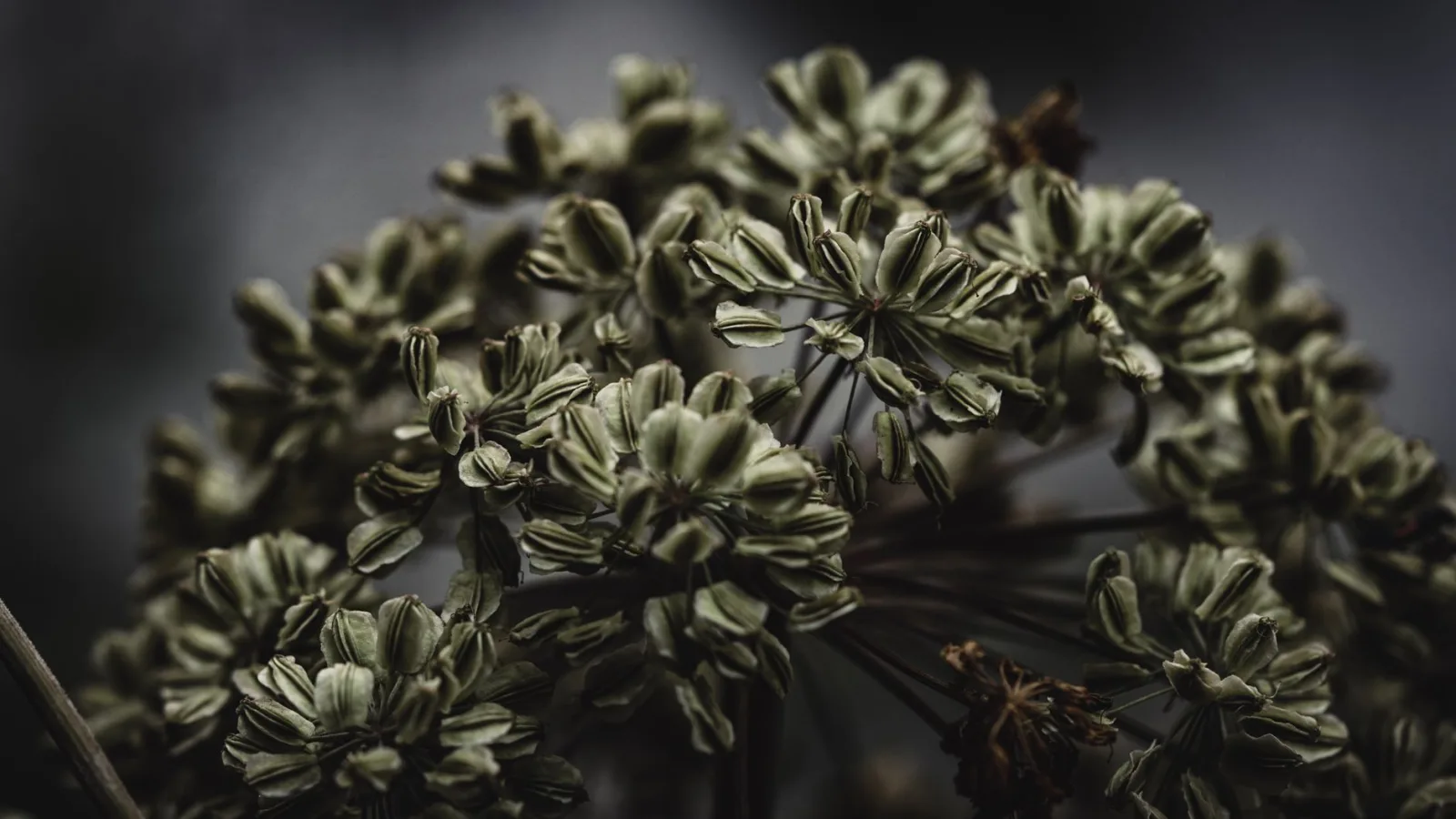
By August, the Korean angelica in the garden has thickened its leaves and toughened its stalks. Next to the palm-sized young leaves you picked in spring, the scent is deeper and the chew is stiffer. Leaf season ends this month. Underground, though, it's a different story. The Donguibogam records that the root is dug in the second and eighth lunar months. Leaves in spring, root in late summer — that's the order.
What the Old Medical Texts Wrote Down
Korean angelica appears in the herb section (草部) of the Donguibogam under the name danggui (當歸). Its nature is called warm, its taste sweet and pungent, and it is described as non-toxic. The text notes that it grows wild in the mountains and fields and is also raised in cultivated plots, and that the root is dug in the second and eighth lunar months and dried in the shade. It left standards for choosing, too: thick-fleshed roots that had not dried out were considered good, oily ones better, and a shape like a horse's tail was prized. This is a record from an old medical text, and it differs from the judgments medicine makes today. The entry heading and a reading of the original passage are collected in the Donguibogam entry for danggui.
What Modern Analysis Reads in It
In the root of Korean angelica (Angelica gigas), decursin and decursinol angelate are identified as the principal coumarins. In the root of Japanese angelica (Angelica acutiloba), compounds of the ligustilide family predominate instead. Even when both are traded under the single name danggui, a different species means a different chemical makeup. This concerns the composition of compounds and has nothing to do with preventing or treating disease.
The smell that rises when you rinse the leaves comes from terpenes in the essential oil. That's the distinctive aroma that stays with you after eating them as ssam, the Korean way of wrapping food in a leaf. One caution: coumarins can irritate skin in combination with sunlight. On a day you've spent a long stretch trimming leaves or roots, wash your hands before you head outside.
Where They Overlap, Where They Part
There are points where the old record and modern analysis line up. The Donguibogam says to dry the root in the shade. Shade drying loses less essential oil than spreading a root out in the sun. And the instruction to choose roots that are thick and oily can be read as a way of gauging, by eye and by hand, how much has accumulated inside them.
Read only this far, it's tempting to conclude that the old standards confirm today's measurements outright. But the divergences are sharper. Calling the nature warm and the taste sweet is a way of putting a felt bodily response into the vocabulary of an older medicine; decursin content is a number produced by an instrument. The two accounts do not prove each other. Better not to read the uses recorded in the Donguibogam as claims of efficacy in today's terms.
Planting, Picking, Eating
In the Northern Hemisphere, sow seed in March or April and pick leaves from May through August. In the Southern Hemisphere, shift the whole calendar by six months. Try picking the leaves before they reach palm size — the young ones are tender. When a leaf has gone stiff at the stem, strip the leafstalk and use the blade alone; it can go straight to the table.
- Wrap grilled meat in them, ssam-style. Korean angelica leaves are thicker and more strongly scented than lettuce, so they meet fatty meat squarely in the same bite.
- Add just a little doenjang (fermented soybean paste) or ssamjang (a seasoned dipping paste). The salt and savoriness press down on the leaf's aroma, which makes it easier on anyone trying it for the first time. Chopped fine, the leaves are also good stirred into doenjang soup at the very end.
- Steep shade-dried leaves in hot water for 2–3 minutes only. Any longer and bitterness comes up. Simmering the root into a strong decoction is closer to handling medicinal herbs, so we don't recommend it for the kitchen-garden table.
Go out to the garden today, start with whichever of the remaining leaves still have slender stalks, and put them on the dinner table. Planting and harvest months, and what pairs well with it, are all in the Korean angelica crop guide.