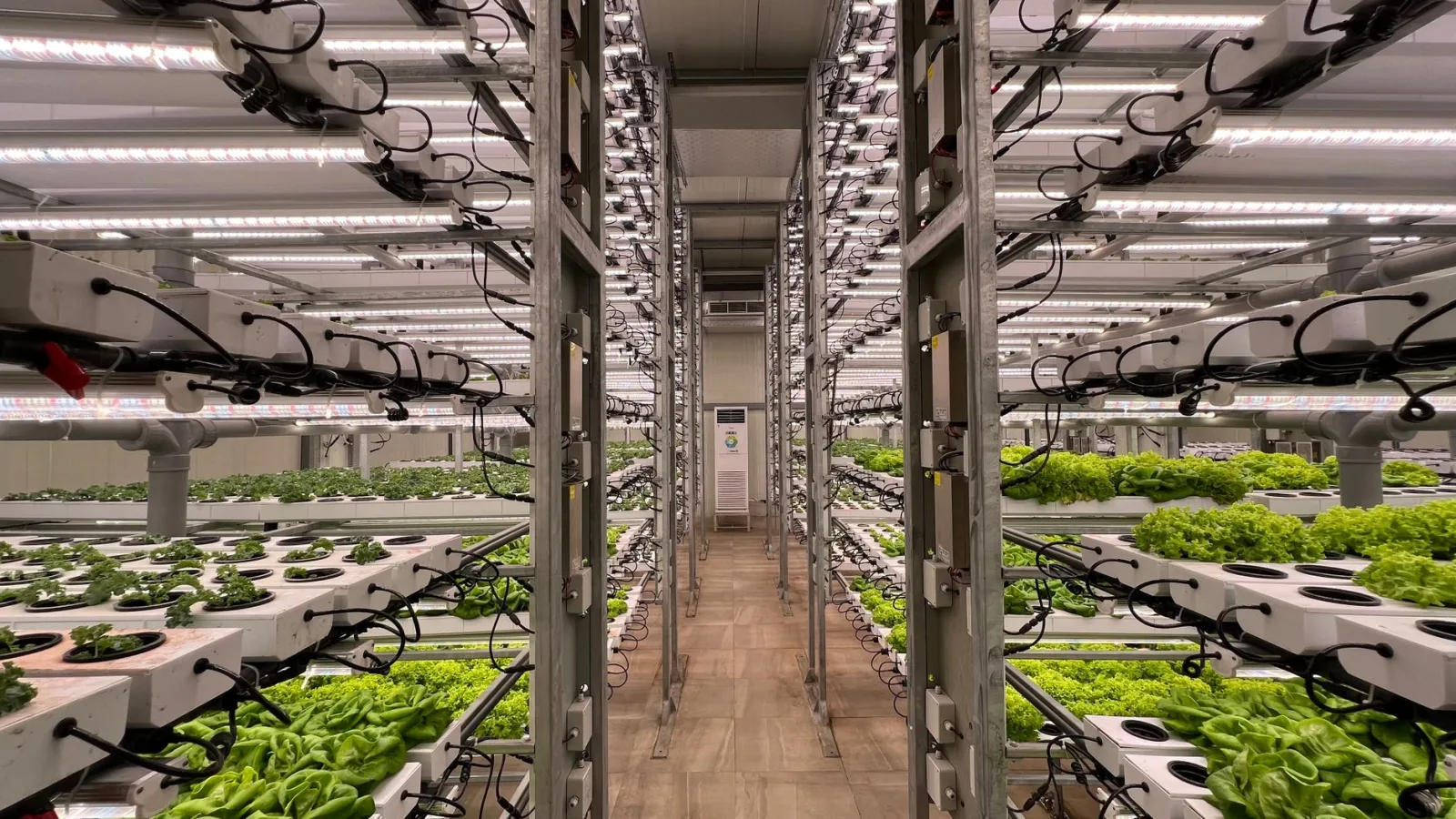
Put a bowl of lettuce on the dinner table often enough and a small question starts to nag at you. It's all lettuce — so why is some of it crisp and faintly sweet, and some of it just watery and dull? A lot of us are growing greens under LEDs these days, on a balcony or in one of those countertop growing units. Bigger versions are showing up around town, too: stacked indoor farms raising leafy greens on nothing but water and light, no soil involved. As it turns out, the light you give a plant and the way you water it change more than flavor. New research says they change what ends up inside the leaf.
The color of the light changes what's in the leaf
Indoor farms usually run on red and blue LEDs, since those two colors do the heavy lifting for leafy greens. One research team took that starting point and grew lettuce under three different light recipes: a fairly plain red-and-blue mix; a full-spectrum light that spreads energy evenly across the wavelengths sunlight contains; and red-and-blue with a little far-red added — the deep red light at the long end of the spectrum.
The three lights parted ways. The lettuce grown with a touch of far-red came out higher in sugars and in phenolic compounds, the antioxidants in vegetables that are thought to help slow oxidation in the body. The plain red-and-blue light went the other direction: it produced the highest vitamin C and the lowest nitrate buildup in the leaves. Nitrates are common enough in leafy greens, but plenty of people would rather have less of them.
How you water matters just as much
Watering shapes lettuce nearly as much as light does. This study paired each light with two systems: aeroponics, where the roots hang in the air and get misted, and ebb and flow, where the tray floods with water and then drains back out. Under the same light, the growing method alone shifted both the harvest and the nutrition.
- Full-spectrum light plus aeroponics gave the biggest harvest — about 5 kilograms (roughly 11 pounds) per square meter, with a well-rounded mineral profile.
- Far-red-enriched light plus aeroponics pushed up sugars and antioxidants.
- Red-and-blue light with ebb and flow produced more flavonoids.
- The highest vitamin C and the lowest nitrates came from red-and-blue light with aeroponics.
Decide what you're growing for
No single light won across the board. The one that yielded the most also drew the most electricity — though because it produced so much lettuce, the energy it took to grow a given amount worked out about the same as the far-red recipe. Which light is "best," in other words, depends on whether you're after volume, vitamin C, or antioxidants.
If you've got a growing unit at home, start by deciding what you actually want from it. For a generous harvest and a broad spread of minerals, reach for full-spectrum. To favor vitamin C and hold nitrates down, lean on a red-and-blue mix. The next time you set a lettuce seedling in place, try settling the question of light before anything else.
Source A study of Batavia lettuce grown under different LED spectra and cultivation systems, published in BMC Plant Biology