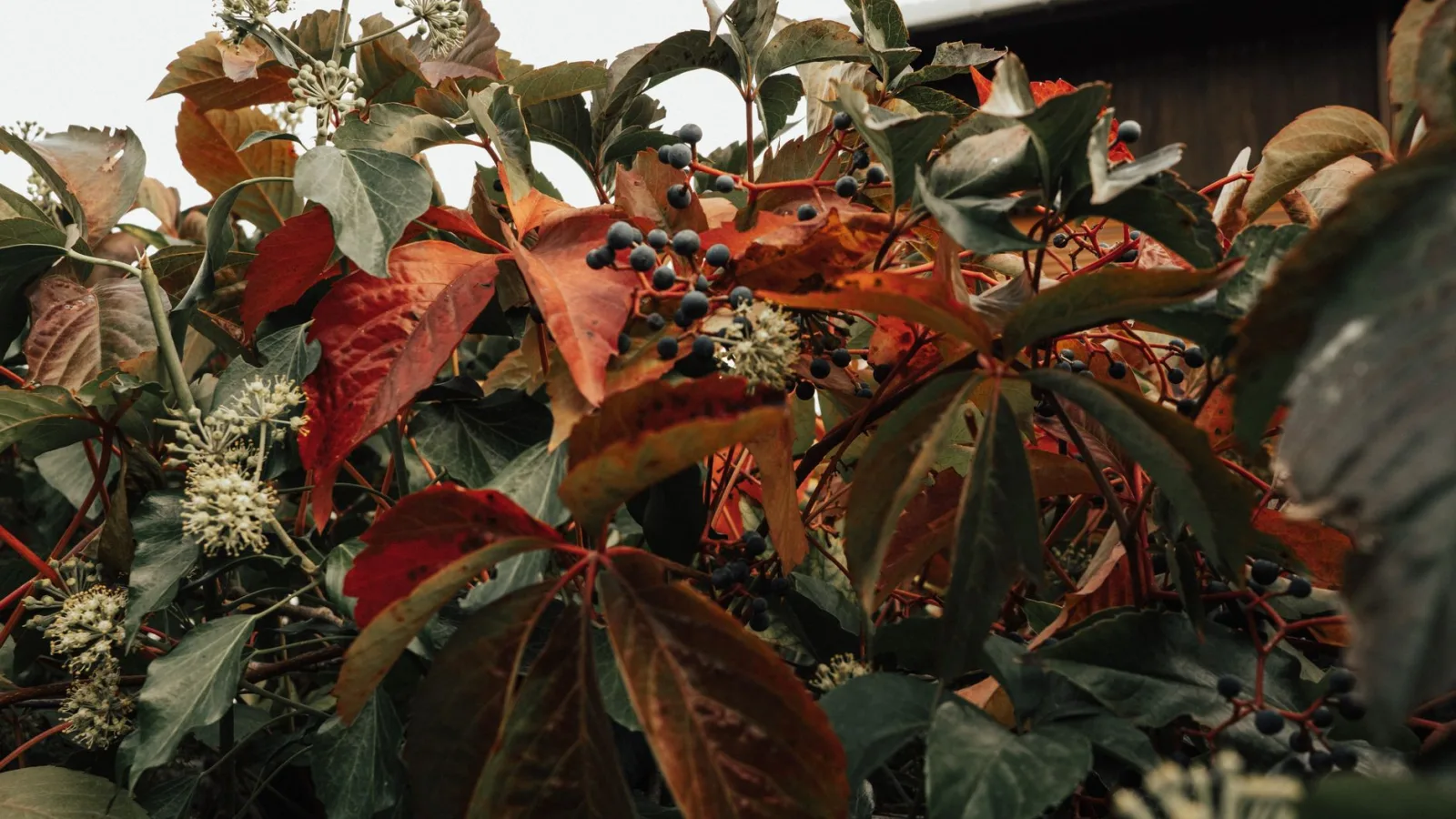
The leaves have dropped, and only the stems of the Chinese trumpet creeper (Campsis grandiflora) remain on the wall. All summer this vine carried orange, trumpet-shaped blooms. Look closely now and you'll see short roots growing from each node, gripping the face of the bricks. With no flowers in the way, it's easy to see which direction the stems climbed and how much thicker they've grown year by year. A medical text written more than 400 years ago described this vine as a medicinal herb whose flowers were picked and dried. In today's yards, we grow it as a wall plant that casts summer shade.
The Dongui Bogam recorded it as a medicine made from dried flowers
The Dongui Bogam (Treasured Mirror of Eastern Medicine) lists this vine in its Mokbu (木部), the section on trees, under the proper name jawi (紫葳), with neungsohwa (凌霄花) given as an alternate name. It describes the plant's nature and taste as "性微寒 味酸 無毒": slightly cold in nature, sour in taste, and nontoxic, adding that some sources call it sweet. The text says the vine grows almost everywhere. It starts out leaning on large trees for support, and it flowers only after several years, once it has climbed all the way to the top. The flowers are yellowish red and peak in midsummer, and they were picked and dried for use. You can read more of the original text and its commentary in the jawi entry in Homiclub's Dongui Bogam.
Where the old text and today's Crop Guide agree, and where they differ
Set the old record beside today's Crop Guide, and most of the overlap concerns the plant's physical makeup. The guide lists water and woody fiber as the trumpet creeper's main components. That water content is why the plant shrinks so much when it dries, and it sheds light on the old practice of drying the flowers before use. Dried flowers would have been lighter and smaller than fresh ones, and easier to store. Woody fiber, meanwhile, makes the stems thicker and tougher with each passing year. That fits with the Dongui Bogam filing this vine under trees rather than herbs, and describing it climbing to the tops of tall trees.
Where the two part ways is on nature and taste. "Slightly cold," "sour," and "nontoxic" were the categories old medical texts used to sort medicinal materials, and they don't line up with modern medical judgments. The Crop Guide lists no confirmed health benefits or nutritional values, and it gives no instructions for using the flowers in tea or food. We recommend against brewing the flowers or drying them to eat on the strength of old records alone. It's safest to treat the trumpet creeper as a vine to grow and enjoy looking at.
The tale that its pollen can blind you
An old story holds that trumpet creeper pollen will blind you if it gets in your eyes. The Crop Guide notes that a study of the pollen's shape found no hook-like structures that could catch in the eye. The guide doesn't say who carried out the study or when, so the most we can take from it is that no hooks were observed. Still, any pollen can irritate your eyes. On days when you've gathered fallen blossoms or pruned the vine, wash your hands before you rub your eyes.
A wall with all-day sun, and a sturdy support
Plant in spring, once the ground has thawed. In the Northern Hemisphere, plant in March or April for flowers in July and August; in the Southern Hemisphere, shift those dates six months later. Choose a wall that gets sun all day: south-facing in the Northern Hemisphere, north-facing in the Southern. The vine blooms in proportion to the sun it gets. On a wall short on light, or in the shade of a large tree, it will send out long stems but very few flowers.
- Set the support slightly away from the wall. Cucumbers climb by wrapping their tendrils around things, but trumpet creeper climbs with clinging rootlets that grow from the nodes along its stems. These rootlets attach to rough surfaces like brick or wood and leave marks behind, though they can't grip smooth glass or metal. If you'd like to keep the walls of your house clean, put up a trellis or run heavy-gauge wire, and train the young stems up it by tying them loosely with twine.
- Build the support sturdy from the start. A mature vine is surprisingly heavy.
- Thin out the lower side shoots. The flowers show off best once the vine reaches the top of the wall, so remove some of the lower side shoots to push growth upward. Now, with the leaves gone, is a good time to take note of where the stems have spread.
- Try training it over a pergola or up the posts of a garden pavilion. In midsummer the leaves grow thick enough to cast shade, and when they drop in fall, the sunlight comes back through.
A month-by-month care calendar and ideas for good placement are laid out in the Chinese trumpet creeper entry in Homiclub's Crop Guide. If the vine flowers sparsely in its first year, there's no need to hurry it along. When the Dongui Bogam says the vine blooms only after several years, once it has reached the top, it's describing a medicinal plant. It's also the first thing anyone bringing a trumpet creeper to their wall for the first time should know.
Sources: Heo Jun, Dongui Bogam, Tangaek-pyeon (Materia Medica), 木部 (Trees), "Jawi (紫葳)" (published 1613) · Homiclub Crop Guide, "Chinese Trumpet Creeper"