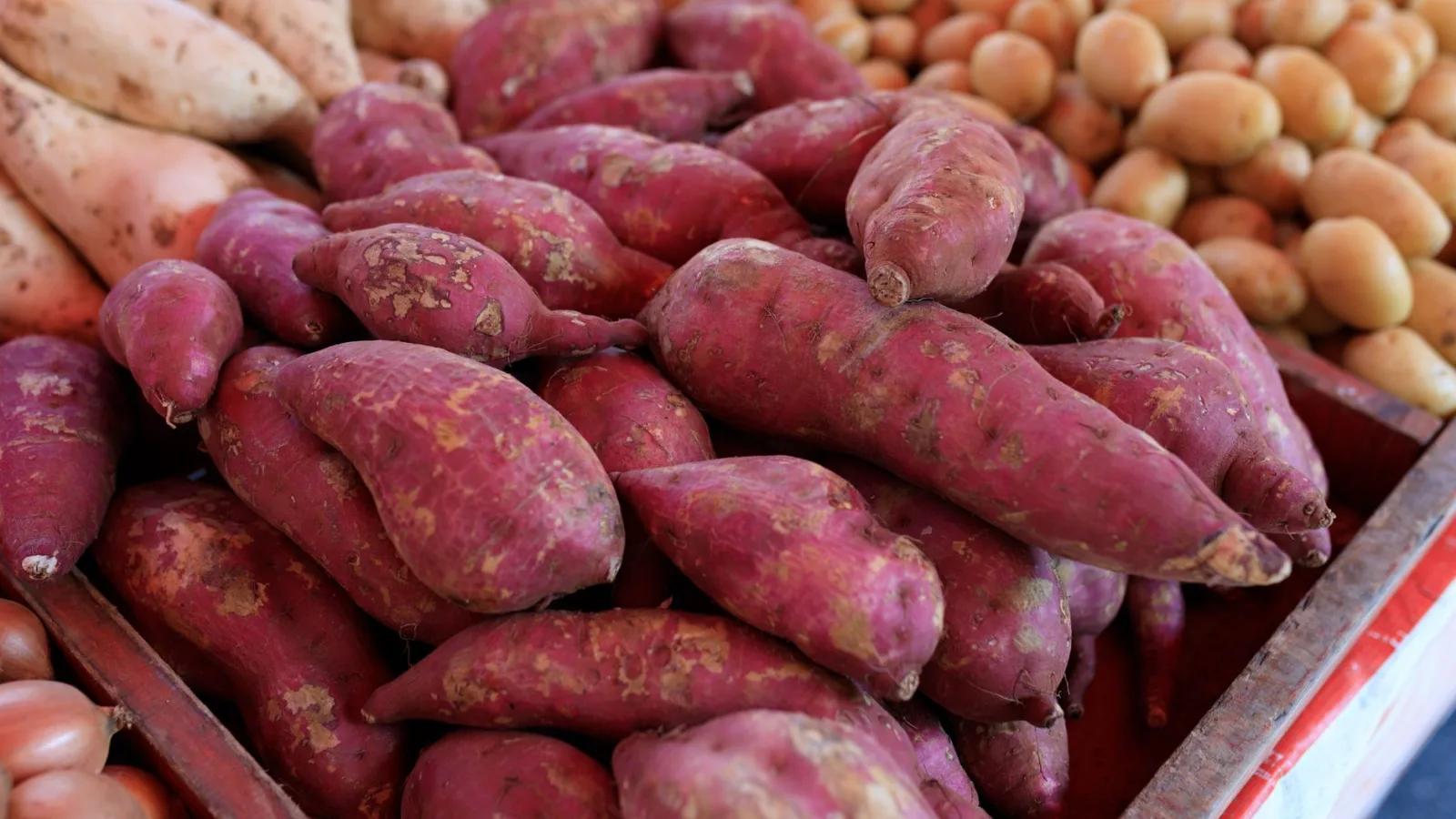
Dig your sweet potatoes in the fall, slice them in half, and you'll end up with two kinds side by side: some a deep orange inside, some nearly white. The deeper the orange, the more carotenoid pigment packed into the root. Anyone who's gardened for a few seasons has probably already noticed the catch — the darker-fleshed varieties tend to make smaller roots and a thinner harvest.
The Old Trade-off Between Color and Yield
Sweet potatoes are an important food crop across much of the world. Carotenoids convert to vitamin A in the body, where they can support eye health and immune function. In places where vitamin A is scarce, carotenoid-rich sweet potatoes have long been used to help fill that gap in the diet.
Breeders, though, have spent decades facing a gain-one, lose-one problem. Varieties high in carotenoids tended to produce lighter roots, while the heavy yielders tended to be pale inside. Raising both at once was considered a hard thing to pull off.
Two Standout Lines from 27 Crossed Varieties
A study published in 2026 in BMC Plant Biology took the problem head on. The researchers selected 27 elite sweet potato varieties and used them to build an open-pollinated breeding population. After several rounds of field evaluation, they narrowed the field to two lines that improved on both yield and carotenoid content.
The first line came in 40 times higher in carotenoids than its parent variety. The second held on to its parent's already-high carotenoid level while producing considerably more root. Both lines improved on general growing traits as well. The long-standing assumption that color and yield can't rise together no longer looks so solid.
The Gene Behind Carotenoid Production
The team went down to the molecular level to work out why carotenoids accumulated so heavily in that first line. Analyzing the carotenoid biosynthesis genes, they found one — IbGGPPS2 — expressed markedly more in the high-carotenoid line. That gene produces an enzyme that builds a precursor compound the carotenoid pathway depends on.
When the researchers overexpressed the gene in Arabidopsis and in sweet potato, carotenoid content rose by 15 to 24 percent. Still, a 40-fold difference is hard to pin on a single gene, and since the sweet potato genome is a complicated hexaploid, the team expects other genes are working alongside it. IbGGPPS2 looks like one important contributor among several.
What to Look For in Your Own Patch
This is the fruit of a breeding program, so you won't find these new lines at the garden center anytime soon. Even so, there are a few things you can put to use in your own beds right now.
- Pick varieties with orange or yellow flesh. In Korea, hobak goguma — the "pumpkin sweet potato," with its soft orange interior — carries comparatively more carotenoids.
- Carotenoids absorb better in the company of fat. Try a small drizzle of perilla oil or olive oil over steamed or roasted sweet potatoes.
- Don't toss the leaves and stems. The leaves hold carotenoids of their own, along with a range of minerals.
This fall, when you cut open a sweet potato from your own garden, give the color inside one more look.