
Tangaek — Decoctions · Trees
茯苓 Poria
 Related Crop · Poria →
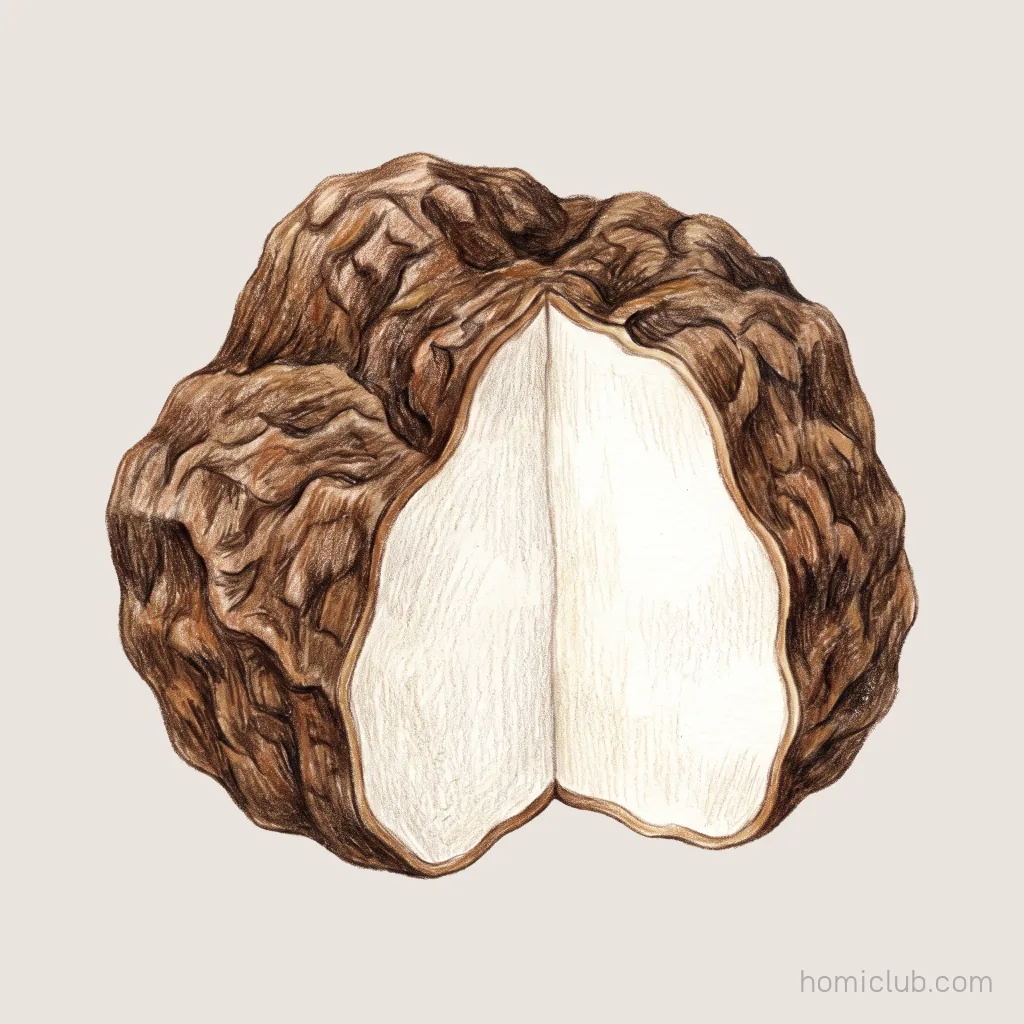
Poria is a fungal sclerotium that forms on the roots of felled pine trees, dark on the outside and white within. It reaches Korean markets today as baekbongnyeong, sold whole or ground into a powder that goes into rice cakes and porridge. The Donguibogam's wood section notes that the mass wrapped around the root itself was called boksin.
Original, read line by line 東醫寶鑑 · Tangaek — Decoctions vol. 3
-
性平, 味甘, 無毒. 開胃, 止嘔逆, 善安心神.
Its nature is neutral, its taste sweet, and it is non-toxic. It opens the stomach, stops retching, and settles the heart spirit well.
HomiclubBongnyeong is a fungal sclerotium that forms on the roots left after a pine is felled; it is dark outside and white within. Herb shops sell it as baekbongnyeong, and its powder is mixed into rice cakes and porridge.
-
主肺痿痰壅. 伐腎邪, 利小便, 下水腫, 淋結, 止消渴, 療健忘.
It governs pyewi (肺痿, lung wilting) and phlegm congestion. It attacks evil in the sin (腎, kidney), disinhibits urination, precipitates water swelling and imgyeol (淋結, strangury bind), stops wasting thirst, and treats forgetfulness.
-
仙經服食亦爲至要, 云其通神而致靈, 和魂而鍊魄, 明竅而益肌, 厚腸而開心, 調榮而理胃, 上品仙藥也. 善能斷穀不飢.
In the dietary practice of the Seongyeong (仙經, immortals' canon) it is likewise held most essential, said to open the sin (神, spirit) and reach the numinous, harmonise the hon (魂) and refine the baek (魄), brighten the orifices and augment the flesh, thicken the intestines and open the heart, regulate the yeong (榮, nutrient qi) and order the wi (胃, stomach) — a superior-grade elixir. It can well allow one to forgo grain without hunger.
-
生山中, 處處有之. 松脂入地千歲爲茯苓, 其抱根而輕虛者爲茯神.
It grows in the mountains and is found everywhere. Pine resin that has entered the ground for a thousand years becomes bokryeong, and what embraces the root while remaining light and porous becomes boksin.
HomiclubThe thousand-year transformation of pine resin is the old account; in fact the mass is a fungus that grows on pine roots and knots into a hard body underground. It is located by probing the soil around a stump with an iron rod.
-
二月八月採, 皆陰乾. 大如三四升器, 外皮黑, 細皺, 內堅白, 形如鳥獸龜鱉者, 良. 《本草》
It is dug in the second and eighth months and all of it dried in the shade. Pieces the size of a three- or four-doe vessel, black and finely wrinkled outside, firm and white within, and shaped like a bird, beast, tortoise, or soft-shelled turtle are good. 《Boncho (本草)》
-
有白赤二種. 白者, 入手太陰經ㆍ足太陽經ㆍ足少陽經, 赤者, 入足太陰經ㆍ手太陽經ㆍ少陰經.
There are two kinds, white and red. The white enters the hand taeeum, foot taeyang, and foot soyang channels; the red enters the foot taeeum, hand taeyang, and soeum channels.
-
又云, 色白者入壬癸, 色赤者入丙丁. 《湯液》
It is also said that the white in colour enters imgye (壬癸) and the red in colour enters byeongjeong (丙丁). 《Tangaek (湯液)》
-
白色者補, 赤色者瀉. 《本草》
The white supplements and the red drains. 《Boncho (本草)》
-
凡用, 去皮爲末, 水飛, 浮去赤膜, 曬乾用, 免致損目. 陰虛人勿用. 《入門》
Whenever it is used, remove the skin, grind it to powder, levigate it in water, skim off the red film that floats, and dry it in the sun; this avoids injury to the eyes. Those with eum (陰, yin) vacuity should not use it. 《Ipmun (入門)》
Related Crop
Poria →
Trees — more entries
This is a cultural and historical record from a classical text, not a claim about any food’s effects. Nothing here is a health supplement or intended to prevent or treat disease. Consult a medical professional about health concerns. · Text: Korean Medicine Classics DB · Reading: Homiclub