- Type
- Alliums
- Difficulty
- Easy
- Season
- Summer
- Sowing
- From bulblet
Shallot
Allium cepa var. aggregatum
Sulfur compounds and quercetin · an allium that splits into several cloves
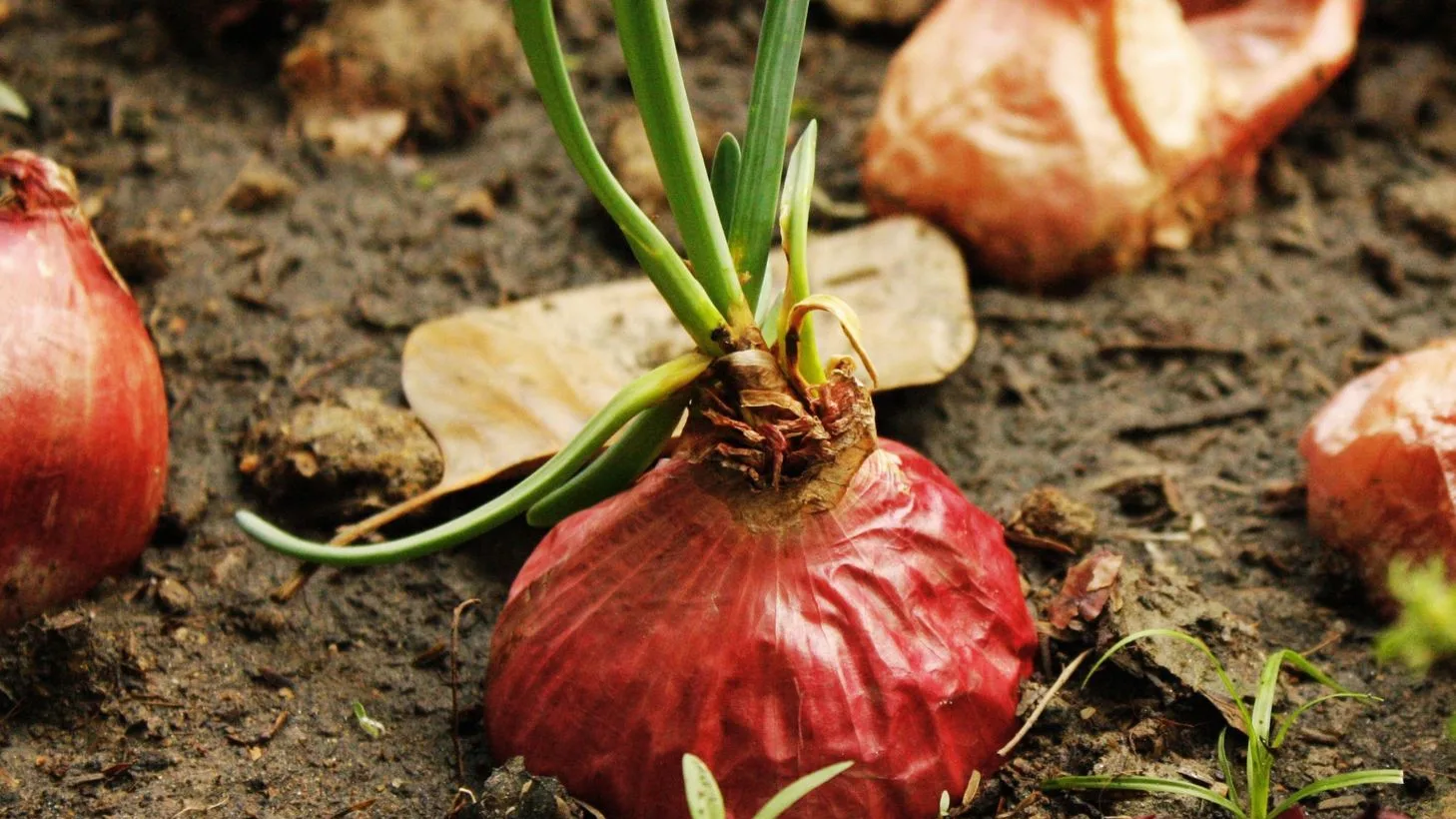
A shallot is an allium that divides into several cloves inside one bulb. It is treated as the same species as the onion, but the bulbs are smaller, the skin red or grey-brown, and cooked it turns sweet sooner than an onion does. Like garlic it goes in as sets broken into cloves, planted in autumn and lifted the following early summer when the leaves fall over. Once lifted it wants a dark, airy, dry place to hang, or the bulbs go soft. The Vegetable section of the Donguibogam carries an allium entered as 胡葱, described as resembling garlic but smaller and round, with red skin and a slightly pointed tip, and lifted in the fifth or sixth lunar month. A folk note added there says its taste is like a spring onion but far less pungent, and guesses it to be what was then called 紫葱. Whether that name stands for the shallot as it is known today is not certain. Used as the base of a saute or steeped in vinegar for a dressing, it breaks down finer than an onion.
Year-Round Calendar
- 1
- 2
- 3
- 4
- 5
- 6
- 7
- 8
- 9
- 10
- 11
- 12
- 9
- 10
- 6
- 7
Where It Grows
- Main producer Grown here in greater quantity than anywhere else in the world, under the name bawang merah. Brebes in Java and Sulawesi are the centres.
- Main producer Small-bulbed strains are grown on a large scale, centred on Tamil Nadu.
- Major producer The red shallots of Soc Trang in the south and Ly Son island are well known.
- Major producer The growing areas are the north and the Sisaket district in the northeast.
-
Major producer
Brittany and Anjou are the centre of European shallot growing. Planted in February-March and lifted in midsummer. Harvest July, August
- 7
- 8
The crop is thought to have originated in a region stretching from Central Asia into West Asia, and cannot be pinned to a single country. Because it belongs to the same species as the onion (Allium cepa var. aggregatum), FAO statistics do not count shallots separately from onions. The list above is not a statistical ranking; it gathers the countries where the shallot is the main allium in use. In Southeast Asia the scale is large, since it is a foundation vegetable in the cooking, and in Europe France is the representative growing region.
- Optimum
- 15~25℃
- Range
- 5~30℃
- Hardiness
- Half-hardy
- Day length
- Long-day
The leaves grow in cool weather, and the bulbs form as the days lengthen. Strains grown in temperate regions are long-day types that need more than 13-14 hours of daylight before the bulb thickens, while strains grown in the tropics branched off to form bulbs under shorter days. The plant tolerates a degree of winter cold, but the seed bulbs rot where water collects.
In Korea Nationwide
Planted in autumn and left to overwinter (carried through the winter in the ground), the same way as onions. In the central region the seed bulbs are covered with straw or non-woven fabric to keep them from freezing. It is not a widely grown crop; most of it is kitchen gardens and small-scale cultivation.
How to grow
- Light
- Six hours of sun or more. A spot that keeps some winter sun is better
- Soil and depth
- Free-draining soil at least 20cm deep. Work in compost and break the ground down fine before planting
- Spacing
- 15 to 20cm between plants, 25cm between rows. One bulb becomes several, so give it more room than an onion
- Watering
- Watch it only until it roots. Cut the water two or three weeks before lifting so the bulbs keep
- Feeding
- Base dressing at planting, then a single feed in early spring as the leaves start again. Nitrogen given late builds leaf instead of bulb
- Harvest
- June and July. Lift when about half the leaves have fallen over. Lift on a dry day and leave them out on the bed for a day to skin over
What makes the difference. Tie the bulbs in bunches with the leaves still on and hang them somewhere shaded and airy. Set aside the largest, firmest of them as next year's sets
Why this one is harder. Planted in spring the heat arrives before the bulbs fill, and they stay small. Autumn planting over winter gives the bigger bulb. Where water sits, though, the sets rot through the winter
Common problems
- Onion maggot You will see Leaves yellow and wilt; pulled up, the base is soft What to do Do not dig in half-rotted compost just before planting. Pull affected plants and take them off the plot, and do not follow with another allium in that spot
- Onion thrips You will see Pale streaks on the leaves with a silvery sheen What to do They build up in hot, dry spells. Water over the foliage to raise humidity and clear surrounding weeds that shelter them
- Downy mildew You will see Grey mould settles on the leaves and they fold over What to do It spreads through a wet spring. Space the plants for airflow and take affected leaves off the plot
This page describes how a crop is grown and used. It does not claim health effects for any food, nor is it intended to prevent or treat disease. Component and study notes are references only and do not mean the same result occurs in people. Consult a medical professional about health concerns.
Health Benefits
The old record — hochong (胡葱). The Donguibogam lists it in the Vegetable section as 胡葱 and gives an old Korean name for it. Its nature is set down as warm, its taste as pungent, and it is recorded as having no toxicity. It is described as resembling garlic but smaller and round, with red skin and a slightly long, pointed tip, lifted in the fifth or sixth lunar month, and counted among the strong-smelling vegetables. The entry also warns against eating it over a long stretch. A folk note attached says the taste is like a spring onion but far less pungent, and guesses it to be what was then called 紫葱. Whether the name stands for the shallot as known today is not certain. What an old medical text wrote differs from how it is judged now.
Sulfur compounds of the genus Allium. Alliin-type sulfur compounds are reported in Allium vegetables, and repeated analyses show enzymes converting them into the substances behind aroma and pungency once the tissue is broken. The same work reports that heating shifts that profile. These are compositional analyses.
Where the quercetin sits. Quercetin and its glycosides are confirmed in Allium vegetables, with analyses reporting the highest levels in the papery skin and outer scales. This is a record of distribution and nothing beyond it.
Nutrition
- Sulfur compounds (alliin type) (formed as the cloves are sliced or chopped) — the source of the aroma and pungency typical of alliums
- Quercetin (concentrated in the papery skin and outer scales) — a flavonol reported across the genus Allium
- Fructans (the storage sugar of the bulb) — a chain-form carbohydrate built from fructose units
- Anthocyanins (the pigment of the red-skinned lines) — the pigment that colours the skin and outer scales
The sulfur compounds formed on cutting In alliums, enzymes go to work the moment the tissue is broken and sulfur compounds form. The aroma and pungency of a shallot come from that. Cooked slowly in fat their profile shifts, the pungency settles and the sweetness comes forward. This entry stays with the compositional record.
Quercetin Quercetin and its glycosides are reported across the genus Allium. Analyses put the highest levels in the papery skin and outer scales, so peeling too far throws that part away. This is a record of where the compound sits.
Fructans and sweetness The bulb stores fructans, chains built from fructose. Cooking shortens those chains and the sweetness rises, which is the usual explanation for how sweet a long-cooked shallot tastes. Fructans also give some people gas, so cut the quantity if it sits badly.
Anthocyanins in the red skin The red-skinned lines carry anthocyanins. They gather in the skin and outer scales, so the flesh inside runs no deeper than a pale violet. Steeped in vinegar the colour sharpens, as anthocyanins do in acid.
Pairings
○ Slow-cooked in butter — Cooked long and low in butter the pungency settles and the sweetness leads. Chop fine, spread evenly across the pan, and drop the heat further once colour starts. This is the most common way it is used as the base of a sauce.
○ Vinegar and olive oil — vinaigrette — Leave chopped shallot in vinegar for ten minutes before whisking in the oil; the raw heat softens and only the aroma stays. It breaks down finer than raw onion, so nothing chunky is left in the salad.
○ A pan sauce for roast meat — Add chopped shallot to the pan the meat came out of, cook it in the remaining fat, then pour in wine or stock and scrape the base. It is the ingredient used to lift what has caught on the pan.
△ Never give it to dogs or cats — Alliums are known to damage the red blood cells of dogs and cats, so any broth or stir-fry containing shallot is kept away from pets. Cooking or drying it changes nothing. Sweep up skins and trimmings that fall from the counter straight away.
△ Sprouted or soft bulbs — Do not use bulbs that have thrown a long sprout in storage or feel soft under pressure. If mould has settled at the base, throw the whole bulb out rather than cutting the patch away. After lifting, hang them somewhere dark, dry and airy, never bagged in plastic.
△ Allium allergy — Anyone who has reacted to spring onion, garlic or onion is dealing with the same genus here. If the mouth has itched or swelled before, do not eat it. If slicing stings the eyes and nose badly, soak the bulbs briefly in cold water first.
Varieties
- Jachongi (紫葱) line (sets) — The line carrying the old Korean name: red skin, one bulb dividing into several cloves
- Grey-skinned line (sets) — The French type with grey-brown skin. Small and firm
- Long-bulbed line (sets) — Bulbs that run long rather than round. Easier to peel
Source: Donguibogam, Vegetable Section 胡葱 · Rural Development Administration (Nongsaro)