- Type
- Trees & Vines
- Difficulty
- Easy
- Season
- Summer·Fall
- Sowing
- Plant a sapling
Rose of Sharon
Hibiscus syriacus
Anthocyanins and mucilage · a flower that opens at dawn and falls by evening
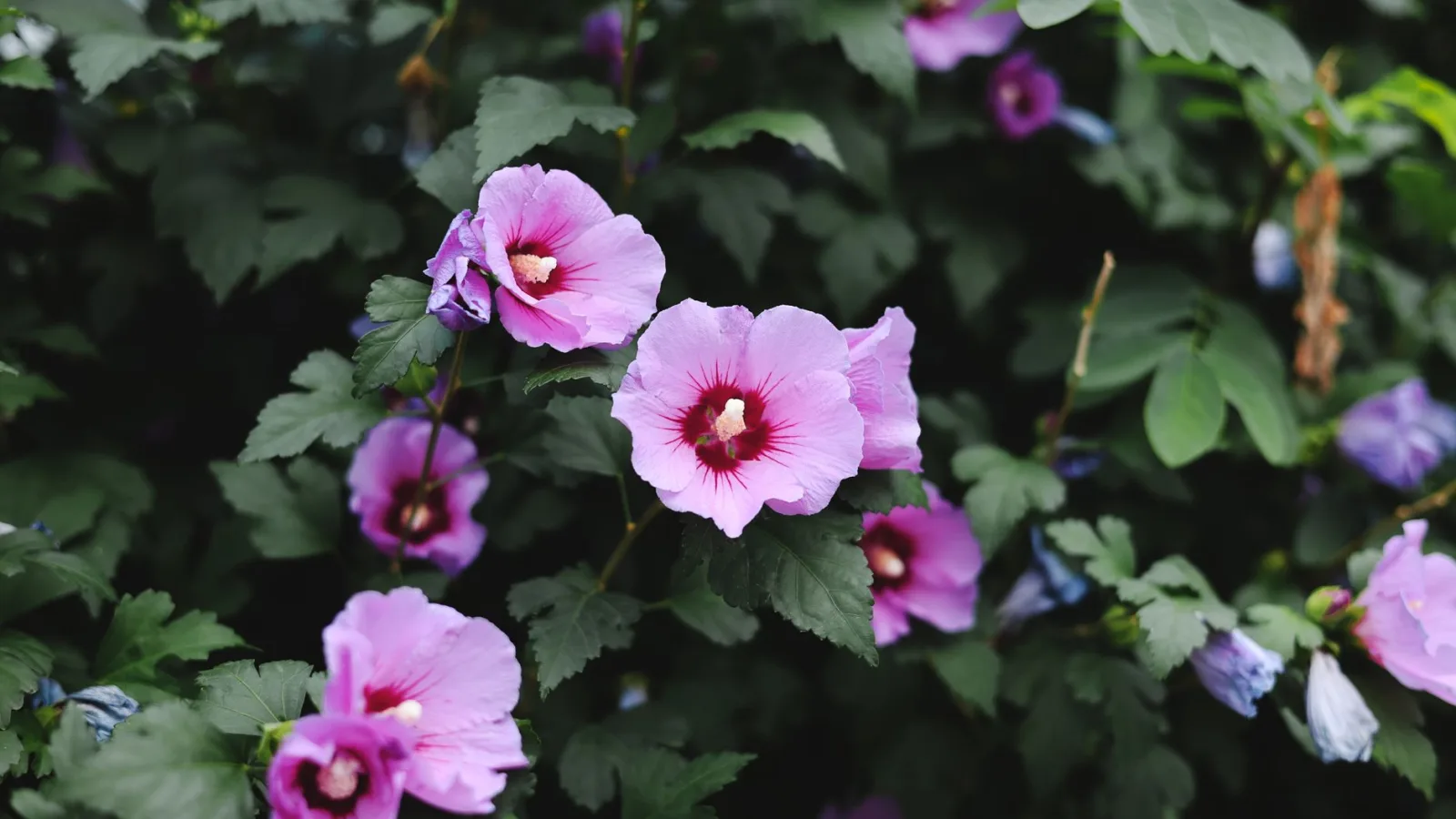
Rose of Sharon is the mallow-family shrub planted along hedges, in flower beds and in school yards across Korea, and it is the national flower. From midsummer into early autumn it opens fresh blooms every morning and drops them by evening. A single flower lasts one day, but another opens elsewhere on the shrub the next, so the display runs close to three months. Pick a newly opened flower in the morning, dry it in the shade, and it becomes a flower tea whose infusion runs pale violet or pink depending on the bloom. The Donguibogam lists it in the Wood section as Mokgeun, records the Korean name as mugunghwa exactly as it is still said, sets down a neutral nature with no toxicity, and notes that it is found everywhere and gathered at any season. The red hibiscus tea sold in shops comes from the same genus but a different species, roselle, and the two are not interchangeable. Aphids settle on this shrub readily, which is why street and park plantings get sprayed so often. Flowers for tea come from an unsprayed shrub in your own bed, picked in the morning.
Year-Round Calendar
- 1
- 2
- 3
- 4
- 5
- 6
- 7
- 8
- 9
- 10
- 11
- 12
- 3
- 4
- 7
- 8
- 9
Where It Grows
- Origin The native distribution is understood to lie in the south-central region, south of the Yangtze basin. It is called mujin.
-
Main producer
As the national flower it is planted throughout the country, and cultivar breeding and nursery production continue. The flowers are picked from July to September. Harvest July, August, September
- 7
- 8
- 9
- Major producer Under the name mukuge it has long been planted as a garden tree and as a flower for the tea room.
The syriacus of the botanical name points to Syria, but the true native range is south-central China. The plant entered Europe by way of West Asia in the 16th century, and the name of that waystation stayed attached to the botanical name. It is now widely planted in gardens across Europe and North America as well, but that spread was as an ornamental, so those regions are not counted here as growing areas.
- Optimum
- 20~30℃
- Range
- 10~35℃
- Hardiness
- Hardy
A temperate deciduous shrub that flowers in summer. It withstands down to −20 to −25℃, so it overwinters — survives the winter in the ground — even in the inland central region, and it flowers freely only where the sun falls all day. The flowers are carried on shoots grown that same year, so how far the branches are cut back in spring sets how much bloom the year produces.
Harvested 2–3 years after planting. Nursery plants go in during March and April, and in the planting year there are few flowers. Once the plant has settled in after two or three years, new flowers open every morning from July to September, year after year. A single bloom is finished in a day, so what is picked is that day's freshly opened flower.
In Korea Nationwide
It is planted nationwide. It is hardy enough to overwinter even in the inland central region, but where the summer is short, as in the mountains of Gangwon, it flowers late and the flowering period is brief.
How to grow
- Light
- Full sun all day. In shade the flowering falls off markedly
- Soil and depth
- It is not fussy. Ordinary garden soil suits it as long as the drainage is good
- Spacing
- One to one and a half metres between plants, tightened to 60 to 80cm for a hedge line
- Watering
- Keep it from drying out through the first year only. Once established it carries itself on rainfall
- Feeding
- A spadeful of compost around the base in early spring before growth starts. Heavy nitrogen gives leaf at the expense of flower
- Harvest
- Pick in July to September, in the morning once the dew has dried, taking flowers that opened that day. Remove the calyx and dry them in the shade. The Donguibogam says they are gathered at any season
What makes the difference. It flowers on wood made that same year. Cut last year's growth back hard in early spring before the leaves break, and the strong new shoots carry far more flower
Why this one is harder. Aphids favour this shrub more than most. If the flowers are going into tea you have to hold the line with water and hand-picking rather than sprays, so check the new shoot tips often from spring onward. In a year when the shrub has been sprayed, do not use its flowers
Common problems
- Aphids You will see Colonies on new shoot tips and flower buds, with sticky leaves What to do Wash them off with a jet of water; if they keep returning, use a soap or oil spray. Never spray a shrub whose flowers you take for tea
- Fall webworm You will see Leaves skeletonised to a net and larvae clustered at branch tips What to do Cut out the affected branch whole and bag it for disposal. Caught early they never spread through the shrub
- Powdery mildew You will see White patches on the leaves as though dusted with flour What to do Thin the branches so air moves through and remove affected leaves. Do not water over the top of the plant
This page describes how a crop is grown and used. It does not claim health effects for any food, nor is it intended to prevent or treat disease. Component and study notes are references only and do not mean the same result occurs in people. Consult a medical professional about health concerns.
Health Benefits
The old record — mokgeun (木槿). The Donguibogam lists it in the Wood section as Mokgeun and records the Korean name as mugunghwa, exactly as it is still said. It sets down a neutral nature and no toxicity. On provenance it says the shrub is found everywhere, and on gathering that it is taken at any season. It is a short entry quoting the Boncho. This is a historical medical record and differs from modern judgment.
Analyses of the flower pigment. Analyses report anthocyanin pigments in the petals. Deeper-coloured blooms give a deeper infusion, and the same work records the shift toward red under acid conditions. This is an analysis of composition and has nothing to do with preventing or treating disease.
Nutrition
- Anthocyanins (the red-violet pigment of the petals) — the pigment that gives the flower its colour
- Mucilage (present in the flowers and the bark) — a polysaccharide that softens the infusion
- Flavonoids (distributed in flowers and leaves) — polyphenol compounds
A flower that lasts one day A single bloom opens in the morning and closes and falls by evening. Another opens elsewhere the next day, so the shrub as a whole carries flowers for close to three months. Flowers for tea are picked in the morning once the dew has dried, taking only those that opened that day. A spent flower has already lost both colour and scent.
Petal colour in the cup The red-violet of the petals comes from anthocyanin pigments. Dried violet flowers give a far deeper infusion than white ones. Anthocyanins shift toward red under acid, so a drop of lemon visibly changes the colour in the cup.
Mucilage As a mallow-family plant it carries mucilage in flowers and bark alike, which is what gives the infusion its faintly soft body. Steeped too long it turns cloying, so keep it to around three minutes.
Pairings
○ A drop of lemon — A drop of lemon juice pushes the anthocyanins toward red and brings the colour up in the cup. It sharpens the taste too. Add much more and only the sourness is left.
○ Honey — The tea is delicate enough that a little sweetness carries it. Add the honey once the cup has cooled slightly rather than while it is still scalding.
○ Dried chrysanthemum or mint — The scent is light, so blending it with another flower or leaf tea does not set up a clash. Add only one or two so the rose of Sharon still shows through.
△ Roadside and park shrubs — Aphids settle on this shrub readily, so street and park plantings get sprayed regularly. Do not pick flowers along roads, in parks or from school hedges. Flowers for tea come from an unsprayed shrub in your own bed.
△ Telling it from hibiscus tea — The red hibiscus tea sold in shops is the dried calyx of roselle, a different species in the same genus. It is strongly sour and deep red, while rose of Sharon tea is far lighter in both scent and colour. Check the botanical name or the ingredient listing when buying, and do not substitute one for the other.
△ Spent or infested flowers — Flowers that have closed by evening, or that have dropped to the ground, are not used. A flower that carried aphids is discarded rather than washed. Get into the habit of turning each bloom over to check between the petals and behind the calyx as you pick.
Varieties
- Baedal group (sapling) — White petals with no red central blotch
- Dansim group (sapling) — A red central blotch at the throat. Subdivided further by the petal colour around it into white, red and blue-toned forms
- Asadal group (sapling) — White petals with red markings bleeding through them
- Double-flowered forms (sapling) — Layered petals, widely planted as ornamentals. Single flowers are the ones usually taken for tea
Source: Donguibogam, Wood Section 木槿 · Korean Plant Names Index