- Type
- Legumes
- Difficulty
- Moderate
- Season
- Summer
- Sowing
- From seed
Mung bean
Vigna radiata
Vitexin and fiber — the small bean behind mung jelly and bean sprouts
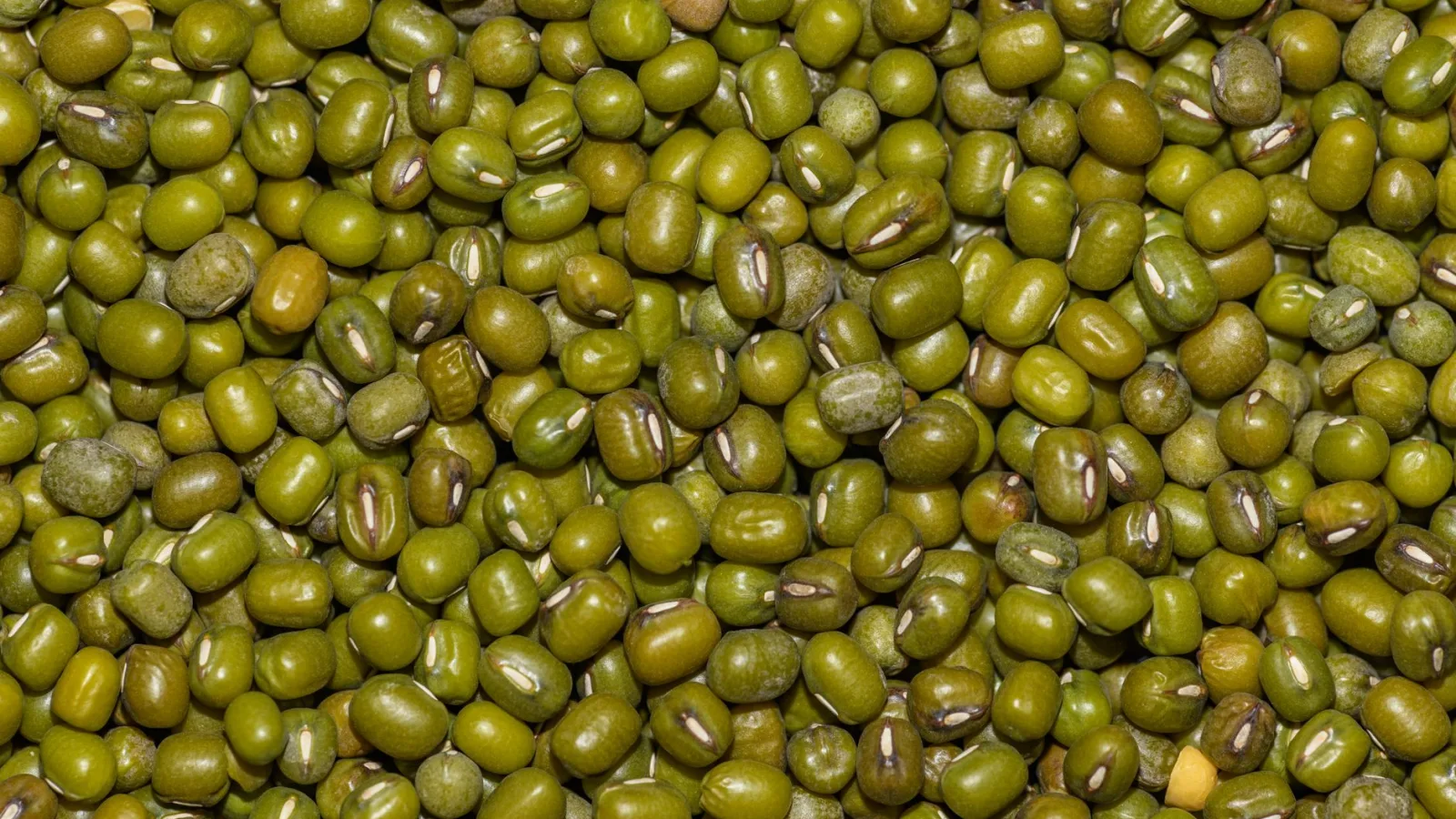
The mung bean is among the smallest-seeded of the legumes. Soaked and ground, its settled starch is simmered into the jelly called nokdumuk; sprouted in the dark with no soil at all, it becomes sukju bean sprouts. Sprouting takes only a handful of seed, water, and a dark container, which makes it one of the easiest things to grow in a city apartment. Easy does not mean any seed will do. Use only seed sold for eating — seed sold for sowing may be treated with disinfectant — wash and dry the container each time, and rinse two or three times a day so no water stands in the bottom. Throw out the whole batch if it turns slimy or smells sour, and anyone pregnant, young children, older adults, and people with weakened immunity should eat the sprouts cooked rather than raw. The Donguibogam lists the bean in the Grains section as 菉豆. It rates green, round, small beans as the best ones, and it sets down a preparation method — soak the beans, grind them, strain, let the starch settle, then dry it into flour — alongside a distinction between the hull, described as cold, and the inner bean, described as neutral.
Year-Round Calendar
- 1
- 2
- 3
- 4
- 5
- 6
- 7
- 8
- 9
- 10
- 11
- 12
- 6
- 7
- 9
- 10
Where It Grows
-
Origin
Held to have been domesticated in the Indian subcontinent, and still the largest producer in the world. Planting is divided into a rainy-season crop and a spring crop. Harvest September, October
- 9
- 10
-
Main producer
Leads exports. The dry-season crop, planted in the paddies after the rice is taken in, is substantial. Harvest February, March
- 2
- 3
- Major producer Grown in North China and the Northeast, with large consumption as well.
- Major producer On Java it is planted as a catch crop after the rice is taken in.
- Major producer Grown in the central and northern regions, and also shipped as seed for bean sprouts.
Domesticated in the Indian subcontinent, it spread early to East and Southeast Asia. South Asia remains the centre of both production and consumption, and because the growing period is short, it has established itself as a catch crop, sown and harvested in the brief gap after the rice is taken in. Korea plants little of it and imports a considerable share of what it uses.
- Optimum
- 25~35℃
- Range
- 15~40℃
- Hardiness
- Not hardy
- Day length
- Short-day
A heat-tolerant summer annual. Its growing period is short, 60~90 days, so it can still be harvested the same year even when sown after the monsoon rains. Frost kills it, and if rain is frequent as the pods fill, the seeds sprout inside the pods. It is a short-day plant that sets flowers as the days shorten, though cultivated varieties have been bred to respond less strongly.
In Korea Nationwide
Sown around the monsoon rains in June~July and picked from September~October, starting with the pods that have ripened black. Ripening is uneven, so a single plant is picked over three or four passes. Bean sprouts are germinated indoors without soil, in any season.
How to grow
- Light
- Six hours or more a day. A spot that takes full summer sun suits it
- Soil and depth
- Free-draining soil at least 20 cm deep. Too much manure gives stem growth and fewer pods
- Spacing
- Rows 60 cm apart, plants 10-15 cm apart. Sow two or three seeds per hole and keep one
- Watering
- Keep it moist through germination and flowering. Cut back once the pods begin to fill
- Feeding
- As a legume it needs almost no nitrogen. Work phosphorus and potassium into the base dressing and you can skip top dressing entirely
- Harvest
- Pick pods as they turn black. It never finishes in one go — expect three or four passes at 7-10 day intervals
What makes the difference. Fully ripe pods split open on their own in strong midday sun and fling the seed. Picking early while the dew is on loses far less
Why this one is harder. Uneven ripening is the real nuisance. Black pods and green pods hang on the same plant, so harvest has to be split across several visits
Common problems
- Stink bugs You will see Puncture marks on the pods and seed that never fills out What to do Hand-pick them in the morning. Cut back nearby weeds to remove their shelter
- Aphids You will see Clusters on new shoots and flower stalks, with curling leaves What to do Wash them off with a jet of water; if they return, spray egg-yolk oil, covering leaf undersides
- Powdery mildew You will see White powder settles on the leaves and the lower ones dry off first What to do Open up spacing to let air through and remove affected leaves
This page describes how a crop is grown and used. It does not claim health effects for any food, nor is it intended to prevent or treat disease. Component and study notes are references only and do not mean the same result occurs in people. Consult a medical professional about health concerns.
Health Benefits
What the Donguibogam records. The Donguibogam lists the mung bean in the Grains section as 菉豆. It calls the bean cold in nature, notes alternate readings of neutral, and describes it as sweet in taste and without toxicity. It separates the hull, described as cold, from the inner bean, described as neutral, and picks out green, round, small beans as the best. It also preserves a preparation method — soak, grind, strain, dry the settled starch into flour — and a note that mung beans were used to fill pillows. This is a record from an old medical text and differs from modern medical judgment.
Sprouting and vitamin C. Analyses have reported vitamin C in sprouted mung beans where the dried seed held almost none. The explanation is that germination shifts the seed's composition. This is a compositional finding and does not mean treatment or prevention of disease.
Flavonoids in the hull. Analyses have repeatedly identified flavonoids such as vitexin and isovitexin in the mung bean hull. Hulled, split mung beans show markedly less of the same compounds. This is a compositional finding and does not mean treatment or prevention of disease.
Nutrition
- Protein (About 23 g per 100 g of dried seed) — Typical of a legume
- Dietary fiber (About 16 g per 100 g of dried seed) — Concentrated in the hull
- Folate (About 600 mcg per 100 g of dried seed) — High even among legumes
- Vitexin and isovitexin (Flavonoids concentrated in the hull) — Compounds repeatedly detected in mung bean
Protein and amino acids Dried mung beans carry about 23 g of protein per 100 g. Like other legumes they are relatively rich in lysine, the amino acid grains run short on, which is why eating them with rice has persisted for so long. Methionine, on the other hand, is comparatively low, so grain and bean each supply what the other lacks.
Folate Dried mung beans are reported at around 600 mcg of folate per 100 g. That is high even measured against other legumes. Folate is heat-sensitive, though, so long boiling loses a good share of it and more leaches into the cooking water. Sprouting the beans and blanching them briefly keeps losses small.
What sits in the hull Flavonoids such as vitexin and isovitexin are reported to be concentrated in the mung bean hull. Removing the hull turns the bean yellow and gives a clearer jelly, but it takes those compounds and much of the fiber with it. The Donguibogam likewise separated the two, calling the hull cold and the inner bean neutral. This is a record from an old medical text and differs from modern medical judgment.
Sprouting mung beans at home Sprouts are grown on water alone, with no soil, so they need constant attention. Use only seed sold for eating — seed sold for sowing may be treated with disinfectant and is not food. Wash and dry the jar or sprouter every time it is used, and rinse the seeds two or three times a day so that no water stands at the bottom. The warm, damp conditions that make a seed germinate also suit bacteria, so if the batch turns slimy or smells sour, throw all of it away rather than rinsing it off. Anyone pregnant, young children, older adults, and people with weakened immunity should eat sprouts cooked rather than raw.
Pairings
○ Rice — Mung beans are cooked together with rice as nokdubap. Dried beans take longer to soften than rice, so soak them two or three hours or parboil them before mixing. Starting at roughly 8 parts rice to 2 parts beans works well.
○ Pork, bean sprouts, and kimchi — Bindaetteok is a pancake of soaked mung beans ground to a batter. Because it is fried, the fat of pork and the acidity of sour kimchi balance the plainness of the bean. Adding bean sprouts brings texture back into the bite.
○ Water and time — Mung bean jelly has only two ingredients: beans and water. Soaked beans are ground, strained, and the settled starch alone is collected and cooked with constant stirring. The Donguibogam's method for mung bean flour follows the same order — soak, grind, strain, let it settle.
△ Home-grown sprouts — seed and hygiene — The warm, damp conditions sprouting needs are also good conditions for bacteria. Use only seed sold for eating; seed sold for sowing may be treated with disinfectant and is not food. Wash and dry the jar or sprouter every time it is used, and rinse two or three times a day so no water stands in the bottom. If a batch turns slimy, smells sour, or changes color, throw all of it away rather than trying to rinse it clean.
△ Raw sprouts — pregnancy, children, weakened immunity — Even sprouts grown carefully carry some risk when eaten raw. Anyone pregnant, young children, older adults, and people with weakened immunity should skip raw sprouts and eat them thoroughly cooked, in a soup or a stir-fry.
Varieties
- Eoul — A Rural Development Administration cultivar whose pods ripen relatively evenly
- Dahyeon — A Rural Development Administration cultivar with larger seed
- Nampyeong — A Korean cultivar long grown in the southern half of the country
- Landrace mung bean — Small, deeply colored seed used for jelly and bindaetteok pancakes
Source: Donguibogam, Grains section, 菉豆 · Rural Development Administration (Nongsaro)