- Type
- Herbs & Aromatics
- Difficulty
- Moderate
- Season
- Spring·Summer·Fall
- Sowing
- From seed
Fennel
Foeniculum vulgare
Anethole · leaves and seed from one plant
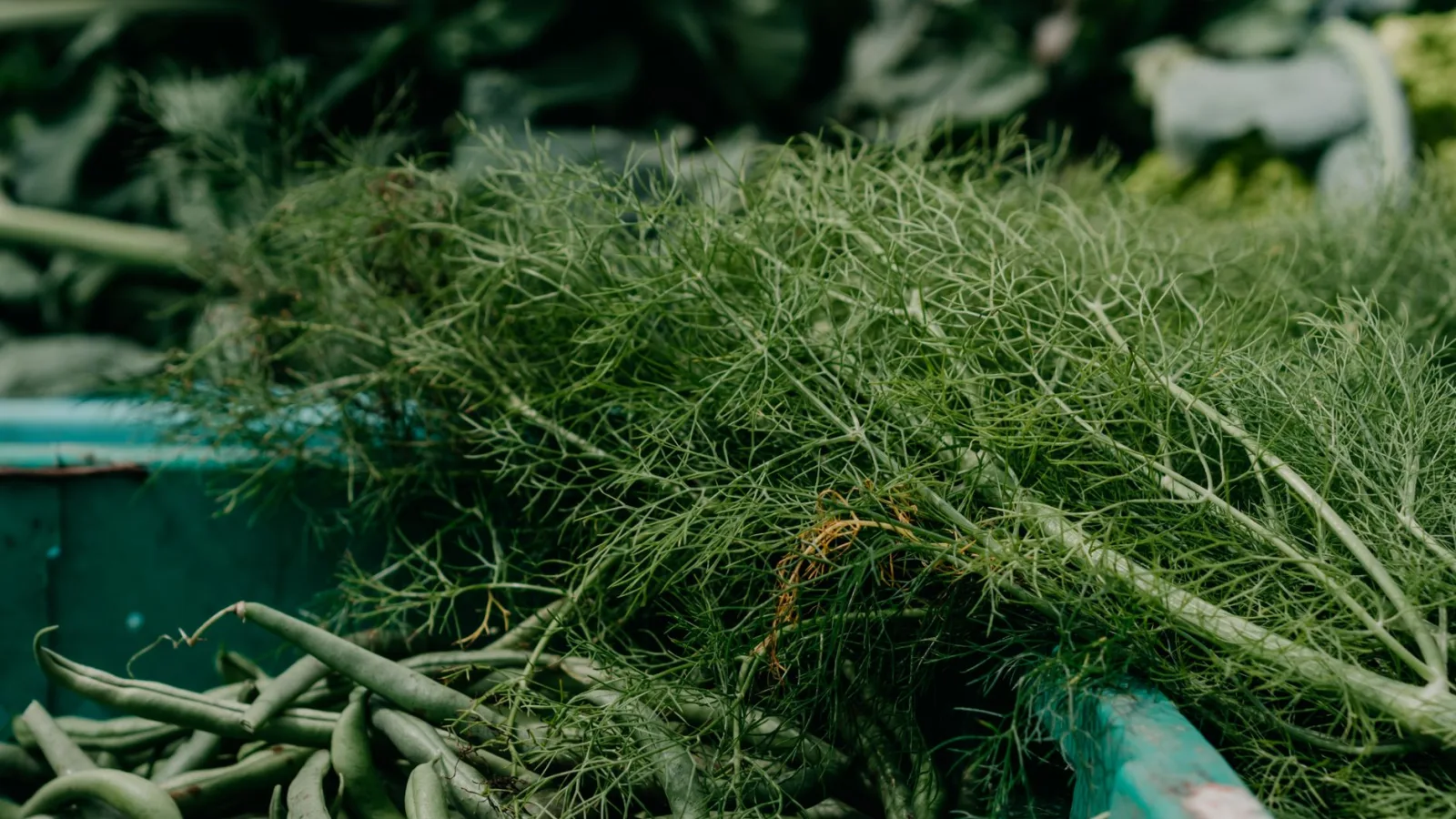
Fennel is a perennial in the carrot family, throwing up feathery divided leaves and flat yellow umbels. In a city plot it sits at the back of a bed or in a large pot, giving leaves through the summer and ripe seed in autumn. Florence fennel swells its leaf bases into a bulb that is eaten as a vegetable, and it is grown a little differently from the leaf-and-seed type. The Donguibogam lists it in the Herb section as 茴香, giving it a neutral nature, a pungent taste and no toxicity. The same entry describes leaves like old coriander but far sparser and finer, growing in clumps, with fruit like barley grain only smaller and green.
Year-Round Calendar
- 1
- 2
- 3
- 4
- 5
- 6
- 7
- 8
- 9
- 10
- 11
- 12
- 4
- 5
- 7
- 8
- 9
- 10
Where It Grows
- Main producer The dry lands of Gujarat and Rajasthan produce the most seed fennel.
- Major producer Grown for spice in the dry regions of the north and west.
- Major producer Grown for seed on irrigated land along the Nile.
- Main producer The largest producer of Florence fennel, whose leaf sheaths are eaten as a vegetable, with the south — Puglia, Sicily and other southern regions — at its centre.
- Major producer Vegetable fennel is grown along the Mediterranean coast and shipped to the rest of Europe.
Because fennel is native to the Mediterranean coast and cannot be pinned to a single country, no "country of origin" row has been given. Today the producing regions split by use: for seed grown as a spice, India is the world's largest producer, while for Florence fennel, whose leaf sheaths are eaten as a vegetable, Italy and Spain lead. Because the FAO counts fennel in a single category together with anise, star anise, coriander and the like, a ranking for fennel alone cannot be read directly from the statistics.
- Optimum
- 15~25℃
- Range
- 5~30℃
- Hardiness
- Half-hardy
- Day length
- Long-day
This is a plant suited to the strong sun and dry summers of the Mediterranean. In cool weather the leaves and leaf sheaths (the swollen base that forms the "bulb") thicken, but when heat and long days coincide the flower stalk bolts first and the sheaths split open. In southern Korea it overwinters (survives the winter in the ground), but from central Korea northward it suffers frost damage.
In Korea Nationwide
Seed is sown in April–May, leaves are picked throughout the summer, and the ripened seed is harvested in autumn. In the south the plants overwinter in place and come up again the following year, but from the central region northward they often freeze to death, so they are sown fresh every year.
How to grow
- Light
- Six hours of direct sun or more. In shade it stretches and the aroma thins
- Soil and depth
- Free-draining sandy loam at least 30cm deep. The taproot runs deep
- Spacing
- 30cm between plants, 45 to 50cm between rows. Give Florence fennel 30cm or more so the bulb has room
- Watering
- Water well once the surface dries. A dry spell splits the bulb and pushes the plant into flower
- Feeding
- Well-rotted compost as a base dressing is enough. Side dress lightly at monthly intervals; excess nitrogen builds leaf and thins the aroma
- Harvest
- Take leaves from the outside as needed from 60 to 70 days after sowing. For seed, cut the whole head once the seeds have hardened to grey-green, hang it upside down in a paper bag to dry, then thresh. Cut Florence bulbs at the base once they reach the size of a fist
What makes the difference. If seed is the aim, do not strip the leaves. Fennel planted close to dill can cross, blurring the aroma of both, so keep them apart
Why this one is harder. The taproot makes transplanting risky. If you must raise seedlings, use paper pots that go into the ground whole. Sustained heat brings on early bolting, so time bulb fennel for the cooler ends of spring and autumn
Common problems
- Swallowtail caterpillars You will see Fat caterpillars strip the foliage, leaving bare stems What to do A few can be left alone, but move them by hand once a plant is being ruined. They specialise in carrot-family plants, so fennel draws them
- Aphids You will see Colonies on flower heads and new shoots, leaves turning sticky What to do Wash off with a jet of water; if it recurs, use an egg-yolk oil spray or an approved organic product. Keep sprays minimal on a plant grown for its leaves
- Slugs You will see Seedlings vanish overnight, leaving slime trails What to do Search under pots and paving slabs and collect them. A torch after dark is the reliable method
This page describes how a crop is grown and used. It does not claim health effects for any food, nor is it intended to prevent or treat disease. Component and study notes are references only and do not mean the same result occurs in people. Consult a medical professional about health concerns.
Health Benefits
What the Donguibogam records — nature, taste, form and harvest. The Donguibogam lists fennel in the Herb section as 茴香, giving it a neutral nature, a pungent taste and no toxicity. It describes leaves like old coriander but far sparser and finer, growing in clumps, with fruit like barley only smaller and green. The fruit, it notes, is gathered in the eighth and ninth lunar months and dried in shade. This is a historical medical record and differs from modern medical judgment.
The star anise the Donguibogam sets apart. The same entry separates out 八角茴香, describing its character as dry and fierce. Modern botany agrees they are different plants: star anise is the fruit of an Illicium tree, fennel a herb in the carrot family. The only fact carried forward here is that the old record already kept the two apart.
Essential oil composition. Studies analysing fennel seed oil report trans-anethole as the principal component, with fenchone and estragole also detected. The same studies note wide variation in total oil and in the ratios between compounds across cultivar, origin and harvest date. These are compositional analyses and have nothing to do with disease.
Nutrition
- trans-Anethole (commonly reported as over half the seed essential oil) — the aromatic compound behind fennel's sweet scent
- Fenchone (a secondary component of the oil) — the camphor-like, sharper edge of the aroma
- Estragole (methyl chavicol) (a minor fraction of the oil) — an aromatic compound whose intake limits are under discussion
- Dietary fibre (concentrated in the dried seed) — insoluble fibre taken in when seeds are chewed whole
Essential oil and the shape of the aroma The scent of fennel seed comes from its essential oil. Analyses repeatedly report trans-anethole as more than half of that oil, with fenchone and estragole following. Anethole carries the sweetness, fenchone the sharper note. The proportion shifts a great deal with cultivar and harvest timing, so under-ripe seed smells thin and grassy. This entry stays with the compositional record. Culinary quantities are not the concern; drinking fennel tea daily over a long stretch, or giving it to infants and toddlers, is not advised.
Fibre in the seed A large share of dried fennel seed by weight is dietary fibre. The amounts used in cooking are small, so the contribution to a day's fibre is modest. Whole seeds pass through with their coats intact, while ground seed releases aroma fast and loses it just as fast. Grind only what is about to be used.
Water and potassium in the Florence bulb The bulb of Florence fennel is around 90 percent water, closer to a vegetable than a spice. It carries potassium and is low in calories. Sliced thin and raw it is crisp and strongly aromatic; roasted, the sweetness comes forward and the aroma softens. Cut surfaces brown quickly, so trim it just before use.
Pairings
○ White fish — Around the Mediterranean, fennel stalks and fronds have long gone onto fish as it grills. Dried stalks laid under the grate scent the smoke. Fronds scorch easily, so add them at the end.
○ Pork and sausage — Crushed fennel seed worked into minced pork is the signature of Italian sausage. The aroma cuts through the fat. A teaspoon of seed per 500g of meat is plenty; more and the spice takes over.
○ Orange and citrus salad — Thin slices of Florence fennel with citrus segments and olive oil. The acidity holds the strong aroma in check. Salt at the last moment so the fennel does not weep.
△ Never confuse it with hemlock or water hemlock — The carrot family fennel belongs to contains several severely poisonous plants. Poison hemlock (Conium maculatum) has finely divided leaves that read much like fennel and purple blotches on the stem; water hemlock (Cicuta virosa) grows at the water's edge with a chambered, hollow rootstock. Do not eat any wild carrot-family plant on the strength of its smell. Fennel's sweet scent when leaves are crushed is distinctive, but scent alone is not a safe way to separate species.
△ Star anise and Japanese star anise — The 八角茴香 the Donguibogam sets apart is the fruit of a different plant entirely. The culinary spice is Illicium verum, while the near-identical Japanese star anise (Illicium anisatum) contains toxic compounds and must not be eaten. Broken pieces are far harder to tell apart, so buy only from a source you can name.
△ Young children, pregnancy and fennel preparations — Fennel oil contains estragole, and prolonged use of concentrated preparations is not advised. The European Medicines Agency herbal monograph states that fennel preparations are not recommended for children under four, nor during pregnancy and breastfeeding. Culinary quantities and concentrated oils or extracts are two different things. If in doubt, ask a doctor or pharmacist.
Varieties
- Florence fennel (seed) — Swells its leaf bases into a bulb eaten as a vegetable (var. azoricum)
- Sweet fennel (seed) — The standard leaf-and-seed type (var. dulce). Grows tall
- Bronze fennel (seed) — New growth comes up bronze. Earns its place in an ornamental bed
- Korean landrace fennel (seed) — The line the Donguibogam's 俗方 note calls planted and found everywhere in Korea
Source: Donguibogam, Herb Section 茴香 · Rural Development Administration (Nongsaro) · Korean Food Composition Table