- Type
- Herbs & Aromatics
- Difficulty
- Easy
- Season
- Summer
- Sowing
- From seed
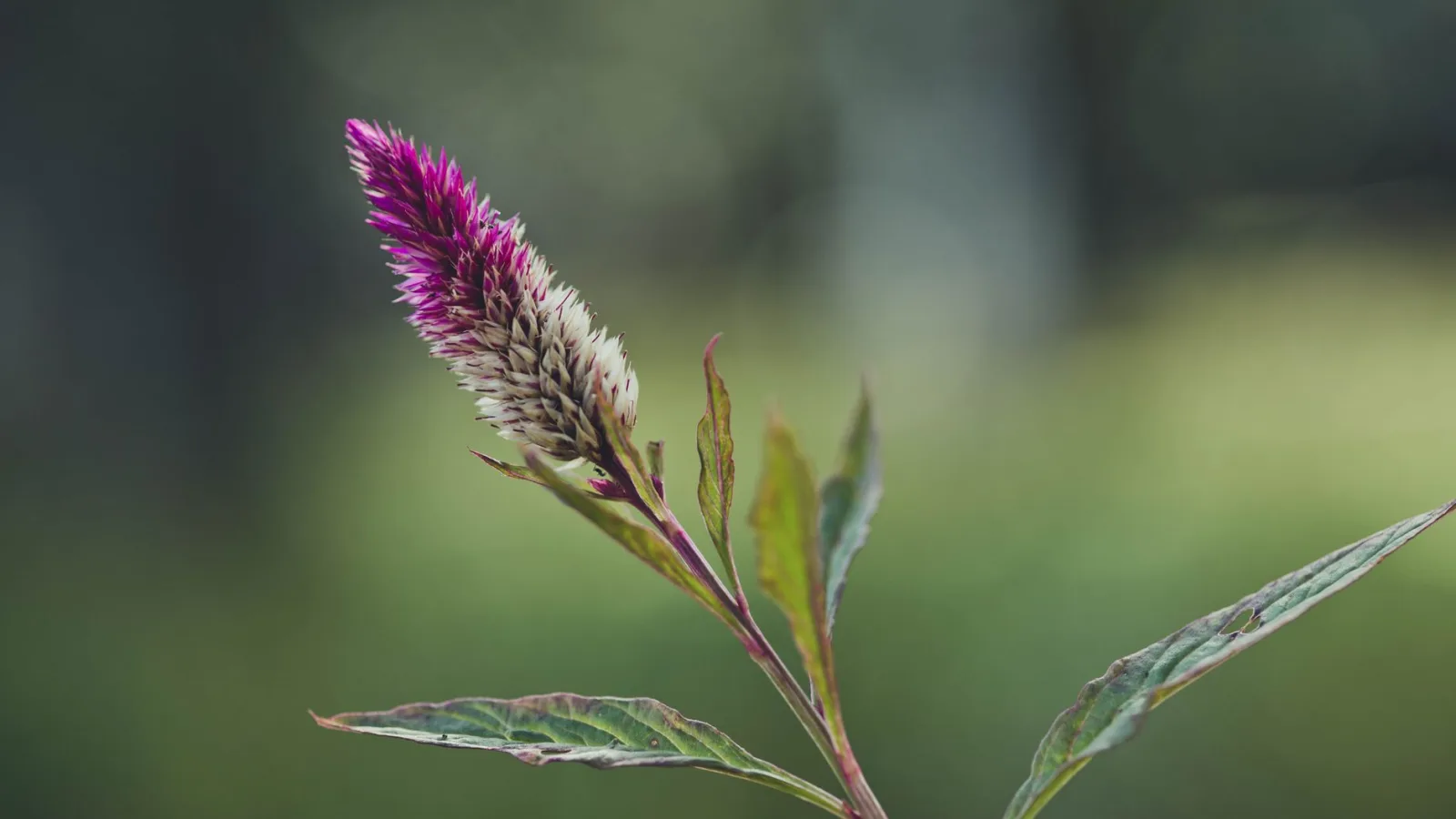
Feather cockscomb
Celosia argentea
Oxalate and beta-carotene · an amaranth-family plant with upright silvery spikes
Feather cockscomb belongs to the same amaranth-family group as the garden cockscomb, and in summer it sends up silvery flower spikes that stand straight. Where cockscomb bunches into a crest, this one tapers like a candle flame, which suits the back row of a bed. The young leaves are blanched and dressed as a namul, and the small black seeds gathered in autumn are toasted and later simmered as a tea. Like most amaranth-family greens it carries oxalate, so it is always blanched and the water thrown away. The Donguibogam lists the seed in its Herb section as Cheongsangja and records the Korean name as gaemaendeurami-ssi (feather cockscomb seed). It gives a slightly cold nature, a bitter taste and no toxicity, and states plainly that this is the seed of the cockscomb flower. The seed, it says, is gathered in the sixth and eighth lunar months, lightly toasted and then crushed for use. Sow in late spring and the spikes rise in summer; fallen seed often brings the plant back the following year.
Year-Round Calendar
- 1
- 2
- 3
- 4
- 5
- 6
- 7
- 8
- 9
- 10
- 11
- 12
- 4
- 5
- 7
- 8
- 9
Where It Grows
- Main producer In the Yoruba region of the southwest it is grown on a large scale as a leaf vegetable known as soko. It is one of the most widely eaten leaf vegetables in West Africa.
- Major producer It is grown in successive plantings throughout the rainy season in vegetable plots on the outskirts of cities.
- Major producer It is grown in fields for its seed, harvested under the name cheongsangja.
- Wild population It grows wild and common in open country and farm fields, and its seed is gathered.
It grows wild and abundantly across tropical Africa and tropical Asia, so its origin cannot be pinned down to any single country. In West Africa it is grown in fields as a leaf vegetable, while in East Asia it is treated as a field crop harvested for seed and as an ornamental flower — the same species put to different uses.
- Optimum
- 20~30℃
- Range
- 15~35℃
- Hardiness
- Not hardy
- Day length
- Short-day
It tolerates heat and dry ground well but is killed by frost. Flower stalks rise as the days shorten; in a spot that gets sun all day it grows straight and upright, while in shade it flops.
In Korea Nationwide
It comes up in open country and along field edges, and is also planted in flower beds. Being an annual that is killed by frost, it comes back the following year from dropped seed.
How to grow
- Light
- Full sun all day. In shade the flower stalk will not stand and the plant sprawls
- Soil and depth
- Free-draining soil at least 20cm deep. It does well in a pot
- Spacing
- 25 to 30cm between plants. Crowded, the lower leaves go slimy and the spikes come thin
- Watering
- Water when the surface dries. It takes heat well, but a pot dries out day by day
- Feeding
- Compost at planting, then one weak feed as the flower spikes rise
- Harvest
- Young leaves in June and July, stripped from the plant before it reaches knee height. Seed in September and October, threshed into a paper bag once the spike has dried
What makes the difference. Blanch the leaves, rinse cold and discard the blanching water. Toast the seed briefly in a dry pan over low heat and keep it sealed
Why this one is harder. Decide from the start which plants are for eating and which are for looking at. Nothing is harvested from a sprayed ornamental clump, so give the edible plants a row of their own
Common problems
- Aphids You will see Colonies on flower stalks and new shoots, turning sticky What to do Wash them off with water. Do not spray a plant whose leaves are to be eaten
- Leaf beetles You will see Fine holes punched through the young leaves What to do Pick them off as you see them and remove badly eaten leaves. Damage falls away as the plant grows
- Damping off You will see Seedlings pinch in at the base and topple after germination What to do Do not sow thickly, and let the surface dry between waterings. Pull and discard collapsed seedlings
This page describes how a crop is grown and used. It does not claim health effects for any food, nor is it intended to prevent or treat disease. Component and study notes are references only and do not mean the same result occurs in people. Consult a medical professional about health concerns.
Health Benefits
The old record — cheongsangja (靑箱子). The Donguibogam lists the seed in its Herb section as Cheongsangja and records the Korean name as gaemaendeurami-ssi (feather cockscomb seed). It gives a slightly cold nature, a bitter taste and no toxicity. It states that this is the seed of the cockscomb flower, and sets down the preparation: gathered in the sixth and eighth lunar months, lightly toasted, then crushed for use. What an old medical text wrote differs from how it is judged today.
Oxalate in the amaranth family. Food analyses repeatedly report oxalate in amaranth-family greens, together with measurements showing that part of it leaches into the water during blanching. That is the basis on which blanching and discarding the water became standard. These are compositional analyses and have no bearing on disease.
A record of the leaves being eaten. Records of Celosia leaves eaten as a vegetable survive in the edible-plant literature of tropical Asia and Africa. Blanching the young leaves before use appears in common across them. This concerns culinary practice.
Nutrition
- Oxalate (widespread in amaranth-family greens) — the organic acid behind the rule of blanching and discarding the water
- Beta-carotene (deep green leaves) — the carotenoid that colours the leaf
- Dietary fibre (leaves and stems) — the basis of the bite that survives blanching
Blanch it and throw the water away Amaranth-family greens carry oxalate, so the basic preparation for the young leaves is boiling water followed by discarding that water. Part of the oxalate leaches out while it blanches. Slicing this group raw into a salad does not suit it.
Young leaves only Once the flower spike begins to rise, stem and leaf coarsen together and stay tough after blanching. The window is early summer, before the plant reaches knee height. Strip the leaves and leave the thick stems.
The seed is toasted The original text says to toast the seed lightly and crush it before use. Toasting takes off the raw note and brings the aroma up in the simmering. Small seeds scorch easily, so keep the pan dry, the heat low and the time short.
Where it sits as a leaf vegetable The deep green leaves carry beta-carotene, and the bite of the stem comes from dietary fibre. Records from tropical regions show the leaves eaten as an everyday vegetable. This entry stays with the compositional record.
Pairings
○ Dressed with doenjang — Blanch the young leaves, wring them out and dress with doenjang and sesame oil. Handle it the way amaranth greens are handled and little goes wrong. Keep the garlic light so the leaf still shows.
○ Tea from the toasted seed — Simmer a pinch of lightly toasted seed in water for about five minutes and strain. Long boiling turns it dull, so keep it brief. Store the toasted seed sealed and brew it as needed.
○ Ground perilla seed — Dress the blanched leaves with ground perilla seed, or stir-fry them with a little liquid. The oil in the perilla fills out the dry grain of the leaf. Stirred into a soup at the end it does the same. Perilla (Deulkkae)
△ Bedding plants and seed packets — separate what is for eating — Potted plants from a florist and ornamental seed packets are sometimes treated with fungicide or dye, so they are not handled as food. Take leaves and seed only from plants raised for eating from the start. Do not pick leaves from an ornamental clump that has been sprayed.
△ Eating it raw — always blanch — Amaranth-family greens carry oxalate, so the young leaves are not eaten raw. Blanch in boiling water, rinse cold and discard the blanching water. Anyone who has had urinary stones is generally advised not to eat large amounts of high-oxalate vegetables at once, and this green falls under the same rule.
△ Amaranth-family plants seen in the open — Amaranth-family plants on waste ground look much alike, and that ground is also where herbicide and exhaust land. Do not gather beside roads or on field margins. Feather cockscomb has alternate leaves, an upright candle-like spike and glossy black seed; if all three do not match, leave it.
Varieties
- Feather cockscomb (seed) — Silvery spikes tapering like a candle flame. It also self-sows in open ground
- Cockscomb (Celosia argentea var. cristata) (seed) — Flowers bunched broad and thick like a rooster's comb. A cultivated group of the same species
- Plumed celosia lines (seed) — Spikes split into feathery plumes in red and yellow. Commonly sold for beds
Source: Donguibogam, Herb Section 靑箱子 · Rural Development Administration (Nongsaro)