- Type
- Leafy Greens
- Difficulty
- Easy
- Season
- Spring·Fall
- Sowing
- From seed
Chickweed
Stellaria media
Vitamin C, saponins · the first green of a Korean spring
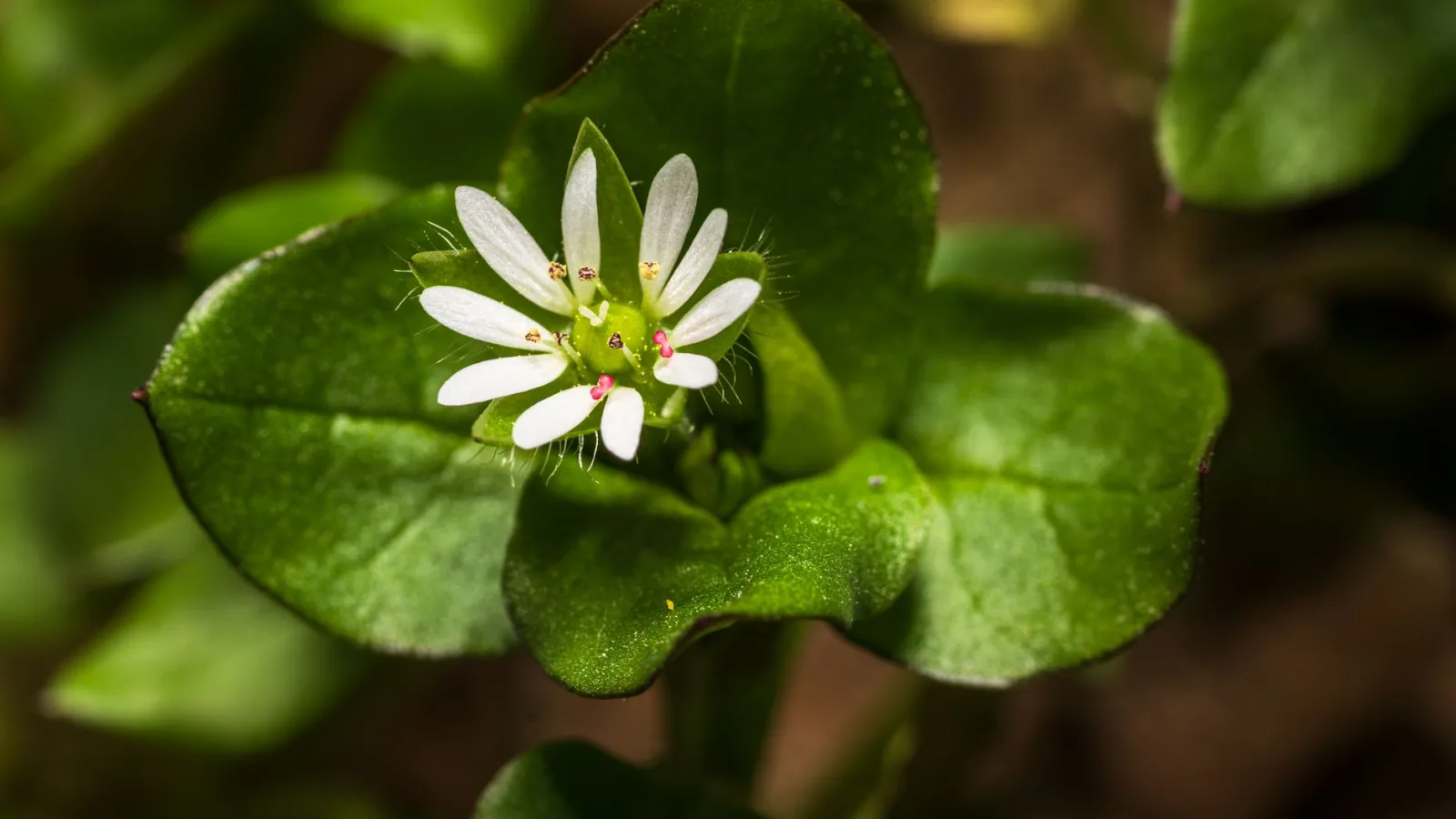
Chickweed comes up on its own along field edges and the borders of flower beds. It germinates in autumn, sits out the winter as a flat rosette, and gives tender stem tips from March through May. The five white petals are split so deeply that they read as ten, and a single line of hairs runs down one side of the stem, which is how it is told apart from its neighbours. Mouse-ear chickweed (Cerastium), which comes up in the same ground, is hairy across the whole leaf and stem and feels quite different in the hand, while Pseudostellaria heterophylla grows in mountain woodland and carries a tuberous root, a plant of another genus entirely. Neither is a variety of chickweed but a separate look-alike species, and neither is harmful. The plants that do need watching are the spurges sharing the same field margins. Snap the stem or leaf of Euphorbia helioscopia or one of its relatives and white latex weeps out; those are not eaten, and the latex irritates skin and mucous membranes. Chickweed yields no latex when snapped, only thread-like fibres, so break one stem before picking and drop the clump if a white sap shows. Leave any clump that cannot be named with certainty. The Donguibogam lists it in the Vegetable section as 蘩蔞, records the Korean name of the day, and gives it a neutral nature, called slightly cool by some, a sour taste and no toxicity. The same entry explains the alternate name 雞腸草: cut the stem and thread-like fibres string across, and the stem is thin and hollow like a chicken's gut. It also notes that the plant is boiled as a green and can be eaten raw.
Year-Round Calendar
- 1
- 2
- 3
- 4
- 5
- 6
- 7
- 8
- 9
- 10
- 11
- 12
- 9
- 10
- 3
- 4
- 5
Where It Grows
-
Wild population
It comes up on its own along field banks, roadsides, and the edges of flower beds across the country, and is picked as a wild green in early spring. Harvest March, April, May
- 3
- 4
- 5
- Wild population Known as hakobera, it has long been carried on as a plant picked in spring.
- Wild population Called fanlü, it is a common weed of fields and roadsides.
It appears to be native to Eurasia, spanning Europe and Western Asia, and because it cannot be pinned to any single country, no origin row has been listed. It has since spread to nearly every continent wherever conditions are cool and moist and is now a common field weed, but as it is not a crop that is planted and sold, there are no production statistics. The three countries above are listed as places where it grows wild and has long been picked as a spring green.
- Optimum
- 10~20℃
- Range
- 0~25℃
- Hardiness
- Hardy
This is a plant of cool, damp ground. It grows even at around 5℃, overwintering as a flat, cushion-shaped mat, but once early summer arrives and temperatures pass 25℃ it grows leggy, sends up nothing but flower stalks, and vanishes. Its roots are shallow, so it wilts within a day if the soil dries out.
Harvested 1–1 years after planting. Seed sown in September or October overwinters that same year as a cushion-shaped mat, and the plants are picked from March to May of the following year. The sowing months and the harvest months do not fall in the same year.
In Korea Nationwide
It springs up on its own along field banks and roadsides nationwide. It sprouts in autumn, overwinters, is picked from March to May, and disappears once June arrives.
How to grow
- Light
- Half a day of sun is enough. Strong midsummer sun pushes it straight to flower
- Soil and depth
- Free-draining soil with some fertility left in it. Field edges or used potting mix both work
- Spacing
- No rows. Broadcast the seed and thin to three or four plants per palm-width
- Watering
- Water when the surface dries. The roots are shallow, so a dry pot wilts within a day
- Feeding
- Almost none needed. A thin layer of finished compost as a base dressing is plenty
- Harvest
- From March to May, cut the tender top 5-10cm with scissors. Leave the roots and side shoots come again for several pickings. Once flowering is over and seed sets, the stems turn stringy
What makes the difference. Once it settles in, dropped seed brings it back the following year. To save seed, leave three or four plants to flower through and keep cutting the rest
Why this one is harder. It is a plant that leaves when summer arrives. From June it vanishes from the plot, so treat it as a one-season spring crop
Common problems
- Aphids You will see Shoot tips curl and the undersides of leaves turn sticky What to do Wash them off with a jet of water; if they keep returning, spray a soy-oil emulsion
- Slugs You will see Ragged holes in the leaves and silvery trails What to do Pick them off the morning after rain, and look under pots and boards
- Grey mould You will see The centre of the clump goes soft with a grey dust over it What to do Thin crowded plants to open airflow and cut away any softened stems
This page describes how a crop is grown and used. It does not claim health effects for any food, nor is it intended to prevent or treat disease. Component and study notes are references only and do not mean the same result occurs in people. Consult a medical professional about health concerns.
Health Benefits
The Donguibogam record — nature, taste and the name. The Donguibogam lists chickweed in the Vegetable section as 蘩蔞, with the Korean name of the period written alongside. It gives the plant a neutral nature, called slightly cool by some, a sour taste and no toxicity. It identifies it with 雞腸草 and explains the name: the stem trails, thread-like fibres string across when it is snapped, and it is thin and hollow like a chicken's gut. It also records that the plant is boiled as a green and can be eaten raw. This is an old medical record and differs from modern medical judgement.
Compositional analysis of the aerial parts. Analyses of chickweed's aerial parts report saponins and flavonoids. Vitamin C has been measured high relative to other gathered greens, though with wide variation by season and plant part. This is a record of composition and nothing should be read past it.
Nutrition
- Vitamin C (reported high for a spring green) — a water-soluble vitamin
- Saponins (distributed through the aerial parts) — glycosides that foam in the blanching water
- Potassium (the main mineral in leaf and stem) — a mineral common in leafy vegetables
- Dietary fibre (in the thin hollow stems) — insoluble fibre that carries the texture
Bulk and water The stems are hollow, so a full handful collapses to very little once blanched. Raw chickweed is mostly water and the tissue is soft enough to fall apart if it is fried for long. Twenty to thirty seconds in boiling water, then straight into cold water, keeps both colour and bite. It weighs almost nothing, so a side dish for one meal takes two hands full.
Vitamin C Some analyses put chickweed's vitamin C high among the greens gathered in spring. Being water-soluble, it leaves with the blanching water if the pot is left too long. That is why the plant was either dipped briefly or dressed raw when the shoots were young. Reported figures swing widely with the season and the part sampled.
Saponins and the scratchy finish Analyses report saponins in the aerial parts of chickweed. They are the usual explanation for the foam that rises off the blanching water. Eaten raw in quantity, they can leave a scratchy feeling at the back of the throat, so take only young shoots and discard the blanching water. Large raw servings are not the way to use this plant.
Pairings
○ Doenjang — Blanched chickweed is mild, and soybean paste gives it a spine. Squeeze out the water and dress with doenjang, minced garlic and sesame oil. Go light on the paste, or the green flavour disappears entirely.
○ Rice and rice porridge — Chop it fine and lay it over rice as the pot finishes, or stir it into white porridge at the very end. Short heat keeps the colour. The old record also has it boiled as a green and eaten raw.
○ Sesame oil and toasted sesame — The thin leaves take up oil readily, and toasted sesame fills in the flat spots. Eat it right after dressing, before water weeps out.
△ Tell it apart from the spurges, which bleed white latex — Spurges such as Euphorbia helioscopia come up among chickweed on early-spring field margins. Snap the stem or a leaf of a spurge and white latex weeps out; that latex irritates skin and mucous membranes and the plant is not eaten. Chickweed gives no latex when snapped, only thread-like fibres stringing across — the same trait the Donguibogam recorded. Break one stem before picking, and drop the clump if a white sap shows.
△ Do not confuse it with scarlet pimpernel — Scarlet pimpernel (Lysimachia arvensis) shares both the habit and the Korean name pattern, and it is not eaten. It grows in southern fields and on Jeju, and its orange-red flowers open one petal layer at a time, unlike chickweed's white bloom. Chickweed has white petals split into what look like ten, with a hair line down one side of the stem; water chickweed, which is harmless, carries five styles and can go in the same basket. Leave any plant you cannot identify while it is out of flower.
△ Roadsides and drainage ditches — Chickweed thrives exactly where people pass, which means herbicide and exhaust. Skip roadsides, sprayed field margins and dog-walking routes. Better to give it one corner of a bed or plot and harvest only from there.
△ Large raw servings — Young shoots are used raw, but not by the bowlful. The saponins can leave the throat feeling scratchy. Blanching and pouring off the water takes most of that away. Anyone eating it for the first time should start small.
Varieties
- Common chickweed (seed) — Five white petals split so deeply they look like ten. Three styles
- Water chickweed (soebyeolkkot) (seed) — Larger, with five styles instead of three. Used the same way
- Mouse-ear chickweed (jeomnadonamul) (seed) — Densely hairy leaves and stems. Grows mixed in along field edges
- Gaebyeolkkot (seed) — A similar name but a different genus. Shaded hillsides, with tubers
Source: Donguibogam, Vegetable Section 蘩蔞 · Rural Development Administration (Nongsaro) · Korea National Arboretum species database