- Type
- Berries
- Difficulty
- Moderate
- Season
- Summer
- Sowing
- Plant a sapling
Korean Black Raspberry
Rubus coreanus
Anthocyanins and ellagic acid in a dark red bramble fruit
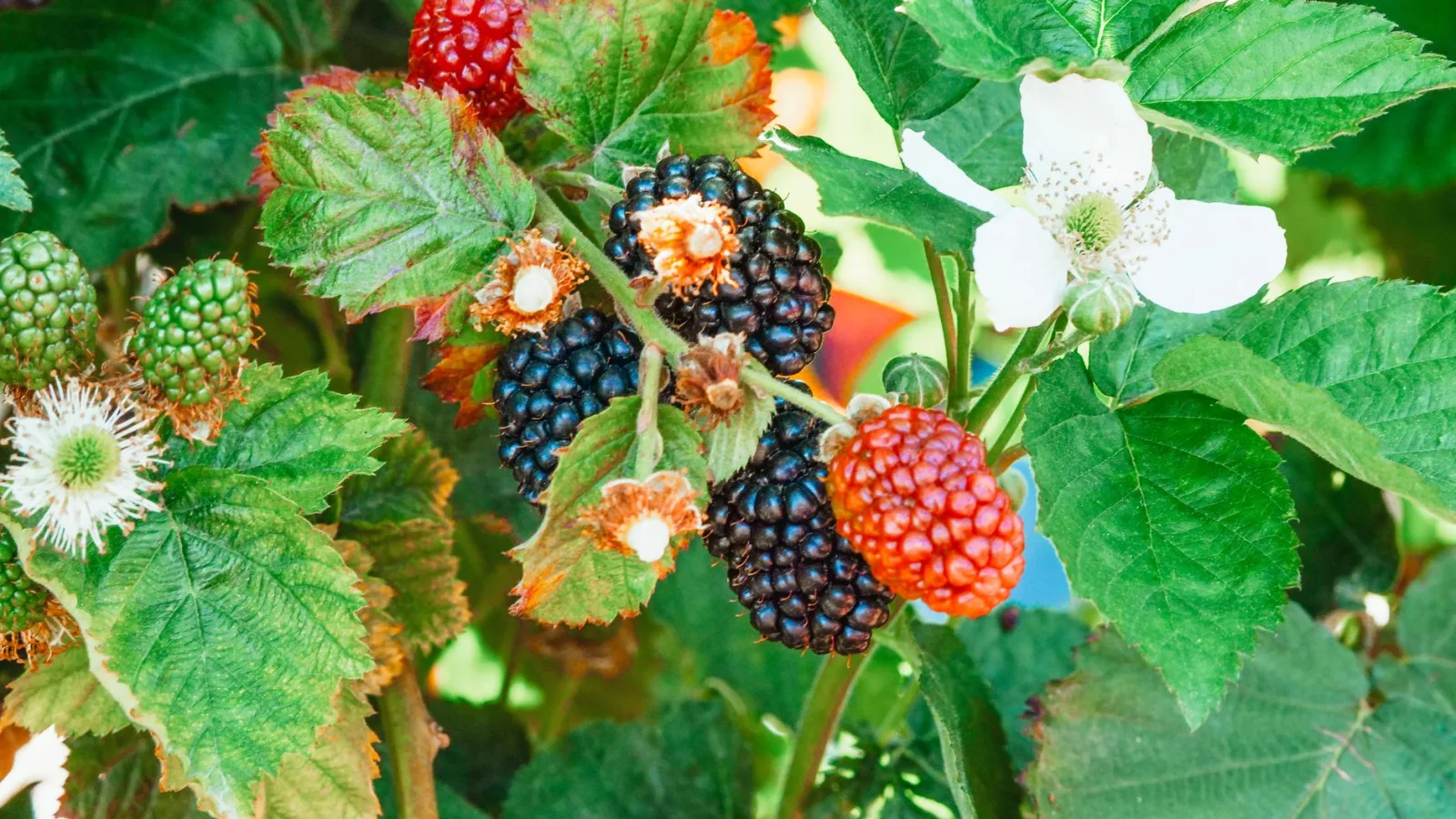
Bokbunja is a bramble of the genus Rubus in the rose family, picked from late June as the fruit darkens to deep red. Each little drupelet in the cluster holds one hard seed, giving it a texture much like wild raspberry. The Donguibogam records it in the fruit section as 覆盆子 and reads the name as meaning an overturned bowl; it lists 蓬藟 as a separate entry rather than another name for the same fruit.
Year-Round Calendar
- 1
- 2
- 3
- 4
- 5
- 6
- 7
- 8
- 9
- 10
- 11
- 12
- 3
- 11
- 6
- 7
Where It Grows
-
Main producer
Commercial field cultivation is effectively limited to Korea. The main centers are Gochang and Jeongeup in North Jeolla, along with the South Jeolla area. Harvest June, July
- 6
- 7
- Wild population Wild plants are found in the mountains of the central and eastern regions.
- Wild population It grows on mountain foothills in the western regions.
This is an East Asian species that grows wild in the mountains of Korea, China, and Japan, and since field cultivation is almost entirely confined to Korea, the list of regions ends at three. World raspberry statistics count a different, European-native species (Rubus idaeus), so they should not be read as overlapping with the distribution of the Korean black raspberry, or bokbunja (Rubus coreanus).
- Optimum
- 15~25℃
- Range
- 5~30℃
- Hardiness
- Half-hardy
This is a bush found on mountain foothills from central Korea southward. Because the fruit is borne only on canes that grew the previous year, the next year's harvest is smaller if those canes freeze in winter. In places with cold winters, growers therefore lay the canes down and cover them with soil.
Harvested 1–2 years after planting. Seedlings planted in spring or late autumn begin bearing fruit from June–July of the following year. The fruit sets only on canes that grew the previous year, and those canes wither and die after harvest, so the crop is picked from a fresh set of canes each year.
In Korea Central Korea and south
The main growing areas are Gochang and Jeongeup in North Jeolla, together with South Jeolla. In open fields from central Korea northward, where winters are cold, the previous year's canes freeze easily and the harvest is uneven.
How to grow
- Light
- A spot with five or more hours of sun.
- Soil and depth
- Free-draining, slightly acidic soil.
- Spacing
- One plant per pot.
- Watering
- Water when the surface dries.
- Feeding
- A handful of slow-release fertilizer in March and another in July once picking is done.
- Harvest
- Pick from late June into July, taking fruit that comes away without pressure once it darkens.
What makes the difference. Bokbunja fruits on canes grown the previous year, and those canes die back after cropping. When picking ends in July, cut the spent canes off at the base and keep the new ones that came up this season for next year's crop.
Common problems
- Aphids You will see Shoot tips curl and ants march up the canes What to do Wash them off with a jet of water and pinch out the affected tips
- Gray mold You will see Gray fuzz forms on ripening fruit and it collapses What to do Pick ripe fruit promptly and open up the canopy. Keep water off the berries
This page describes how a crop is grown and used. It does not claim health effects for any food, nor is it intended to prevent or treat disease. Component and study notes are references only and do not mean the same result occurs in people. Consult a medical professional about health concerns.
Health Benefits
What the old text says. Korean black raspberry appears in the Donguibogam's fruit section as 覆盆子, recorded as neutral in nature, sweet and sour in taste, and free of toxicity. The name is explained as meaning an overturned bowl. The same section carries 蓬藟 as a separate entry, so the two names are not treated as one fruit. This is a record from a seventeenth-century medical text, not a modern medical judgement.
What has been confirmed today. Compositional analyses report cyanidin-type anthocyanins and polyphenols such as ellagic acid and ellagitannins in the fruit. Human studies remain few, so what can be said today goes no further than the composition itself.
Nutrition
- Anthocyanins (Cyanidin-type pigments) — The pigment behind the dark red colour
- Ellagic acid and ellagitannins (Characteristic of the bramble genus) — The base of the astringency
Anthocyanins The dark red color comes from cyanidin-type anthocyanins. Fully ripe fruit is deeper in color and higher in content. These pigments dissolve readily in water, which is why an infusion or juice takes on such a strong stain.
Ellagic acid and ellagitannins Rubus fruits are known for high levels of ellagic acid and related polyphenols. They concentrate in the seeds and skin, and they are the source of that slight pucker in the mouth. This compound group has been the subject of a good deal of antioxidant research.
Pairings
○ Yogurt and milk — Crushed into plain yogurt, the acidity doubles up while the dairy fat softens the astringency. The color bleeds through beautifully and the bowl needs nothing else.
○ Honey or sugar as syrup and jam — Packing ripe fruit in sugar or cooking it down as jam carries a very short season further. Pectin is on the low side, so a squeeze of lemon helps it set.
△ Drinking bokbunja wine for health reasons — Bokbunja wine is alcohol. Whatever the fruit contains, the burden of the alcohol comes along unchanged.
△ If the seeds are a problem — Every drupelet holds a hard seed, and they go down whole. Anyone with a sensitive stomach or diverticular disease may prefer to strain them out.
Varieties
- Jeonggeum No. 1 (Sapling) — A native black raspberry variety bred by the National Institute of Forest Science.
- Gochang and Jeongeup landraces (Sapling) — The regional lines long used for bokbunja wine.
Source: Donguibogam, Fruit Section (覆盆子) · National Institute of Forest Science · Rural Development Administration (nongsaro.go.kr)