

- Type
- Roots & Stems
- Difficulty
- Moderate
- Season
- Spring·Fall
- Sowing
- From seed
Balloon Flower Root (Doraji)
Platycodon grandiflorus
Platycodin saponins — a root with a bitter edge
The old medical texts called this root gilgyeong (桔梗), and it is listed under that name in the Donguibogam's Tangaekpyeon volume on materia medica — the writing of an old text, and different from how it is judged today. Its distinctive bittersweet bite comes from platycodin, a triterpenoid saponin, and because that saponin dissolves readily in water, rubbing the root with salted water and soaking it softens the taste. Most modern research applied compounds extracted from the root to cells or animals, so it cannot be carried over to the root eaten as a vegetable. Soaked roots are dressed as a side dish or stir-fried, candied in honey as doraji-cheong syrup, or simmered with Korean pear into doraji-baesuk. The plant is a perennial: nothing is dug in the year it is sown, and roots are lifted in autumn after two or three seasons of growth. When digging in the wild, note that roots of pokeweed (genus Phytolacca) have been confused with it in reported poisoning cases. Pokeweed roots are thicker and softer-fleshed, and a cut face shows overlapping concentric rings like tree growth rings. Balloon flower roots are straight and pale, and the plant carries star-shaped, five-lobed purple or white flowers facing upward in summer, while pokeweed bears small flowers lined up along a spike and dark red berries. If you are not certain, do not dig it.
Year-Round Calendar
- 1
- 2
- 3
- 4
- 5
- 6
- 7
- 8
- 9
- 10
- 11
- 12
- 3
- 4
- 10
- 11
- 10
- 11
Where It Grows
-
Main producer
It is effectively the only country that consumes the root as a vegetable on a large scale. Hapcheon and Sancheong in South Gyeongsang, Sunchang in North Jeolla, and South Jeolla are the known growing areas. Harvest October, November
- 10
- 11
- Main producer It is grown on a large scale in Anhui, Shandong, Inner Mongolia, and Dongbei (Northeast China) for the medicinal root known as jiegeng. Large volumes are also shipped to Korea.
- Wild population It grows wild in fields and on mountain foothills from Honshu southward. It is planted as an ornamental rather than for eating the root.
- Wild population Wild populations are found in the grasslands of Primorye and the southern Amur region.
Native to temperate East Asia, spanning the Korean Peninsula, China, Japan, and the Russian Far East, it cannot be pinned to any single country. The same plant holds a different place in each country: Korea digs the roots to eat as namul (a seasoned vegetable side dish), China harvests them as a medicinal herb, and Japan grows it mainly for the flowers. There are no global production statistics, as the FAO has no separate entry for it.
- Optimum
- 20~25℃
- Range
- 10~30℃
- Hardiness
- Hardy
It prefers places where summers are not excessively hot. The above-ground parts die back with frost, but the roots overwinter in the frozen ground, so the plant carries over into the next year even in Korea's central inland regions. Standing water rots the roots — with this crop, drainage comes before temperature.
Harvested 2–3 years after planting. Seed is sown in spring or autumn, the plants are grown for two or three years, and the roots are dug in autumn. The sowing month and the harvest month do not fall in the same year, and there is nothing to harvest in the first year. The crop dislikes continuous cropping — a field that has been dug must rest for several years before it can be planted again.
In Korea Nationwide
Known growing areas include Hapcheon and Sancheong in South Gyeongsang, Sunchang and Jangsu in North Jeolla, Yeosu in South Jeolla, and parts of Gangwon. Well-drained hillside fields are the best ground for it.
How to grow
- Light
- Somewhere sunny
- Soil and depth
- 30cm deep or more with good drainage
- Spacing
- 15cm
- Watering
- Sparingly. Standing water rots the root
- Feeding
- Sparingly. Rich soil gives you a soft root
- Harvest
- Lift in autumn after two or three years. The longer it stands, the thicker it is
What makes the difference. There is nothing to lift in year one. Plant it knowing this is a crop that asks for time
Why this one is harder. Two or three years to a crop, and standing water rots the root
This page describes how a crop is grown and used. It does not claim health effects for any food, nor is it intended to prevent or treat disease. Component and study notes are references only and do not mean the same result occurs in people. Consult a medical professional about health concerns.
Health Benefits
The old record — gilgyeong (桔梗). The Donguibogam, in its Tangaekpyeon volume on materia medica, lists this root under the name gilgyeong (桔梗). The name and the fact of that entry are what can be confirmed; what an old medical text wrote about the root differs from how it is judged today.
The modern research was done on extracted compounds. Research on platycodins was mostly carried out by applying compounds extracted from the root to cells or animals, a different set of conditions and quantities from the root eaten as a vegetable dish. Studies in people are scarce, so what can be stated today goes only as far as the composition.
Why the bitterness is soaked out. The bitter, sharp taste of balloon flower root comes from its saponins. Rubbing the root with salted water or leaving it to soak softens the taste, because the saponins dissolve into the water and wash away.
Nutrition
- Platycodin (The bitter compound) — A triterpenoid saponin that foams when stirred into water
- Inulin (Soluble polysaccharide) — The sugar stored in the roots of the bellflower family
Saponins (platycodins) A triterpenoid saponin gives balloon flower root its slightly bitter taste, and it foams when stirred into water. This is the same root the old medical texts wrote about under the name gilgyeong (桔梗), but modern studies in people remain scarce.
Inulin & dietary fiber Roots in the bellflower family store water-soluble polysaccharides such as inulin, and balloon flower root carries inulin along with dietary fiber. Inulin is a polysaccharide that human digestive enzymes do not break down, so it travels as far as the large intestine.
Pairings
○ Honey (doraji-cheong) — Curing doraji in honey to make doraji-cheong syrup gently masks the bitterness of the saponins while soothing the throat. It's a traditional favorite for a scratchy throat or nagging cough.
○ Korean pear (doraji-baesuk) — Simmering doraji together with Korean pear, which adds moisture and fiber, makes a folk beverage that moistens the throat and loosens phlegm. It's a common remedy for caring for the bronchial tubes in winter. Asian Pear
○ Dressed in chogochujang — Doraji that has been soaked to mellow the bitterness, then tossed in chogochujang, a tangy-sweet vinegared red-pepper paste, balances the root's slight bitterness against the bright dressing for a dish that's good for both texture and appetite.
Varieties
- White-flowered doraji (Seed) — Opens white in midsummer, and its pale, straight roots are the easiest to trim and soak for namul.
- Purple-flowered doraji (Seed) — Carries the balloon-shaped purple bloom; the root is used the same way, so plant it where the flowers are wanted too.
- Double-flowered type (Seed) — Layered petals make it an ornamental for the border; choose a single-flowered plant if the root is the goal.
Source: Rural Development Administration (Nongsaro) · Shennong Bencao Jing (Divine Farmer's Classic of Materia Medica)
Stories about Balloon Flower Root (Doraji)
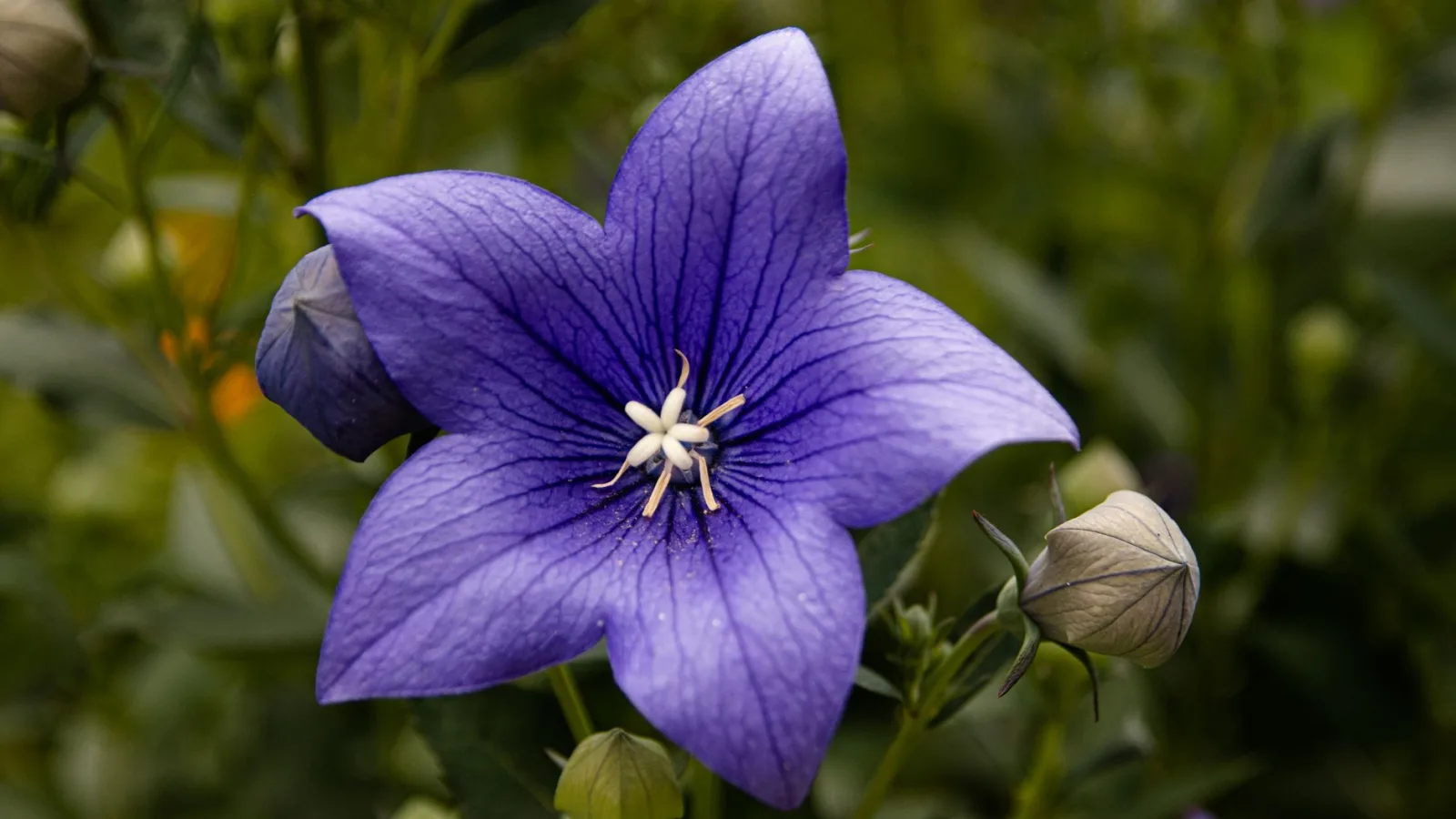
Balloon Flower Root Through the Eyes of the Donguibogam
Doraji, or balloon flower root, is a familiar Korean side dish and a traditional remedy for scratchy throats. Here's what Korea's 17th-century medical classic said about it, how that compares with modern research, and how to enjoy it at home.
Three Leaves — Time to Dig?
In much of the United States, wild ginseng can legally be dug only once a plant is five years old with three prongs. New research finds that count says surprisingly little about whether the plant will set seed or survive — a caution worth carrying into your own garden beds.