- Type
- Herbs & Aromatics
- Difficulty
- Moderate
- Season
- Fall
- Sowing
- Transplant
White chrysanthemum
Chrysanthemum morifolium
Chlorogenic acid and flavonoids · a white flower picked and dried in autumn
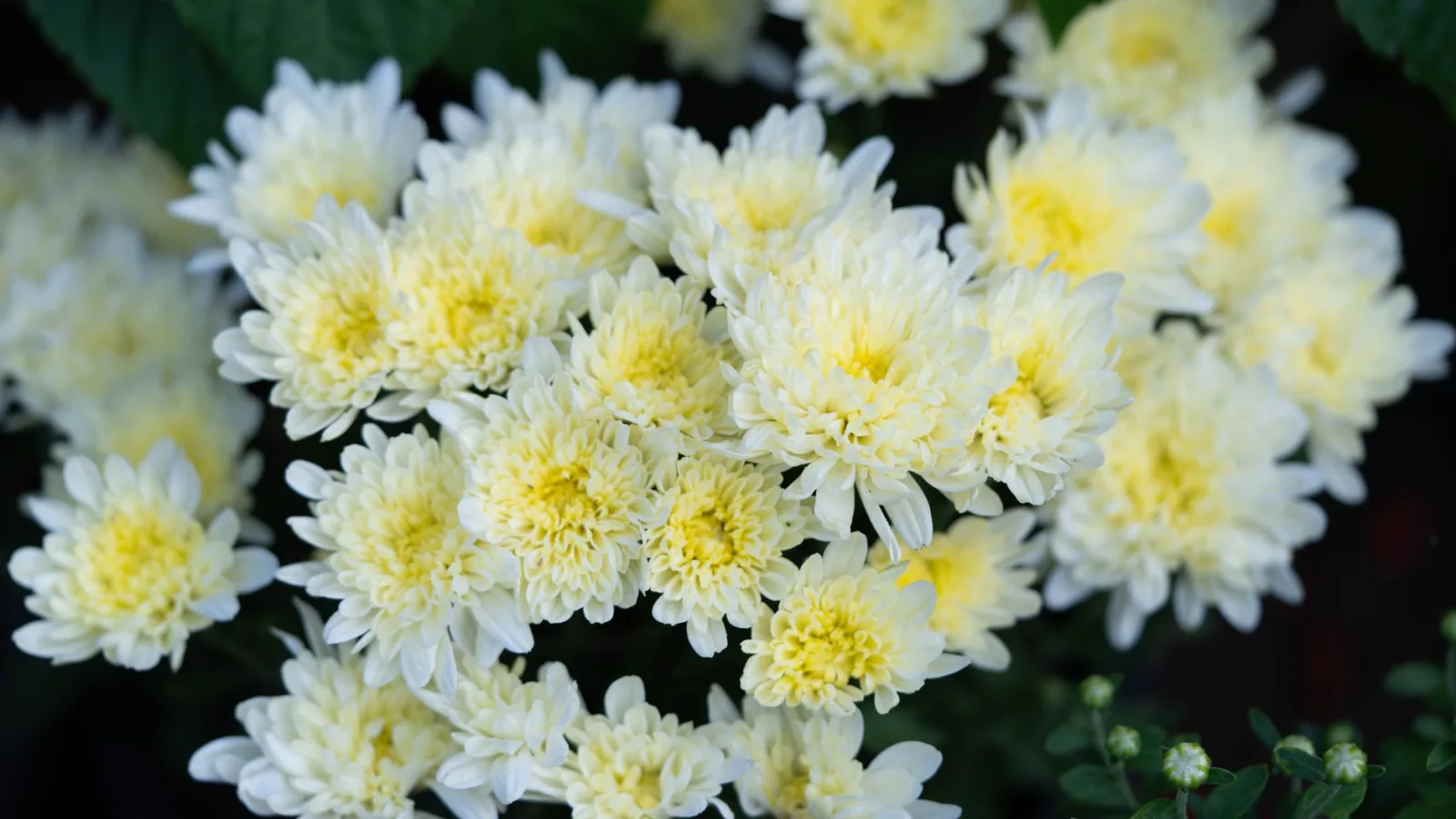
White chrysanthemum is the chrysanthemum that flowers white in autumn, its blooms picked and dried for tea. Stem and leaf are no different from the yellow kinds; only the petals are white, and the central disc stays yellow. Plant in spring and pinch the shoots two or three times in June and July, and the branching that follows carries far more flowers. Dry the picked blooms bone dry in the shade and keep them sealed, and steep them only briefly in hot water. Long steeping brings the bitterness up, so two or three short infusions work better than one long one. The Donguibogam lists Baekgukhwa (white chrysanthemum flower) in its Herb section and records the Korean name as huin gukhwa (white chrysanthemum). Stem and leaf are alike in every way and only the flower is white, it says, adding that the leaves are large and resemble mugwort leaves, the stem green, the root fine, the flower white and the disc yellow. It gives a neutral nature, a pungent taste and no toxicity, and records that the flowers are gathered in the eighth and ninth lunar months and dried in the sun.
Year-Round Calendar
- 1
- 2
- 3
- 4
- 5
- 6
- 7
- 8
- 9
- 10
- 11
- 12
- 4
- 5
- 10
- 11
Where It Grows
-
Origin
Home of the cultivated form bred from a mix of several wild chrysanthemums, and still the world's largest producer. Hangbaiju from Tongxiang in Zhejiang, Gongju from Huangshan in Anhui and Huaiju from Jiaozuo in Henan are the best known. Harvest October, November
- 10
- 11
-
Major producer
Yeonggwang and Haenam in South Jeolla and Sancheong in South Gyeongsang, among others, grow flowers for tea. Harvest October, November
- 10
- 11
- Major producer Yamagata and Aichi grow edible chrysanthemums.
- Major producer The Hangju fields of Tongluo in Miaoli are well known.
It is a cultivated form that arose in China from a mix of several wild chrysanthemums, so it has no separate wild place of origin; China, being identifiable as a country, is entered on the origin row. China still dominates production of the dried flowers, with Korea, Japan and Taiwan following. Ornamental chrysanthemums are grown everywhere in the world, but only the growing regions that pick and dry the flowers for use are included here.
- Optimum
- 15~22℃
- Range
- 5~30℃
- Hardiness
- Hardy
- Day length
- Short-day
This is a classic short-day crop: the flower buds only set once the days grow shorter. It blooms in autumn as the nights lengthen, and if light from something like a street lamp reaches it at night, flowering comes late or the buds never set at all. Once the heads have set, frost spoils the color of the flowers, so they are picked before it arrives. The roots overwinter in open ground.
In Korea Nationwide
Seedlings go in during April and May, and the heads are picked in October and November, just before they open fully. Yeonggwang and Haenam in South Jeolla and Sancheong in South Gyeongsang, among others, grow flowers for tea. Frost spoils the color of the flowers, so they are harvested before it comes.
How to grow
- Light
- Full sun all day. Flower buds set as the autumn nights lengthen, so keep it away from bright street lighting at night
- Soil and depth
- Free-draining soil at least 25cm deep. It does well in a pot
- Spacing
- 40cm between plants. Pinched out to branch, a plant spreads wide
- Watering
- Soak it when the surface dries. Dry ground after the buds set gives smaller heads
- Feeding
- Compost at planting and a weak feed every fortnight until August. Stop once flowering begins
- Harvest
- October and November. Cut the heads just before the flowers open fully. The Donguibogam records gathering in the eighth and ninth lunar months. Frost spoils the colour, so pick ahead of it
What makes the difference. Spread picked flowers in a single layer, dry them bone dry in the shade and seal them. To brew, steep about a minute in hot water and pour off
Why this one is harder. Without two or three pinchings in June and July the plant runs up a single stem and carries few flowers. Pinching makes it branch, and the number of heads rises sharply
Common problems
- Aphids You will see Colonies on new shoots and buds, turning sticky What to do Wash them off with water. Do not spray a plant whose flowers are to be drunk
- Powdery mildew You will see White dust on the upper leaves towards the end of summer What to do Widen the spacing and thin the lower leaves for airflow. Remove affected leaves and water at the base
- Chrysanthemum longhorn beetle You will see The upper stem wilts suddenly and snaps over What to do Cut below the break and discard the stem with the grub inside. Left alone, the remaining stem sends up side shoots
This page describes how a crop is grown and used. It does not claim health effects for any food, nor is it intended to prevent or treat disease. Component and study notes are references only and do not mean the same result occurs in people. Consult a medical professional about health concerns.
Health Benefits
The old record — baekgukhwa (白菊花). The Donguibogam lists it in the Herb section as Baekgukhwa (white chrysanthemum flower) and records the Korean name as huin gukhwa (white chrysanthemum). Stem and leaf are alike in every way and only the flower is white, it says. For form it gives large leaves resembling mugwort leaves, a green stem, a fine root, white petals and a yellow disc. It sets down a neutral nature, a pungent taste and no toxicity, and records that the flowers are gathered in the eighth and ninth lunar months and dried in the sun. What an old medical text wrote differs from how it is judged today.
Polyphenols of the chrysanthemum flower. Food analyses report the detection of chlorogenic acid and luteolin- and apigenin-type flavonoids in chrysanthemum flowers. These are compositional analyses and have no bearing on disease.
A record divided by flower colour. The original separates the white chrysanthemum from the yellow on the ground that stem and leaf are alike and only the flower differs. White-flowered chrysanthemum and gamguk are still handled separately today. This concerns naming and distinction.
Nutrition
- Chlorogenic acid (reported from chrysanthemum flowers) — a polyphenol identified in brewed chrysanthemum tea
- Flavonoids (petals and disc) — a compound group reported as luteolin and apigenin types
- Essential oils (in the dried flower) — the compound group behind the chrysanthemum scent
Steeping time decides the taste Dried chrysanthemum wants a short steep in hot water to put the scent in front. Left to sit, bitterness and a dull, flat note come up together. Two or three short infusions beat one long one.
Polyphenols in the flower Analyses report the detection of chlorogenic acid and luteolin- and apigenin-type flavonoids in chrysanthemum flowers. The colour of the brew and its bitterness are discussed alongside that group. This entry stays with the compositional record.
How it is dried Spread picked flowers in a single layer and dry them in the shade. Sun browns the petals, and hard heat drives off the scent. Once bone dry, seal them and keep them cool; discard any stock that has gone damp, as mould follows.
No caffeine Chrysanthemum tea is an infusion of flowers rather than tea leaves, so it carries no caffeine. That is the point usually made in its favour for evening drinking. Sugar or honey added to it, of course, is sugar added to the cup.
Pairings
○ Two short infusions — Pour hot water over three or four dried flowers and pour it off within a minute. The second infusion is often said to be the most fragrant. From the third the flavour thins.
○ Goji berries or jujube — A few goji berries or jujubes steeped alongside add sweetness and make the cup easier to drink. Pit the jujubes first. Add the chrysanthemum last and keep its steep short. Goji Berry · Jujube
○ A spoon of honey — If bitterness remains, stir in a little honey once the infusion is done. Adding it after the cup has cooled slightly keeps more of the scent. For children, brew it very weak.
△ Ornamental chrysanthemums from pots and beds — Florist pot plants and bedding chrysanthemums have almost always been sprayed in production, so they are not used for tea. Take flowers to drink only from plants raised for that purpose from the start. Treat flowers used at funerals or events the same way.
△ Pyrethrum and gujeolcho — not every daisy is chrysanthemum tea — Pyrethrum, Tanacetum cinerariifolium, is grown for its insecticidal compounds; it flowers white and is not used as tea. Gujeolcho also flowers white but belongs to a different group. Do not choose tea material by flower colour alone — check the leaf shape and the label together. If you are not certain, do not pick.
△ Daisy-family allergy — Chrysanthemum belongs to the daisy family, and people allergic to mugwort or ragweed pollen sometimes react to plants in that family. On a first try, brew it very weak and take one mouthful; if the mouth swells or hives appear, stop at once and seek medical care. Do not offer it to a child first.
Varieties
- White chrysanthemum lines (seedling) — White-flowered chrysanthemums grown for tea. Even heads with a yellow disc
- Gamguk (Chrysanthemum indicum) (seedling) — A different species with yellow flowers. The Donguibogam likewise divides them by flower colour
- Sanguk (Chrysanthemum boreale) (seedling) — The wild yellow chrysanthemum of hills and fields. Smaller heads than gamguk
- Gujeolcho (Chrysanthemum zawadskii) (seedling) — White-flowered but a different group. Broader petals and deeply cut leaves
Source: Donguibogam, Herb Section 白菊花 · Rural Development Administration (Nongsaro)