- Type
- Grains
- Difficulty
- Moderate
- Season
- Fall·Winter
- Sowing
- From seed
Wheat
Triticum aestivum
Gluten and fiber · sown in autumn, standing through winter
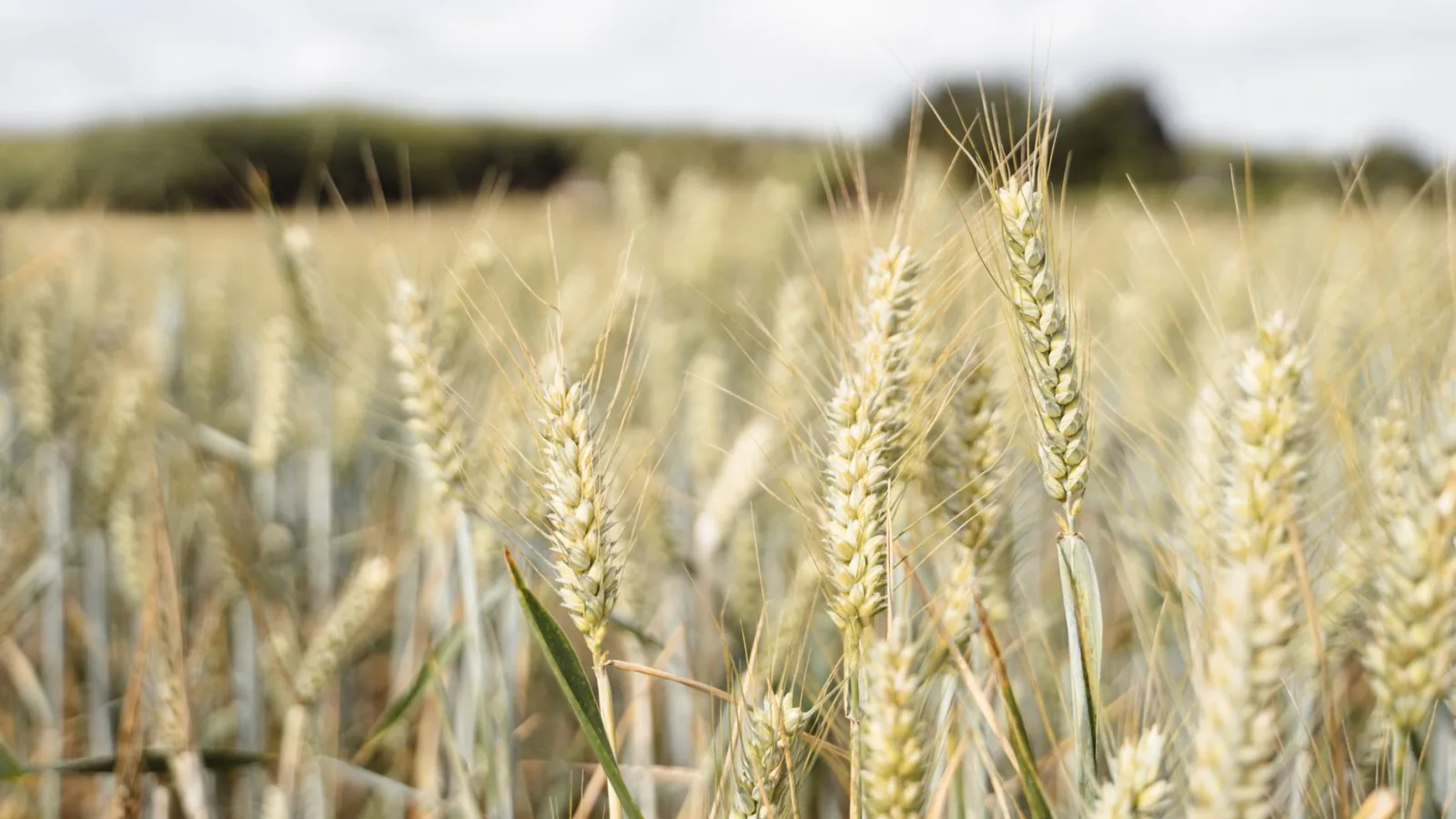
Wheat is sown in autumn, sits through the winter, and is cut the following early summer. Drilled into a corner of a plot or a large box planter, it keeps a strip of green over ground that would otherwise sit bare until spring. The Donguibogam lists it in the Grains section as 小麥 (somaek), calling its nature slightly cold — or neutral, by another account — its taste sweet, and recording no toxicity. The same text gives a handling note: the husk is cold and the inside hot, so when wheat goes into a decoction it should be used whole, with the husk left unbroken. It sets out the life cycle in one line — sown in autumn, growing in winter, heading in spring, ripening in summer — and rates wheat highly among the grains for taking in the character of all four seasons.
Year-Round Calendar
- 1
- 2
- 3
- 4
- 5
- 6
- 7
- 8
- 9
- 10
- 11
- 12
- 10
- 11
- 6
Where It Grows
-
Main producer
A winter wheat belt centred on the North China Plain in Henan, Shandong and Hebei. China is both the world's largest producer and its largest consumer. Harvest May, June
- 5
- 6
-
Main producer
In Punjab, Haryana and Uttar Pradesh, wheat is planted in the cool dry season and harvested before the heat arrives. Harvest March, April
- 3
- 4
-
Main producer
The crop divides between winter wheat on the southern black-earth belt and spring wheat in Siberia; Russia is the world's largest exporter. Harvest July, August
- 7
- 8
-
Major producer
The crop divides between winter wheat on the Great Plains, centred on Kansas, and spring wheat in North Dakota. Harvest June, July, August
- 6
- 7
- 8
-
Major producer
Centred on the Paris Basin, France is the largest producing country in Europe. Harvest July, August
- 7
- 8
-
Major producer
Grown in the dry country of Western Australia and the southeast. Being in the southern hemisphere, it is sown in April–June and harvested in late spring, so the harvest season is the reverse of the northern hemisphere's. Harvest November, December, January
- 1
- 11
- 12
Wheat comes from the Fertile Crescent of West Asia — the belt running from what is now southeastern Türkiye through Syria and northern Iraq — so it cannot be pinned to any single country, and no country-of-origin row has been given here. Domesticated there some ten thousand years ago, it spread to Europe, India and China, and in modern times the great plains of the Americas and Oceania became the largest producing regions. Because those regions are scattered across the northern and southern hemispheres, harvests run from March (India) to January of the following year (Australia), which is why wheat reaches the international market year-round.
- Optimum
- 15~22℃
- Range
- 3~32℃
- Hardiness
- Hardy
- Day length
- Long-day
Wheat is a cool-climate grain. Sown in autumn, it passes the winter as a young plant, and under a covering of snow it can survive down to −20℃; it needs that spell of winter cold before it will head in spring. From heading onward it wants long days, and frequent rain during ripening spoils the grain.
In Korea Central Korea and south
Because wheat is sown in autumn and overwinters (passes the winter) as a young plant, it does badly in mountain areas where winters are severely cold. Gwangju and South Jeolla, along with North Jeolla, account for most of the country's cultivation, followed by South Gyeongsang and South Chungcheong.
How to grow
- Light
- Five hours or more. Low winter sun is enough to carry it through
- Soil and depth
- At least 20 cm deep and free-draining. On acid ground, work in lime two weeks before sowing
- Spacing
- Drill in rows 20 to 25 cm apart, seeds 3 to 5 cm apart, covered with 2 to 3 cm of soil
- Watering
- Water right after sowing and again around heading in spring. Through winter it needs almost none
- Feeding
- Work in base fertilizer at sowing, then top-dress once in late February or early March as growth restarts
- Harvest
- Cut when heads and stems have both gone gold and a grain is hard between the teeth, in mid to late June
What makes the difference. Tread the seedlings once at the start of winter, when they are 5 to 6 cm tall. It settles the roots into the soil, curbs leggy growth, and leaves the crop steadier in spring
Why this one is harder. Frost heave. Repeated freezing and thawing lifts the soil and snaps young roots. Do not sow too late, and press lifted soil back down once in midwinter
Common problems
- Fusarium head blight You will see Parts of the head turn pink and the grains shrivel to empty husks What to do If rain persists around heading, open up spacing for airflow. Remove affected heads separately and do not eat them
- Aphids You will see Small insects lined up along heads and leaves What to do Wash them off early with a jet of water, and leave any ladybirds that arrive
- Powdery mildew You will see White patches spreading over leaves as if dusted with flour What to do Widen spacing for airflow and strip the lower leaves. Cut back on nitrogen top-dressing
This page describes how a crop is grown and used. It does not claim health effects for any food, nor is it intended to prevent or treat disease. Component and study notes are references only and do not mean the same result occurs in people. Consult a medical professional about health concerns.
Health Benefits
The Donguibogam record. The Donguibogam lists wheat in the Grains section as 小麥 (somaek). Its nature is given as slightly cold, or neutral by another account, its taste as sweet, and it is recorded as carrying no toxicity. The husk is described as cold and the inside as hot, so the grain is to be used whole in a decoction with the husk unbroken; flour (麪) is set down as hot and bran (麩) as cold. The text records the life cycle — sown in autumn, growing in winter, heading in spring, ripening in summer — and distinguishes autumn-sown wheat from wheat spring-sown in warm country and cut in summer, which it says takes in less of that character and carries toxicity. This is an old medical record and differs from modern medical judgment.
Long fermentation and phytic acid. Studies have reported that long lactic fermentation of wheat dough lowers phytic acid and increases how readily minerals dissolve out. The same work notes that the size of the reduction varies greatly with fermentation time, temperature and the strains involved.
Wheat bran fiber and gut transit. Studies going back decades have reported that wheat bran fiber changes stool bulk and gut transit time. The reports add the caveat that discomfort increases rather than eases if water intake is not raised alongside it.
Nutrition
- Gluten (gliadin and glutenin) (8 to 14 percent protein in flour) — Elasticity and stretch in dough
- Arabinoxylan (Main fiber of the bran) — Holds a large amount of water
- Ferulic acid (Outer layer) — Phenolic acid retained in wholemeal
- Minerals (magnesium, selenium) (Concentrated in bran and germ) — Varies widely with soil
The dough that gluten builds Most wheat protein is gliadin and glutenin. Add water and work the dough and the two tangle into a gluten network that traps fermentation gas, which is what lifts a loaf. Strong flour is usually set above 12 percent protein and cake flour below 10. Even with one flour, kneading time and hydration change how the network behaves. Gliadin is the antigen at issue in coeliac disease, and wheat is a declarable allergen, so processed foods carry its name on the label.
Fiber in the bran The outer bran layer concentrates insoluble fiber, arabinoxylan chief among it. Wholemeal flour mills that layer in, so it carries far more fiber than white flour. The trade-off is mechanical: bran fragments cut the gluten network, and wholemeal dough rises less. That is why blends of roughly 30 percent wholemeal are so common.
Ferulic acid in the outer layer Wheat is among the cereals richest in ferulic acid, most of it in the outer layer. Nearly all of it is bound to cell-wall arabinoxylan, so little is absorbed when the grain is eaten as is. Milling the outer layer away removes it. This is where wholemeal and white flour part company in composition.
Wheatgrass is not a grain Sown thickly and cut at 10 to 15 cm, the young leaf is sold as wheatgrass. It behaves like a leafy green, mostly water and chlorophyll, with no gluten in the blade itself. A week on a damp cloth is enough, with no soil at all. Grown at home, though, kernels and seed coat mix in easily, so cut the blades alone and leave the grain behind; where coeliac disease has been diagnosed, home-grown wheatgrass is not advised. The same seed yields two entirely different foods.
Pairings
○ Beans and lentils — Wheat protein is short on lysine while beans and lentils carry plenty, so eating them together fills out the amino acid profile. Korean kongguksu, wheat noodles in cold soybean broth, and bread with lentil soup work on the same principle. Grain-and-legume pairings recur across many food cultures. Soybean
○ Olive oil and nuts — Dipping wholemeal bread in olive oil, or working nuts into the dough, adds fat that softens the coarse crumb. Fat also stretches out how long the bread satisfies. Chop nuts coarsely so they cut the gluten network less.
○ Long fermentation (sourdough) — Fermenting wheat dough with lactic acid bacteria over many hours builds sourness and aroma, and analyses report that phytic acid in the dough falls. It is a method that spends time instead of ingredients. Twelve hours at room temperature or a day in the refrigerator is the range most home bakers can hold.
△ Coeliac disease and wheat allergy — Gliadin, one of the gluten proteins, is the antigen at issue in coeliac disease. Wheat is a declarable allergen, so processed foods name it on the label and the label is the thing to read first. With a diagnosis, flour and wholemeal go, and so do barley and rye, which carry proteins of the same family; soy sauce, batter, noodles and breadcrumbs all need checking, since wheat hides easily in them. Wheatgrass is a leaf and carries no gluten of its own, but seed can travel with it, so that label needs checking too. Home-grown wheatgrass has no label to check and mixes in kernels and seed coat readily, so it is not advised where coeliac disease has been diagnosed.
Varieties
- Geumgang (seed) — Higher-protein Korean variety used for bread flour
- Saegeumgang (seed) — Successor variety bred from Geumgang
- Jogyeong (seed) — Korean variety bred for baking performance
- Anjeunbaengi (seed) — Short-strawed Korean landrace
Source: Donguibogam, Grains section, 小麥 · Rural Development Administration (Nongsaro)