- Type
- Mushrooms
- Difficulty
- Hard
- Season
- Summer·Fall
- Sowing
- Foraged
Rock Tripe
Umbilicaria esculenta
Lichen acids and polysaccharides · the black garnish that grows on cliff rock
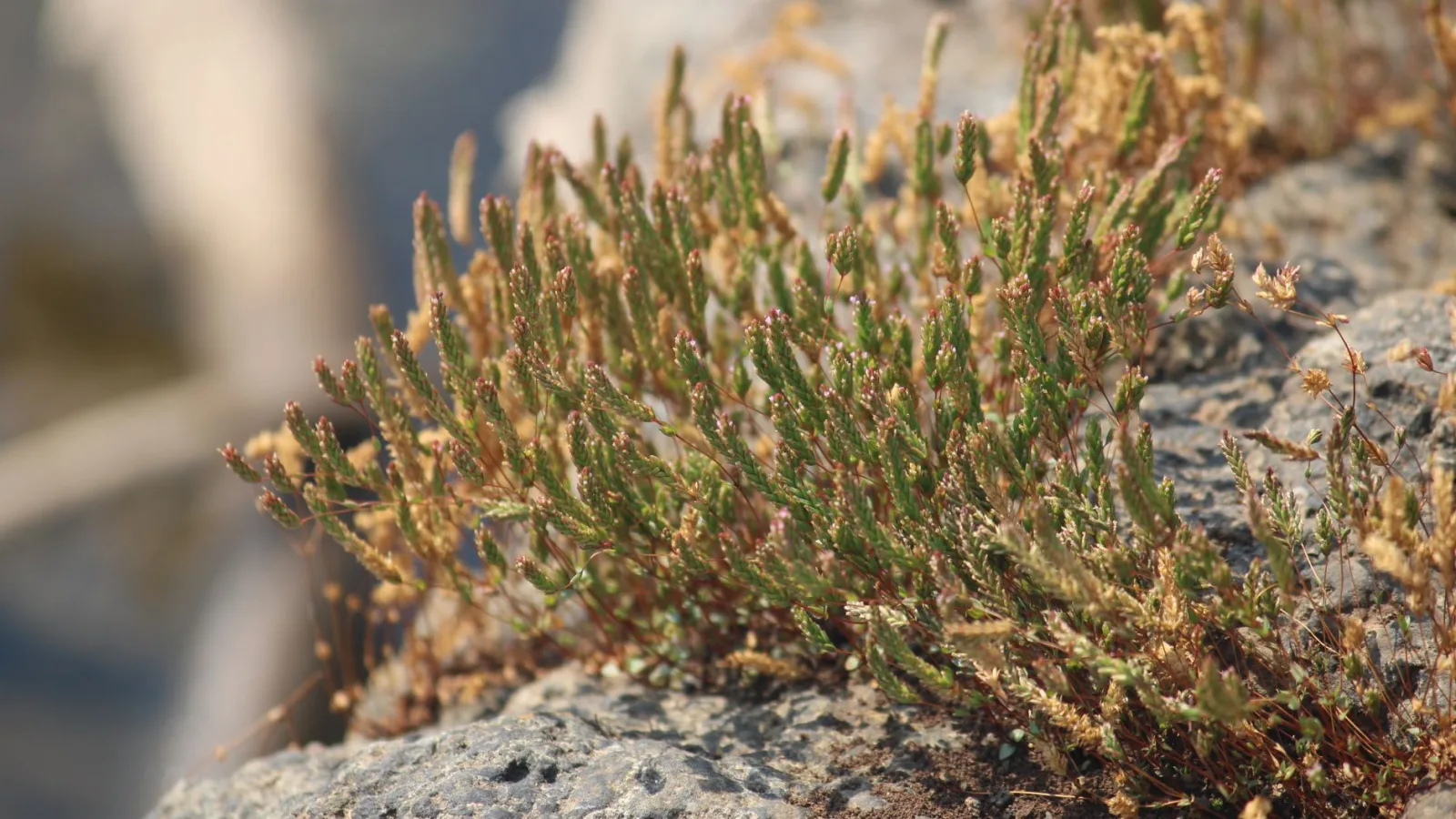
Despite the Korean name ending in mushroom, rock tripe is not a mushroom at all but a lichen, a fungus and an alga living as one. It fastens to high mountain cliff rock at a single point like a navel and hangs there in black, leathery sheets, growing so slowly that a stripped patch takes years to come back. The Donguibogam lists it in the Vegetable section as 石耳, and the Korean name seogi-beoseot carried through; the text sets down a cold nature, with a note that some call it neutral, a sweet taste and no toxicity. It records that the lichen grows on the rock cliffs of famous mountains and adds that it is also called yeongji, which is not the mushroom called yeongji today. At banquets it served as the black garnish, shredded fine and laid like threads over japchae and rice cakes. It is also the black among the garnishes set on a sinseollo hot pot. Dried rock tripe is soaked in lukewarm water, the navel on the underside is picked off, and it is rubbed and rinsed until the black water runs clear, or an earthy note stays behind. Gathering it meant hanging off a cliff on a rope, and accidents were frequent, so buying the dried material is the safer way to get it.
Year-Round Calendar
- 1
- 2
- 3
- 4
- 5
- 6
- 7
- 8
- 9
- 10
- 11
- 12
- 7
- 8
- 9
Where It Grows
-
Wild population
It grows clinging to high mountain rock cliffs in Gangwon and North Gyeongsang, and is gathered in summer and autumn. Harvest July, August, September
- 7
- 8
- 9
- Wild population It is harvested as seogi, or "stone ear," on Huangshan in Anhui and in the rocky mountains of Zhejiang and Hunan.
- Wild population Known there as iwatake, it is harvested from granite cliffs in the mountains.
An East Asian lichen distributed across mountain rock cliffs in Korea, China and Japan. There is effectively no way to cultivate it, so everything that reaches the market is gathered from the wild, and there are no production figures by country. Because it grows slowly, a rock face stays bare for a long time wherever harvesting concentrates, and collection is restricted in national parks and private forests.
- Optimum
- 10~20℃
- Range
- 0~25℃
- Hardiness
- Hardy
- Day length
- Not applicable
It is a lichen — a fungus and an alga living together — so it clings to rock rather than soil. It takes up residence on high mountain cliffs where fog and dew are frequent, growing only while it is wet; when it dries out it stops growing and simply endures. It grows so slowly that a rock face once stripped stays bare for several years.
In Korea Mountain areas
It is gathered from high mountain rock cliffs in Gangwon and North Gyeongsang in summer and autumn. It is especially plentiful on fog-prone north-facing cliffs.
How to grow
- Light
- It grows on high mountain cliff rock reached by both sun and mist. There is effectively no way to cultivate it
- Soil and depth
- Nothing grows in soil here. It attaches to bare rock at a single central point on its underside and hangs in leathery sheets
- Spacing
- Markets sell it dried by the bag. Choose large intact pieces with little rock grit on the underside
- Watering
- Soak the dried material in lukewarm water for twenty to thirty minutes. Hot water softens the texture; cold water works too slowly
- Feeding
- There is no feeding. It grows very slowly on rain and mist and the minerals of the rock
- Harvest
- It is taken after rain, when it has drawn up water and turned pliable; picked bone dry it crumbles. Cliff gathering is dangerous, though, so buying it is the safer route
What makes the difference. After soaking, pick off the navel and rub it between both hands, rinsing until the black water runs clear. Shred it and give it a brief turn in a dry pan to lift the scent and drive off water
Why this one is harder. It grows on cliff faces, which makes gathering hazardous in itself, and it grows so slowly that one sweep leaves the rock bare for years. Collection is restricted in private forest and national parks, so this is an ingredient to buy and prepare rather than to grow or gather
Common problems
- Rock grit and moss You will see The soaking water runs black and something like sand settles at the bottom What to do Pick the navel and the clinging grit off the underside by hand, then rub and rinse through changes of water. Repeat until the last water runs clear
- Damp and mould You will see A musty smell from the dried pieces and white patches on the surface What to do Store sealed with a desiccant somewhere cool. Discard anything that has picked up a smell
- Crumbling You will see Black powder collecting at the bottom of the bag and pieces broken small What to do Do not handle it roughly while dry. Cut after soaking rather than before, and put the fragments toward chopped uses
This page describes how a crop is grown and used. It does not claim health effects for any food, nor is it intended to prevent or treat disease. Component and study notes are references only and do not mean the same result occurs in people. Consult a medical professional about health concerns.
Health Benefits
The old record — seogi (石耳). The Donguibogam lists it in the Vegetable section as Seogi (stone ear) and records the Korean name as seogi-beoseot. Its nature is set down as cold, with a note that some call it neutral, its taste as sweet, and it is described as having no toxicity. It records that the lichen grows on the rock cliffs of famous mountains, and adds that it is also called yeongji. It is a short entry quoting the Iryong Boncho. The yeongji named there is not the mushroom that carries the name today. What an old medical text wrote differs from how it is judged today.
What the name describes. 石耳 means ear of the rock, and it simply records the way the thallus hangs from stone like an ear. The Korean name seogi-beoseot inherited that Chinese name directly. In modern classification, though, it is handled not as a mushroom but as a lichen, a fungus and an alga living together.
Compounds reported in the genus. Gyrophoric-acid-type lichen acids and polysaccharides have been isolated from Umbilicaria species in repeated analyses. Lichen acids are treated as a group of compounds arising in lichens, and measurements report that the profile differs between species. These are compositional analyses and nothing beyond that.
Nutrition
- Lichen acids (reported in the genus Umbilicaria) — gyrophoric-acid-type compounds particular to lichens
- Polysaccharides (structural material of the thallus) — polysaccharides reported in lichens
- Dietary fibre (concentrated in the dried form) — the fibre behind the leathery texture
- Minerals (taken from rock and rainwater) — minerals that accumulate in lichen tissue
A lichen, not a mushroom The name says mushroom, but this is a lichen — a fungus and an alga living as one organism. It grows on rock rather than soil or wood, fastened at a single point like a navel. Growth is very slow, and a stripped patch takes years to return.
Soaking and rubbing clean Soak the dried material in lukewarm water for twenty to thirty minutes. Pick off the navel and the rock grit at the centre of the underside, then rub it between both hands and rinse repeatedly until the black water runs clear. Skip that step and an earthy taste and a gritty bite stay in the dish.
Compounds reported in lichens Analyses report the isolation of gyrophoric-acid-type lichen acids and polysaccharides from the genus Umbilicaria. Lichen acids are treated as a group of compounds particular to lichens. This entry stays with the compositional record.
Why it works as a garnish The colour is a deep black, and shredded it separates into fine threads that take the dark place on japchae, rice cakes and sinseollo. The aroma is restrained and the texture stays thin in the bite. A brief turn in a dry pan lifts the scent and drives off water so the garnish does not go limp.
Pairings
○ The black garnish on japchae and rice cakes — Shred the soaked, rinsed lichen finely over japchae or fold it into rice cake dough. It divides the colours alongside yellow egg strips and red chilli threads. Thick shreds chew tough, so cut as fine as you can.
○ Sinseollo and hot pot garnish — Gather the shreds into one section on top of a sinseollo. The colour holds without bleeding even as the broth simmers, so the arrangement stays put. Add it last so the texture survives.
○ Sesame oil and salt — Dress the shreds lightly with nothing but sesame oil and salt before setting them on. A light hand keeps it from clashing with the other garnishes. A brief turn in a dry pan removes the water so the garnish does not sag.
△ Do not gather it off a cliff — Rock tripe grows on cliff faces, and gathering it on a rope has caused accidents for as long as it has been eaten. It is not ground for an individual without equipment, so do not set out to collect it yourself. Buying the dried material at a market is the normal way to handle this ingredient.
△ Not from private forest or national parks — Forest products belong to whoever owns the mountain, and gathering is restricted outright inside national parks and protected areas. Rock tripe grows so slowly that one clean sweep leaves that rock bare for years. Do not touch it outside ground where you have permission.
△ Not every black lichen is rock tripe — Several species of black lichen grow on rock and they resemble one another. Rock tripe attaches at a single central point on the underside and hangs in a leathery sheet, black and rough beneath, sometimes reaching the size of a palm. If you are not certain, do not pick — and when buying, check the origin and the state of the pieces together.
Varieties
- Dried, whole pieces (form) — Large intact sheets, the right material for shredding into a garnish
- Dried, broken pieces (form) — Small fragments. Cheaper, and suited to being chopped rather than shredded
- Domestic versus imported (grade) — Origin is marked on the bag. The two differ in piece size and in how much rock grit clings to the underside
Source: Donguibogam, Vegetable Section 石耳 · National Institute of Forest Science · Korea National Arboretum