- Type
- Grains
- Difficulty
- Easy
- Season
- Fall·Spring
- Sowing
- From seed
Oat
Avena sativa
Beta-glucan · sown in autumn, cut in early summer
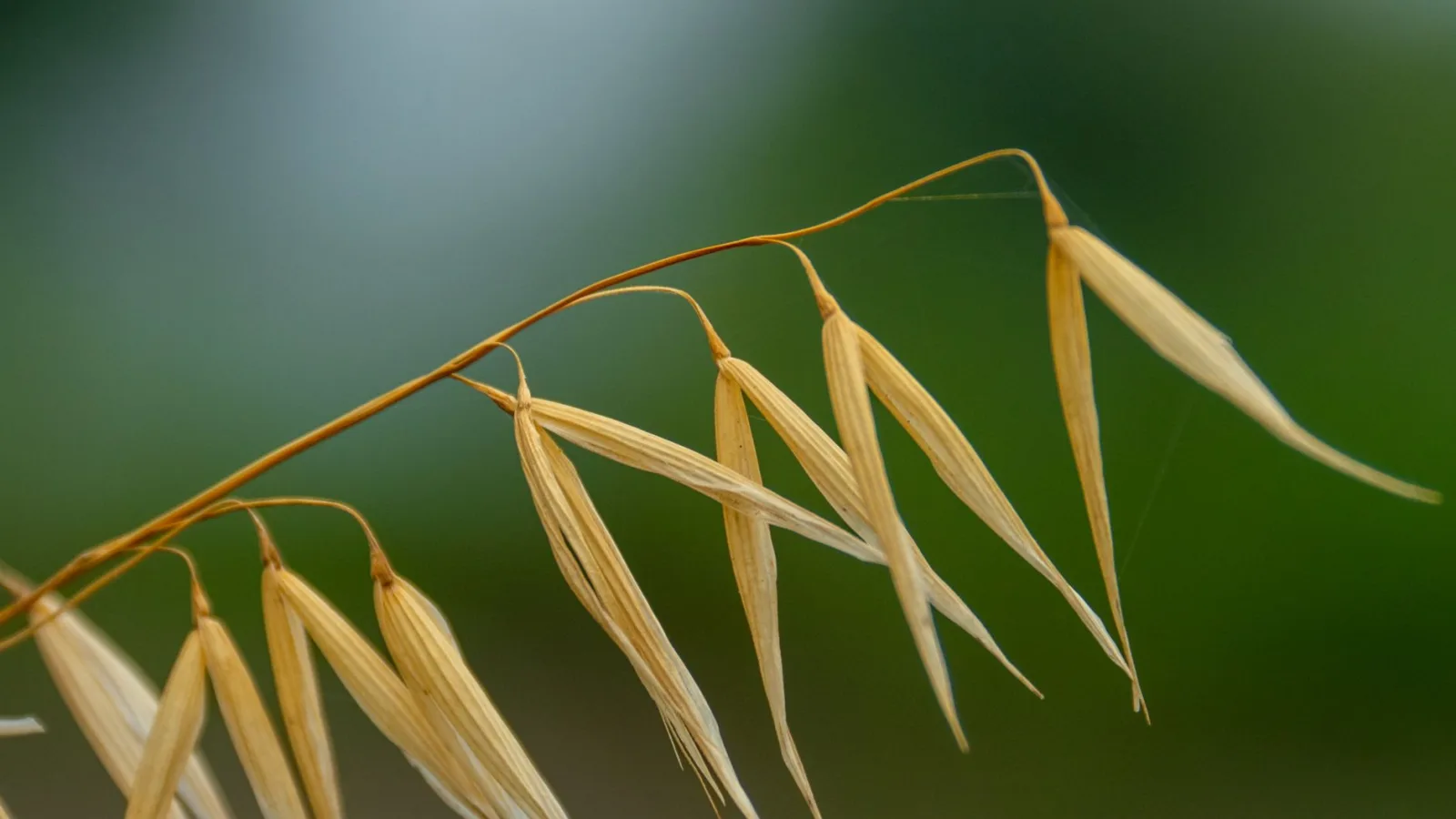
Oats are an annual grass grown as grain: sown in October and overwintered in Korea's south for a June cut, or spring-sown in March further north. The head does not bunch like barley but branches out into dangling bells, which makes the crop easy to pick out from across a field. Naked oats, whose hulls come away cleanly, go into rice; hulled oats mostly go to livestock forage. The cat grass sold in shallow trays is the same plant, reaching 10cm indoors in seven to ten days. The Donguibogam lists it in the Herb section as 雀麥, neutral in nature, sweet in taste and without toxicity, also called 燕麥, with seedlings like wheat but weaker, grain like hulled barley (穬麥) but slimmer, and a fine, long, sparse head.
Year-Round Calendar
- 1
- 2
- 3
- 4
- 5
- 6
- 7
- 8
- 9
- 10
- 11
- 12
- 3
- 10
- 6
- 7
Where It Grows
-
Main producer
The cool grain belts of western Siberia and the Volga region are the centre of production. Harvest August, September
- 8
- 9
-
Main producer
The western prairies (Saskatchewan and Manitoba) are the centre of production and lead the world in oat exports. Harvest August, September
- 8
- 9
-
Major producer
Spring oats are grown on the sandy soils of the north and east. Harvest July, August
- 7
- 8
-
Major producer
With short, cool summers, the country suits oats well and is one of the pillars of European oat exports. Harvest August, September
- 8
- 9
-
Major producer
Being in the southern hemisphere, its harvest coincides with early winter in Korea. Alongside grain, exports of hay oats are substantial. Harvest November, December
- 11
- 12
-
Major producer
In the Castile region, oats are sown in autumn and cut in early summer. Harvest June, July
- 6
- 7
Oats descend from a grass that grew as a weed among the wheat and barley fields of the Near East and the Mediterranean, so no single country is named as their place of origin. Northern Europe, Russia and Canada — where summers are cool and rainfall is even — became the main stage, and in the southern hemisphere Australia harvests on the opposite schedule to the north, keeping supply flowing year-round. A large share of the Canadian and Australian crop goes not to grain for people but to livestock feed and hay.
- Optimum
- 15~22℃
- Range
- 5~30℃
- Hardiness
- Half-hardy
- Day length
- Long-day
Oats prefer a cool climate with steady, evenly spread rainfall. They are less cold-hardy than wheat or barley, so autumn sowings in the central and northern regions are often killed by frost. Longer days trigger heading, so even spring-sown oats ripen before the height of summer.
In Korea Nationwide
In the south, oats are sown in autumn, overwinter (pass the winter in the field) and are cut in early summer; in the central and northern regions they cannot survive the winter cold, so they are sown in spring and cut before the height of summer. Gangjin in South Jeolla and Jeongseon in Gangwon are among the known growing areas.
- 10
- 11
- 6
- 3
- 7
How to grow
- Light
- Six hours of direct sun or more. In shade the stems stretch and lodge
- Soil and depth
- Almost any free-draining field soil will do. Oats tolerate acidity fairly well and still grow at pH 5.5
- Spacing
- Drill in rows 20-25cm apart, covered 2-3cm deep. On a small plot, broadcasting and raking the seed in works fine
- Watering
- Keep the ground from drying only between sowing and emergence, and again while the heads are forming. Rain covers the rest
- Feeding
- Too much nitrogen builds height and the crop goes flat in wind and rain. Work in a light base dressing and side-dress just once in spring
- Harvest
- Cut when the heads have gone golden and a thumbnail no longer dents the grain. Autumn-sown crops in the south are usually ready in June, spring-sown crops further north in July. Stand the cut crop to dry for a few days, then thresh
What makes the difference. Naked and hulled oats are used for different things. If the plan is to cook them into rice, buy a cultivar labelled as a naked oat
Why this one is harder. Winter cold is the dividing line. Autumn sowings in the centre and north often freeze out, so those regions switch to a spring sowing in early March
Common problems
- Sparrows and other birds You will see Ripening heads torn about and grain missing from the husks What to do The old name 雀麥 means sparrow barley for a reason. Net the crop as the grain fills, or run flashing tape above it
- Fusarium head blight You will see Parts of the head turn pink and the grain shrivels What to do Rain at harvest is the cause. Ensure drainage and airflow, cut discoloured heads out and discard them separately, and dry the crop hard after cutting
- Aphids You will see Colonies on leaves and young heads, with yellow mottling on the foliage What to do Wash them off with a jet of water and leave the ladybirds alone. Use an approved organic product if it recurs
This page describes how a crop is grown and used. It does not claim health effects for any food, nor is it intended to prevent or treat disease. Component and study notes are references only and do not mean the same result occurs in people. Consult a medical professional about health concerns.
Health Benefits
What the Donguibogam records — nature, taste, names and form. The Donguibogam lists the plant in the Herb section as 雀麥. It gives a neutral nature, a sweet taste and no toxicity. It notes the alternative name 燕麥 and describes the seedling as resembling wheat but weaker, the grain as resembling hulled barley (穬麥) but slimmer, and the head as fine, long and sparse. Some readers today take this 雀麥 to be the wild oat rather than the cultivated crop. This is a historical medical record and differs from modern medical judgment.
Viscosity analyses of beta-glucan. Physical studies measuring the molecular weight and solution viscosity of oat beta-glucan report that viscosity shifts with degree of processing and cooking time. It is the data behind porridge thickening as it cools. This is a materials analysis and has nothing to do with disease.
Distribution of avenanthramides. Analyses report that avenanthramides are barely detectable in other cereals and sit relatively concentrated in the oat bran layer and young shoots. The same work reports a wide range in content across cultivars and growing conditions. It is a record of where a compound sits.
Nutrition
- Beta-glucan (3-5g per 100g) — a soluble fibre that thickens in water
- Protein (including avenin) (around 13g per 100g) — high protein content for a cereal grain
- Avenanthramides (trace constituents) — polyphenols found mainly in oats
- Fat (6-8g per 100g) — unusually high for a grain, with a large share of linoleic acid
Beta-glucan and viscosity Most of the soluble fibre in oats is beta-glucan, at 3-5g per 100g. Dissolved in water the chains tangle and build viscosity, which is why porridge thickens as it cools. Within the same grain, whole groats, steel-cut, rolled and instant take up water progressively faster in that order. Long cooking raises the viscosity further but the chew disappears with it.
Protein and fat Oats carry around 13g of protein per 100g, high among cereals, and 6-8g of fat, more than rice or wheat. That fat means milled oats eventually smell stale and rancid. Most rolled oats on sale are heat-treated, which knocks out the enzymes that break the fat down. At home, sealed and refrigerated oats get through a Korean summer far better.
Avenanthramides Avenanthramides are polyphenols found mainly in oats and rarely reported in other cereals. They are described as concentrated in the bran layer and the young shoots rather than the endosperm. Content varies widely with cultivar and growing conditions. This entry stays with the compositional record.
Gluten and avenin The storage protein of oats is avenin, not the gliadin of wheat. Botanically that keeps oats out of the gluten grains, but oats sold in Korea are often harvested and milled alongside wheat and barley, so cross-contact should be assumed. Anyone avoiding wheat protein should buy products that carry a specific declaration. Unlabelled bulk oats cannot be treated as safe.
Pairings
○ Soaked in milk or soy milk — Rolled oats soften overnight in cold milk or soy milk with no cooking at all. The beta-glucan releases slowly and the bowl is thick by morning. It holds its flavour for about two days refrigerated.
○ Cooked into rice — Naked oats hull cleanly enough to go into the rice pot without pre-soaking. Half a cup of oats to two cups of rice is a comfortable ratio, with a little extra water. Hulled oats are not meant for the table, so check the cultivar on the bag.
○ Cut young as cat grass — Sown thickly in a shallow tray and kept indoors, oats reach 10cm in seven to ten days. They are the usual grass grown for cats to chew, and the shoots are also cut for people. The second cut is weak, so resowing every ten days works better.
△ Coeliac disease or wheat allergy — Oats contain no wheat gliadin themselves, but wheat and barley routinely find their way in during growing and milling. Anyone diagnosed with coeliac disease or a wheat allergy should buy only products that declare cross-contact control, and should talk to their clinician before starting. There are also reports of people reacting to small amounts of avenin itself. Wheat
△ A large bowl of instant oats all at once — Oats are high in soluble fibre, so someone who normally eats little fibre may get bloating and gas from a sudden large serving. Start at about half a cup, build up, and drink water alongside. Without enough water the fullness only gets worse.
△ Heads caught by monsoon rain — Heads left in prolonged rain near harvest pick up fusarium, and the toxins it produces are not destroyed by cooking. Discard grain that shows pink or reddish tinting on the head. Once cut, dry the crop hard and store it somewhere free of damp.
Varieties
- Daeyang (seed) — A Korean-bred naked oat. The hull comes away cleanly, so it cooks into rice
- Joyang (seed) — A Korean-bred naked oat, widely used for autumn sowing in the south
- Samhan (seed) — A hulled line. Grown for bulk forage rather than the table
- Wild oat (megwiri) (seed) — Not a crop but the volunteer oat of field margins. Some read the Donguibogam's 雀麥 as this species
Source: Donguibogam, Herb Section 雀麥 · Rural Development Administration (Nongsaro) · Korean Food Composition Table