

- Type
- Legumes
- Difficulty
- Easy
- Season
- Spring
- Sowing
- From seed
Kidney Bean
Phaseolus vulgaris
Plant protein and fiber in one hearty bean
Kidney beans are loaded with plant protein and dietary fiber, which is what makes a meal built around them so filling. They also carry minerals and vitamins such as iron and folate. Cook them into rice, simmer them as a side dish, and enjoy them knowing that, as a legume, the plant adds nitrogen back to the soil. Sow in spring and harvest in summer—and always cook them thoroughly, since undercooked kidney beans are high in lectin and should never be eaten raw.
Year-Round Calendar
- 1
- 2
- 3
- 4
- 5
- 6
- 7
- 8
- 9
- 10
- 11
- 12
- 4
- 5
- 7
- 8
- 9
Where It Grows
- Main producer The largest producer in the world. Note, though, that other beans are counted alongside it under the statistical category of dry beans.
-
Main producer
The dry-season crop planted after the rice harvest is large, and most of it is exported. Harvest February, March
- 2
- 3
- Main producer As a staple food, both production and consumption are large. Planting is split across two or three cropping cycles a year.
- Major producer Grown in the cool-summer zones of North China and the Northeast.
-
Major producer
Harvested as dry beans in the dry-summer growing areas of North Dakota and Michigan. Harvest August, September
- 8
- 9
- Major producer Eaten as a staple food, with production centred on the irrigated north and the central highlands.
Its wild ancestor was domesticated separately in two places, Central America and the Andes, so the origin cannot be pinned to a single country and no origin row has been included. It reached Europe in the 16th century and spread worldwide, and today production is concentrated in Latin America, South Asia and East Africa, where the bean is a staple food. FAO's dry bean statistics do not count kidney beans alone, so other beans are mixed into the rankings.
- Optimum
- 18~25℃
- Range
- 10~32℃
- Hardiness
- Not hardy
A summer annual that frost kills. It grows best at 20~25℃, and if a run of days above 30℃ falls during flowering, fewer pods set. In the tropics it is grown on cool highlands rather than in the hot lowlands.
In Korea Nationwide
Planted in April~May and harvested in July~September. Green beans are picked when the pods are plump; dry beans are picked after the pods have yellowed and dried. In the mountainous parts of Gangwon, where summers are cool, harvest comes roughly half a month to a month later.
How to grow
- Light
- Somewhere sunny
- Soil and depth
- 25cm deep
- Spacing
- 30cm
- Watering
- Generous at flowering and while the pods fill
- Feeding
- A legume — go easy on nitrogen. Base dressing only
- Harvest
- Green when the pods are plump; dried when the pods have gone papery
What makes the difference. There are climbing and dwarf types. In a pot the dwarf is easier — no support needed
Common problems
- Aphids You will see Sticky new growth What to do Wash them off
- Stink bugs You will see Spotted pods and shrivelled beans What to do Pick them off when you see them
This page describes how a crop is grown and used. It does not claim health effects for any food, nor is it intended to prevent or treat disease. Component and study notes are references only and do not mean the same result occurs in people. Consult a medical professional about health concerns.
Health Benefits
What the composition shows. Dried kidney beans are high in protein and dietary fiber, with an amino acid profile relatively rich in lysine, the amino acid grains lack. Minerals and vitamins such as iron and folate are detected alongside them. That is as far as the compositional analysis goes.
The research pooled legumes as a group. Clinical trials and meta-analyses examining blood lipids have been reported, but most of them pool legumes as a group rather than isolating kidney beans, and the trials are noted as uneven in design quality. What can be said today goes no further than the fact that such research exists, and it has nothing to do with preventing or treating disease.
Post-meal blood sugar and starch composition. Kidney beans are classed among foods with a low glycemic index, and their composition is discussed alongside that fact: part of the starch passes undigested to the large intestine. Human trials examining post-meal blood sugar curves have been reported, but that does not mean the food manages any particular disease.
Undercooked beans are hazardous. Raw kidney beans are high in the lectin phytohaemagglutinin, and eating them without thorough cooking can bring on nausea, vomiting and diarrhea. Soaking them well and then boiling them hard is the heart of safety here; cooking that only holds them at a low temperature for long stretches has been reported to make matters worse rather than better.
Nutrition
- Plant protein (Abundant) — Protein high in lysine
- Dietary fiber (Very abundant) — Both soluble and insoluble fiber
- Iron and folate (Present) — Minerals and vitamins common to legumes
Protein Dried kidney beans carry about 24 g of protein per 100 g, which places them among the highest of plant proteins. They are especially rich in lysine, the amino acid grains lack, so when eaten with rice or barley the two foods complement each other's amino acid profiles.
Dietary fiber Dried kidney beans contain roughly 15–25 g of dietary fiber per 100 g, balanced between soluble and insoluble forms. That is among the highest levels in the legume family, so even a small portion at a single meal covers a substantial share of the daily recommended intake.
Resistant starch Part of the starch in cooked kidney beans passes through the small intestine undigested and reaches the large intestine, where it feeds the gut microbiota. That this resistant starch is fermented into short-chain fatty acids is established, and nutrition research takes up the gut environment and the post-meal glucose curve alongside it.
Iron, folate, magnesium, potassium & zinc Kidney beans are an excellent source of plant iron, and folate, magnesium, potassium and zinc are all abundant as well. They are counted among the foods that supply, in a single ingredient, the minerals that vegan and vegetable-centered diets tend to run short of.
Alpha-amylase inhibitor (phaseolamin) Phaseolamin, extracted from white kidney beans, partly blocks alpha-amylase, the starch-digesting enzyme. On that basis it has been commercialized as the active ingredient of weight-loss supplements, but that is an isolated extract, a different condition from eating cooked beans.
Lectin (phytohaemagglutinin, PHA) Raw kidney beans hold a large amount of phytohaemagglutinin (PHA), a lectin with strong toxicity, so thorough cooking is essential for safety. Only a few undercooked beans can bring on acute food poisoning with vomiting and diarrhea, which makes care during cooking necessary.
Saponins and polyphenols (proanthocyanidins, anthocyanins) Kidney beans contain saponins, which are not polyphenols but glycosides built on triterpenoid or steroid backbones. On the polyphenol side the leading compounds are proanthocyanidins, anthocyanins and flavonols, and the pigment fraction stands out most in cultivars with red or black seed coats. Isoflavones, the compounds that characterize soybean, are barely detectable in kidney beans and do not belong on a list of their constituents.
Pairings
○ Brown rice and multigrain rice — In gangnamkong-bap (kidney bean rice), the grains and beans complement each other's missing amino acids to form a nearly complete protein. In particular, the beans supply plenty of the lysine that grains lack, raising overall protein quality even in diets light on animal protein.
○ Tomato, onion, and garlic — Add tomato, onion, and garlic to kidney beans and you arrive at traditional dishes like Mexican chili con carne or Italian minestrone. This combination is well established in both food cultures, and the acidity of the tomato brightens and balances the beans' heavy, earthy flavor. Garlic · Onion · Tomato
○ Olive oil and rosemary — In a Mediterranean bean stew, kidney beans with rosemary and olive oil are the most basic pairing. The fat in olive oil helps the body absorb the beans' saponins and polyphenols, while the aroma of rosemary adds dimension to the beans' otherwise plain flavor. Rosemary
○ Bacon and sausage — American-style baked beans are a traditional dish that pairs kidney beans with bacon or sausage. Animal fat and protein meet the beans' plant protein to make a satisfying meal, finished by simmering it down in tomato sauce.
○ Korean chili flakes and soy sauce — Korean-style kidney bean jorim (a soy-braised side dish) is seasoned with soy sauce and gochugaru (Korean red chili flakes) as its base. The salty and spicy notes bring out the beans' clean sweetness, and the dish keeps well, making it a long-lasting banchan (side dish) to have on hand.
△ Raw or undercooked beans — Never eat kidney beans raw—they must be thoroughly cooked. The toxin PHA (phytohaemagglutinin) only breaks down after boiling at 100°C (212°F) for at least 10 minutes, and low-temperature, long-duration methods like a slow cooker can actually concentrate the toxin. Always start with a vigorous boil over high heat. Sprouted beans are no exception: germination does not remove PHA, so kidney bean sprouts are not to be handled like the salad sprouts sold for raw use—cook them.
△ Legume allergies — Anyone allergic to legumes should avoid kidney beans. Cross-reactions between legume species are possible, so if you're allergic to soybeans, approach kidney beans with caution too.
△ Weak digestion and frequent bloating — If you have a sensitive stomach and bloat easily, moderate your kidney bean portions. The oligosaccharides in beans ferment in the gut and produce gas—soaking the beans well and cooking them until fully soft helps lighten the load.
Varieties
- Pole (climbing) type (Seed) — Climbs a stake or net to about two metres. Takes little ground, gives pods a few at once.
- Bush (dwarf) type (Seed) — Stops near 50cm and needs no support. Pods fill together, so one or two pickings do it.
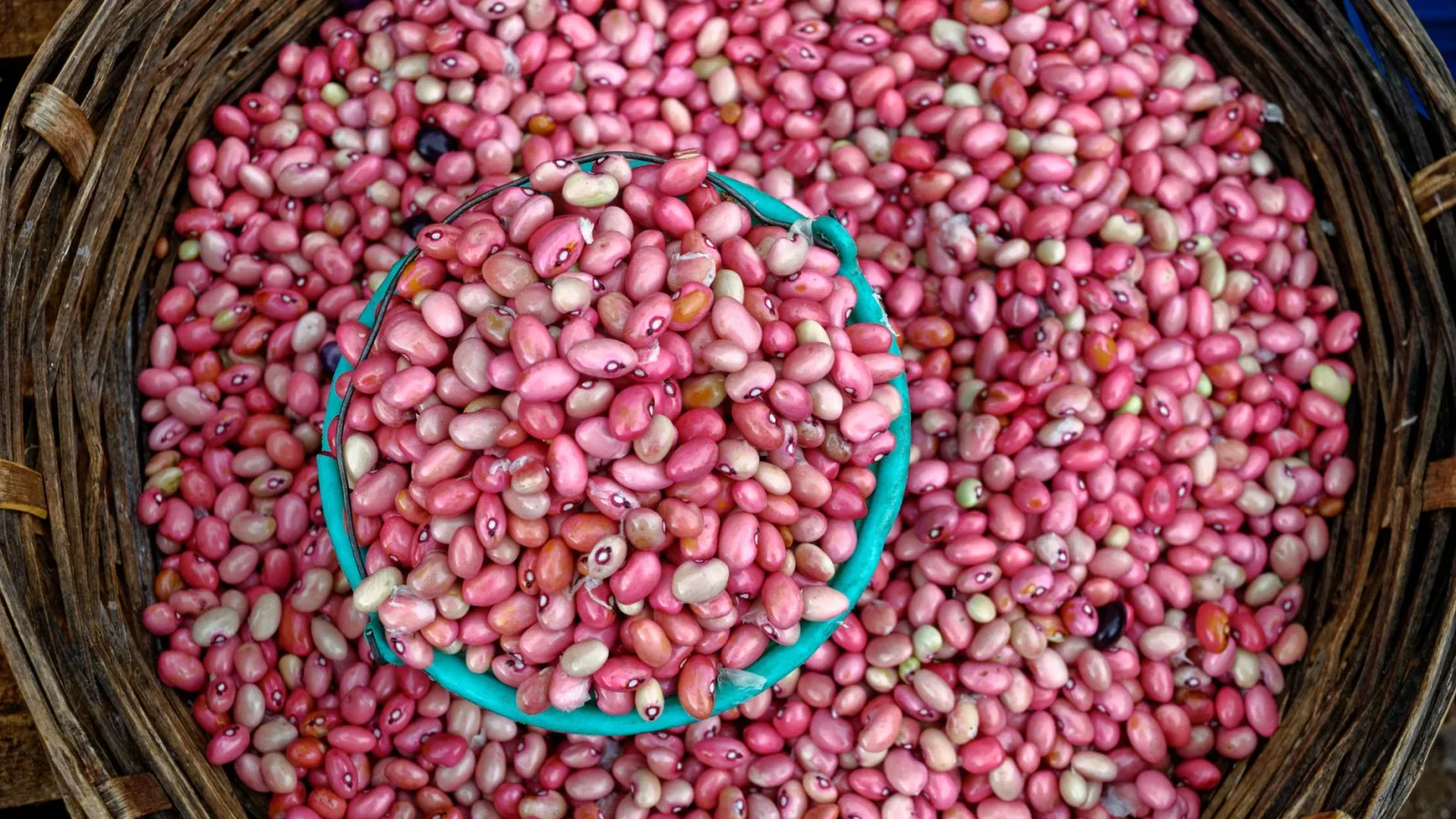
- Horangi-kong (tiger bean, mottled type) (Seed) — Pods and seeds carry red mottling. Seeds run large and show their colour cooked into rice.
- White kidney bean (Seed) — Plump white seeds. They hold their shape through long simmering rather than breaking up.
- Pod type grown as green beans (Seed) — Picked as young whole pods before the seeds fill. First picking some 60 days after sowing.
Source: Food and Nutrition Information
Stories about Kidney Bean
Why the Beans in Your Backyard Plot Made It Into a Global Farming Report
The EAT-Lancet Commission's 2025 report lays out a "planetary health diet" and calculates what the world would have to grow to feed it. The crops at the top of the list — beans, leafy greens, seed oils — are already growing in home gardens.
A Garden That Gets Little Hands Dirty
A season-long garden program in Gyeryong City showed what a few pots of soil can do for young children — and why every family can easily try it at home.