- Type
- Trees & Vines
- Difficulty
- Hard
- Season
- Fall
- Sowing
- Plant a sapling
Hazelnut (Korean hazel)
Corylus heterophylla
Oleic acid and vitamin E from a nut that grows wild in the hills
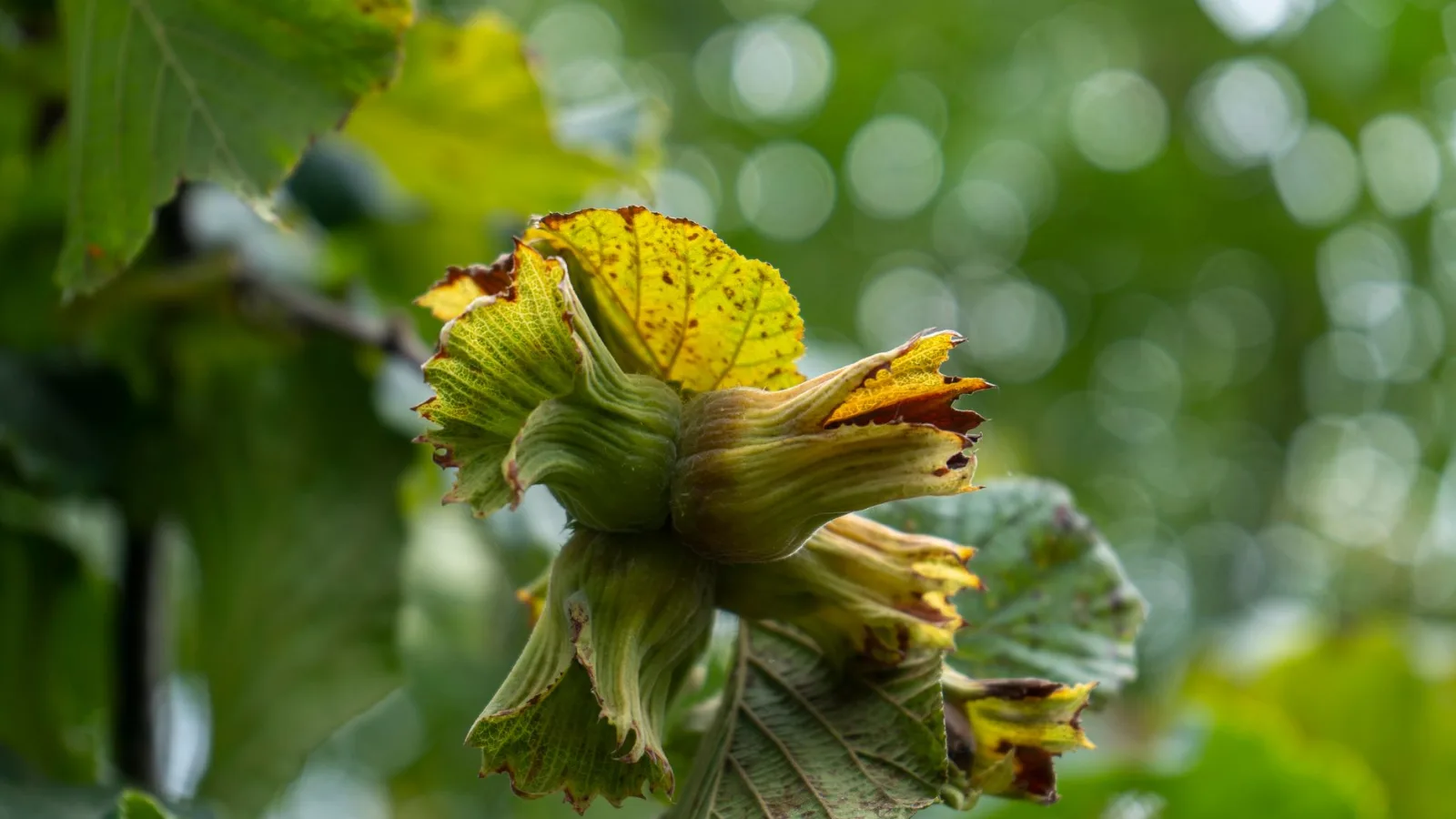
Gaeam is the nut of the Korean hazel, a shrub common on wooded hillsides. The nuts sit wrapped in leafy husks like acorns, fill out in August and September, and crack open to the same rich kernel you know as a hazelnut. The Donguibogam noted simply that it grows everywhere and is gathered in the sixth or seventh lunar month, then shelled and eaten. Where the European hazelnut is familiar through chocolate and coffee, the Korean species runs smaller with a harder shell. The sharp crack in old Korean folktales, the sound that supposedly scared off goblins, is someone biting through one of these.
Year-Round Calendar
- 1
- 2
- 3
- 4
- 5
- 6
- 7
- 8
- 9
- 10
- 11
- 12
- 3
- 11
- 8
- 9
Where It Grows
-
Main producer
Produces most of the world's hazelnuts. The centre is the hillside plots of Ordu and Giresun on the Black Sea coast, and what is grown is the European hazelnut (Corylus avellana), a different species from the Korean hazel. Harvest August, September
- 8
- 9
- Major producer Piedmont, along with Campania and Lazio, are the growing areas, and here too the species is C. avellana.
- Major producer Almost all of it is concentrated in the Willamette Valley of Oregon, and the species grown is C. avellana.
- Major producer Wild Korean hazel (C. heterophylla) is gathered in the forests of Northeast China, and lines crossed with the European hazelnut are grown in Liaoning and Jilin.
-
Wild population
Korean hazel grows wild on hill slopes throughout the country, and there is no large-scale cultivation. Harvest August, September
- 8
- 9
- Wild population Korean hazel is distributed through the forests of the Far East and southern Siberia.
The world hazelnut trade is in practice the trade in the European hazelnut (Corylus avellana), and it is concentrated in one place, the Black Sea coast of Turkey. The Korean hazel of this entry (C. heterophylla) is a different species in the same genus; its native range is the temperate forests of Korea, northeastern China, Japan and the Russian Far East, and it has been carried on through wild gathering and the growing of hybrid lines rather than through commercial planting. When the two species are coloured onto a single map, they have to be kept apart by species.
- Optimum
- 15~25℃
- Range
- 5~30℃
- Hardiness
- Hardy
A deciduous shrub of the northern temperate zone, it needs a spell of winter cold before it will flower properly the following year. The Korean hazel (Corylus heterophylla) endures down to around −30℃, making it hardier than the European hazelnut, but a late frost in early spring ruins its wind pollination.
Harvested 3–5 years after planting. Plant a sapling and it will start bearing fruit three or four to five or six years later. Because pollination is by wind, there must be at least two separate plants.
In Korea Nationwide
It grows wild on hill slopes and forest edges throughout the country. It can be seen on any low hill, and orchard-scale cultivation is rare.
How to grow
- Light
- An open-ground crop. A hillside or field margin with half a day or more of sun suits it.
- Soil and depth
- An open-ground crop. It prefers free-draining, near-neutral soil and roots shallowly.
- Spacing
- An open-ground crop. As a shrub it wants 4-5 m between plants, and you need at least two for nuts.
- Watering
- Water through summer droughts for the first two years. Once established it can be left alone.
- Feeding
- Ring the base with a spadeful of compost in early spring. Overfeeding gives you long shoots and fewer nuts.
- Harvest
- Pick in August or September once the husks have browned, dried, and started to open. Dry the nuts in the shade for about two weeks so they shell cleanly and develop flavor.
What makes the difference. Do not expect nuts from a container plant. When buying, shake one: a rattle means the kernel has shriveled, so pass on it and look for shells with a sheen that feel heavy. Buying them still in the shell keeps them far longer.
Why this one is harder. It matures into a 3-5 m shrub, and because it is wind-pollinated you need two or more genetically different plants before you get any nuts.
Common problems
- Nut weevil You will see A small round hole in the shell with a grub inside What to do Never leave fallen nuts on the ground; gather and destroy them
- Aphids You will see Curled, sticky new growth What to do Wash them off with water and leave some ground cover nearby so ladybirds move in
- Powdery mildew You will see A white floury film across the leaf surface What to do Thin the branches for airflow and pick off affected leaves
This page describes how a crop is grown and used. It does not claim health effects for any food, nor is it intended to prevent or treat disease. Component and study notes are references only and do not mean the same result occurs in people. Consult a medical professional about health concerns.
Health Benefits
What the old text says. Hazelnut appears in the Donguibogam's fruit section as jinja. The entry adds the practical note that they are common everywhere, gathered in the sixth or seventh lunar month, and shelled before eating. This is a record from a seventeenth-century medical text, not a modern medical judgement.
Research on nut intake. Studies have reported observed changes in blood LDL cholesterol when nuts including hazelnuts were added regularly to the diet. Researchers have also pointed out that the effect appears when nuts replace other snacks rather than simply being eaten on top of them.
Nutrition
- Oleic acid (About 75 % of the fat (European hazelnut figures)) — A monounsaturated fatty acid
- Vitamin E (About 15 mg per 100 g (European hazelnut figures)) — A fat-soluble antioxidant
- Protein (About 15 % (European hazelnut figures)) — Mid-range among nuts
- Magnesium and dietary fibre (Minerals and fibre) — Contribute to satiety
The fat profile Food-composition tables for the European hazelnut (Corylus avellana) put fat at roughly 60% of the weight, and about 75% of that fat is oleic acid, a monounsaturated fatty acid — the same fat that dominates olive oil. The hazel of Korean hillsides, Corylus heterophylla, is a different species in the same genus, so read the figures with that in mind. All that fat also means calories: 630 kcal per 100 g.
Vitamin E The same tables put vitamin E at around 15 mg per 100 g, near the top of the nut family. It is fat-soluble, so it absorbs well in the company of the nut's own fat. High roasting temperatures cut into it, which is an argument for a short roast over moderate heat.
Fiber and magnesium A 25 g handful carries 2-3 g of dietary fiber. Magnesium, copper, and manganese come with it. They take real chewing, so a small portion stays satisfying for a long time.
Pairings
○ Coffee and cacao — Roasted hazelnut latches onto the bitterness of cacao and coffee. That is why hazelnut chocolate became a European fixture in the first place. At home, chopping them coarsely into dark chocolate is the whole recipe.
○ Yogurt and salads — Chopped over yogurt or a salad they add texture and fat at once. Vegetables need some fat present for their fat-soluble vitamins to absorb. Chop them at the last minute, since pre-chopped nuts lose their aroma.
○ Whole grain bread — Worked into wholemeal or rye dough, the nutty aroma layers onto the grain. They roast a second time in the oven, so there is no need to toast them first. Around 10-15% of the dough weight is about right.
△ Nut allergy and birch pollen — Hazelnut is one of the tree nuts the European Union requires to be declared on food labels, so anyone with a tree nut allergy should not eat it. Hazel belongs to the birch family. There are documented cases of oral allergy syndrome, with itching or swelling in the mouth, in people with spring birch pollen allergy who eat hazelnuts. Anyone who reacts to birch pollen is safer avoiding hazelnuts as well. Start with a small amount the first time, and if your throat feels tight, stop and get medical attention immediately.
△ Nuts that have gone soft — High fat means they turn rancid once they take on moisture, and mold brings a mycotoxin risk. Throw out anything that smells stale or shows gray or black speckling on the shell. Sealed in a jar in the fridge or freezer they keep far longer.
△ More than a handful — At 630 kcal per 100 g, absent-minded snacking passes a full meal's worth quickly. Twenty to twenty-five grams a day, about a palmful, is a sensible portion. With salted or sugared products, count that too.
Varieties
- Korean hazel (Sapling) — Common in hills throughout the country. The husk opens out like a leaf.
- Asian beaked hazel (Sapling) — The husk extends into a long horn. Slender nuts.
- Manchurian hazel (Sapling) — A deep-mountain native. The husk narrows at the tip.
- European hazelnut (Sapling) — The cultivated kind. Large nuts with a thin shell.
Source: Donguibogam, Fruit Section (榛子) · Korea National Arboretum, National Species Knowledge Information System