

- Type
- Trees & Vines
- Difficulty
- Moderate
- Season
- Summer·Fall
- Sowing
- Plant a sapling
Grape
Vitis spp. (V. vinifera, V. labrusca and their hybrids)
Resveratrol, anthocyanins · fruit that hangs in bunches from a vine
Grapes hang in bunches from a woody vine. Campbell Early was Korea's mainstay for decades, and Shine Muscat has taken a growing share in recent years. The season runs August into September, with Gimcheon and Yeongcheon in North Gyeongsang and Yeongdong in North Chungcheong as the main growing areas. Because it is a vine, it only needs somewhere to climb, which makes a rooftop or a balcony railing workable and puts grapes among the more approachable fruit crops in a city. The Donguibogam called the purple kind mayu, horse milk, and the pale kind sujeong, crystal, and noted that pressing the juice and fermenting it gave grape wine.
Year-Round Calendar
- 1
- 2
- 3
- 4
- 5
- 6
- 7
- 8
- 9
- 10
- 11
- 12
- 3
- 4
- 11
- 8
- 9
Where It Grows
-
Main producer
The world's largest grape producer. Xinjiang, Shandong and Hebei are the main areas, with a large share going to table grapes. Harvest July, August, September, October
- 7
- 8
- 9
- 10
-
Main producer
Most of the crop goes to wine, and growing regions cover the whole country, from Sicily to the foothills of the Alps. Harvest August, September, October
- 8
- 9
- 10
-
Main producer
Almost the entire crop is for wine. Bordeaux, Burgundy and Languedoc are the well-known regions. Harvest August, September, October
- 8
- 9
- 10
-
Main producer
Has the largest area under vines in the world. The dry La Mancha plateau is the centre. Harvest August, September, October
- 8
- 9
- 10
-
Major producer
California's Central Valley produces table grapes, raisins and wine grapes alike. Harvest August, September, October
- 8
- 9
- 10
-
Major producer
Produces large quantities of seedless raisin grapes along the Aegean coast. Harvest August, September
- 8
- 9
-
Major producer
Being in the Southern Hemisphere, its harvest season is the reverse of the Northern Hemisphere's, so it supplies table grapes to Northern Hemisphere markets in winter. Harvest January, February, March, April
- 1
- 2
- 3
- 4
The European grape (Vitis vinifera) was domesticated in West Asia and the Black Sea–South Caucasus region, then spread through the Mediterranean to the rest of the world, while the American grape (V. labrusca) arose separately in eastern North America. Campbell Early, long the mainstay in Korea, is a hybrid of American parentage, and Shine Muscat is a variety bred in Japan, so the two belong to different lines. World statistics count wine, table and raisin grapes together, so a country's overall ranking is not the same as its table-grape ranking. In Southern Hemisphere growing regions the harvest season is the exact opposite of the Northern Hemisphere's.
- Optimum
- 20~30℃
- Range
- 10~35℃
- Hardiness
- Hardy
- Day length
- Not applicable
The grapevine drops its leaves and rests through winter, so it does best where the four seasons are clearly marked. Plenty of sun and little rain during the ripening season are what raise the sugar; frequent rain splits the berries and increases disease. Winter buds of European varieties tolerate around −15℃, while American varieties withstand temperatures lower still. Flower buds are set not by day length but by the previous summer's sunshine, winter cold, and spring temperatures.
Harvested 2–3 years after planting. In the year the seedling is planted you can hardly expect any bunches; a few come the following year, and proper picking begins in the third year. Once a vine is established, it can be harvested for 20 to 30 years. Winter pruning is done in December and January, after all the leaves have fallen.
In Korea Nationwide
Gimcheon, Yeongcheon and Sangju in North Gyeongsang, Yeongdong in North Chungcheong, and Hwaseong in Gyeonggi are the well-known growing areas. The monsoon rains and rainfall in August and September are the biggest variables, so many growers put up rain covers.
How to grow
- Light
- Six hours of direct sun or more. In less light the sugar never climbs and disease increases.
- Soil and depth
- Free-draining soil that is not overly rich. Rich ground gives you vine and little else.
- Spacing
- Three metres in the ground. One plant per pot of at least 45 cm across, always with a support to climb.
- Watering
- Water when the surface dries, up until the rainy season. Once the fruit starts to ripen, cut back so the sugar rises and the berries split less.
- Feeding
- Compost in winter and one feed before flowering. Nothing while the fruit is ripening.
- Harvest
- August into September. Pick when even the lowest berries have coloured and one from the bottom tastes sweet. The top ripens first, so judging by the top berries is too early.
What makes the difference. Half of growing grapes is thinning. When the berries are pea-sized, cut each bunch back to 30 or 40 berries or none of them will size up. Bagging after thinning cuts disease and bird damage together. Prune in December or January once the leaves are down; cut after February and the wound bleeds sap continuously and weakens the vine.
Common problems
- Downy mildew You will see Oily-looking blotches on the upper leaf surface with white mould underneath. What to do It spreads through the wet weeks of June and July. Clear lower leaves for airflow and keep water off the foliage.
- Grape leaf spot You will see Brown spots multiplying on the leaves, with early leaf drop in August. What to do Gather and dispose of fallen leaves; the fungus overwinters in them.
- Spotted lanternfly You will see Massed on the trunk feeding on sap, followed by sooty mould. What to do Scrape egg masses from bark crevices in winter and pick off adults by hand.
This page describes how a crop is grown and used. It does not claim health effects for any food, nor is it intended to prevent or treat disease. Component and study notes are references only and do not mean the same result occurs in people. Consult a medical professional about health concerns.
Health Benefits
What the old record says. Grape appears in the Donguibogam's fruit section as podo. The same passage cautions that eating a great deal of it clouds the eyes, and gives the small wild kind a separate name, yeong-uk. This is a record from a seventeenth-century medical text, not a modern medical judgement.
What studies have observed. Multiple antioxidant experiments have been reported on the polyphenols in grape skin and seed. Findings in humans are limited, and the amounts of extract used in those experiments are far from what you get eating the fruit.
Nutrition
- Anthocyanins (The pigment of dark red skin) — Almost absent from green grapes
- Resveratrol (A polyphenol in skin and seed) — Almost absent from the flesh
- Tartaric acid (An organic acid characteristically abundant in grapes) — The base of the tartness and of a wine's acidity
- Sugars (About 16 g per 100 g of fresh fruit) — Mostly glucose and fructose
Polyphenols in the skin Resveratrol and the anthocyanins live almost entirely in the skin. Slip the skin off and you leave those compounds behind. Varieties like Campbell Early, where the skin comes away in one piece, lose the most this way. Shine Muscat, eaten skin and all, keeps everything. The trade-off is that skin-on grapes need a good thirty seconds of rubbing under running water.
Sugar Grapes carry about 16 g of sugar per 100 g, which is high for a fruit. Bunches often run past 400 g, so finishing one in a sitting puts you over 60 g of sugar. Serving onto a plate helps. Raisins concentrate that nearly fourfold by weight, since the water is gone.
Potassium Fresh grapes have around 190 mg of potassium per 100 g. Juice and concentrate pack more into the same volume. If you are managing potassium for kidney reasons, skip the juice and measure out fresh fruit instead.
Pairings
○ Cheese — The sweet-sour balance of grapes locks in with the salt and fat of cheese. Skin-on green varieties work particularly well. Twenty minutes out of the fridge brings the aroma up.
○ Frozen grapes — Washed, dried, pulled from the stems and frozen, they eat like sorbet. You get through them slowly, so the portion drops on its own. Frozen with the skin on, the skin slips off easily later.
○ Roast chicken or duck — Halved and roasted alongside the bird, the juices turn into a sauce. It sweetens without any added sugar. Add them for the last ten minutes so they keep their shape.
△ Dogs and cats — Grapes and raisins are known to cause acute kidney injury in dogs. Neither the responsible compound nor a safe threshold has been established, so the rule is to give none at all. Pick up dropped grapes immediately. There is even less data for cats, so treat them the same way.
△ Young children and whole grapes — A whole grape is close to the diameter of a small child's airway and is one of the classic choking foods. For children under four, quarter each grape lengthwise. Peeling alone is not enough. Cherry tomatoes need the same treatment. Cherry Tomato
△ Eating a lot at once — The Donguibogam noted that eating grapes in quantity clouded the eyes. By modern measures this is a fruit with concentrated sugar. Splitting a bunch across the day beats finishing it in one go.
Varieties
- Campbell Early (Sapling) — Harvested mid-August. Slips its skin easily and keeps some sourness.
- Kyoho (Sapling) — Large berries, high sugar. Needs bagging.
- Shine Muscat (Sapling) — A green grape harvested in September. Eaten skin and all, seedless. Prone to disease and demanding to grow.
- Amur grape (Sapling) — The wild mountain species. Small and sharply sour, used for juice or wine. This is what Donguibogam recorded as yeong-uk (蘡薁).
Source: Donguibogam, Fruit Section (蒲萄) · Rural Development Administration (nongsaro.go.kr)
Stories about Grape
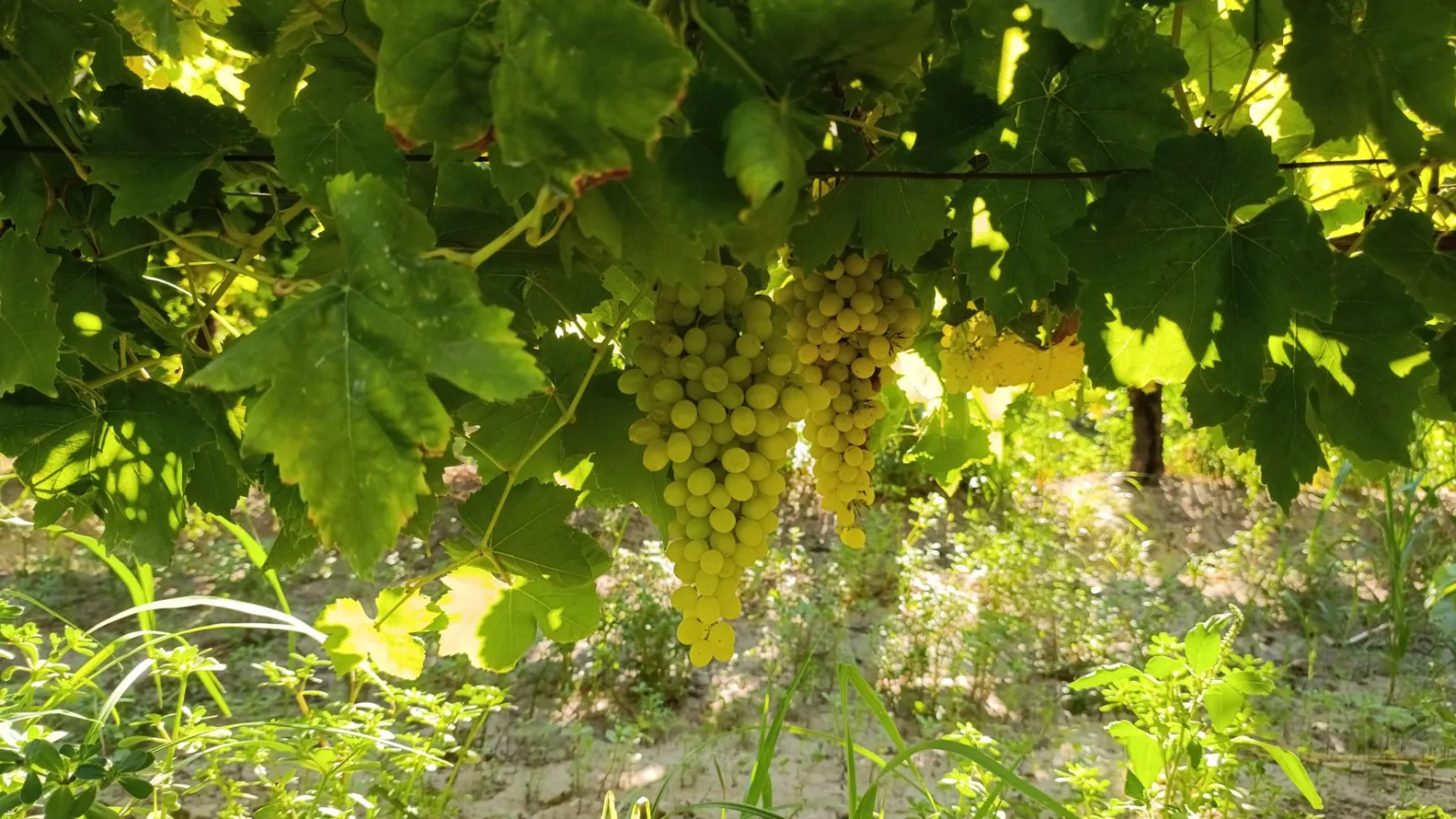
Tigray's Old Grapevines Have Outlasted Drought and War
In Tigray, in northern Ethiopia, old grapevines have outlasted long dry seasons, frequent droughts and two years of war. Researchers say these vines are worth saving, both as a genetic resource and as a record of the region's farming history.
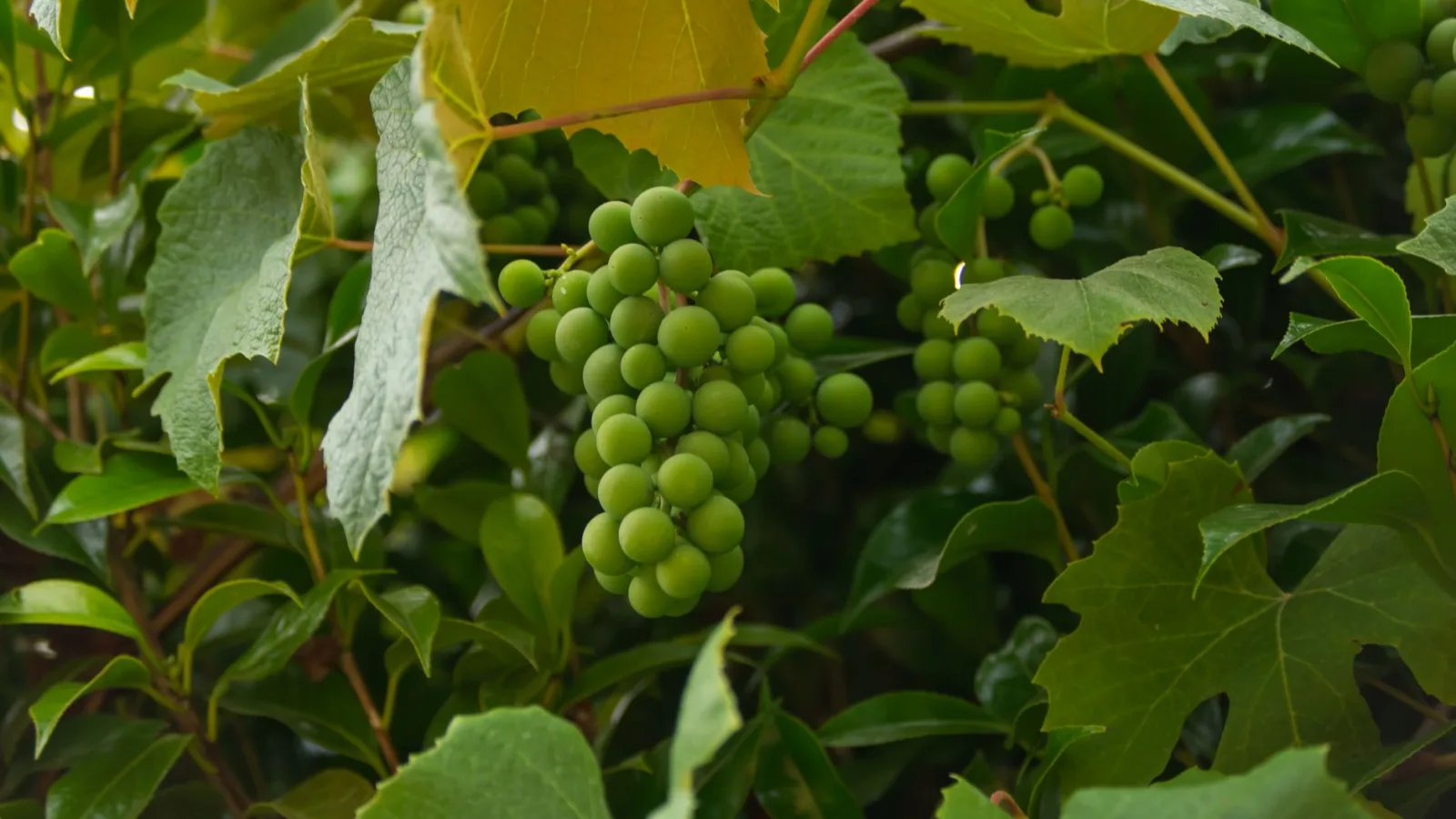
Training a Grapevine Along a Rooftop Railing
Grapes climb, which makes them one of the few fruits you can raise on a rooftop or a balcony railing. Here's how to plant a young vine, train it up a railing, and read the sun and rain that decide how sweet the late-summer harvest turns out.