- Type
- Trees & Vines
- Difficulty
- Hard
- Season
- Summer·Fall
- Sowing
- Plant a sapling
Gardenia
Gardenia jasminoides
Crocin pigment · scent and a yellow dye
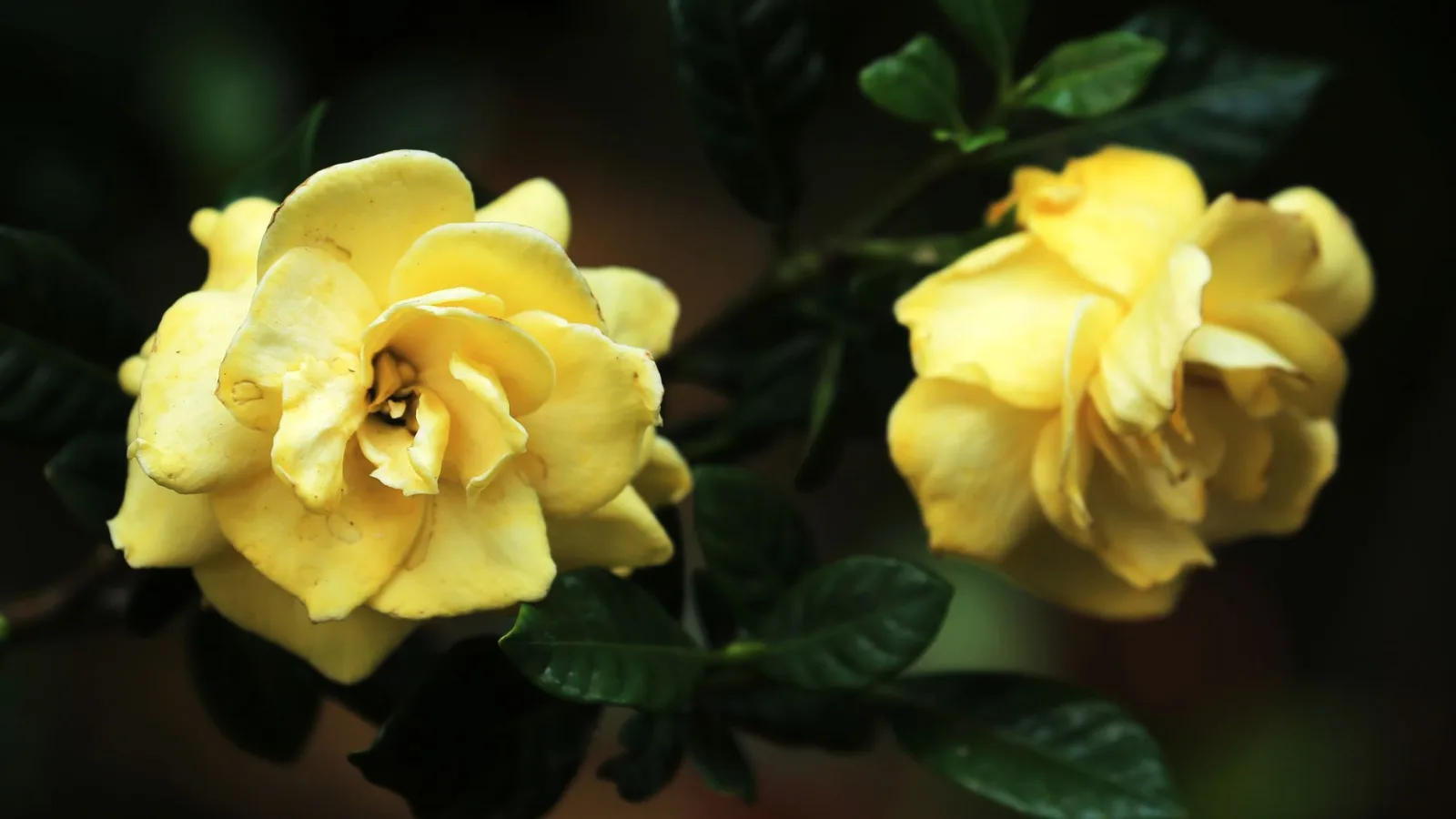
Gardenia is an evergreen shrub in the coffee family. Its white flowers open in six lobes through June and July and carry a long way on the air. The fruit ripens orange in October and November; split in half and steeped in warm water it gives up a deep yellow that Korean cooks use to colour rice, rice cakes and pickled radish. It is not cold-hardy — outside the southern coast it will not overwinter outdoors, and in the centre of the country it is grown in a pot and brought inside. The Donguibogam lists it in the Wood section as 梔子, giving a cold nature, a bitter taste and no toxicity, and specifies the small, round, thin-skinned 山梔子 with seven to nine ridges as the one to select.
Year-Round Calendar
- 1
- 2
- 3
- 4
- 5
- 6
- 7
- 8
- 9
- 10
- 11
- 12
- 4
- 5
- 10
- 11
Where It Grows
-
Main producer
The hill country of Jiangxi, Hunan and Fujian is the center, and it produces most of the fruit supply. Harvest October, November
- 10
- 11
- Major producer Known as kuchinashi, it is grown in Kyushu and southern Honshu.
-
Major producer
There are small growing areas on the southern coast of South Jeolla and on Jeju. The scale is small and most of the crop is consumed domestically. Harvest October, November
- 10
- 11
- Wild population It grows wild on lowland hillsides and is commonly planted in gardens as well.
Its native range is the warm-temperate belt of East Asia, running from southern China through Taiwan, southern Japan and northern Vietnam, so it cannot be pinned to a single country and no country-of-origin row has been given. Demand for the fruit as a yellow dye and as a medicinal ingredient is large, and Chinese cultivation accounts for most of the world's supply. Double-flowered varieties set almost no fruit, so trees planted for their flowers and trees planted for a fruit harvest are separate from the outset.
- Optimum
- 16~28℃
- Range
- 5~35℃
- Hardiness
- Half-hardy
An evergreen shrub of the warm-temperate zone of East Asia, where winters are mild. It tolerates cold down to around −10℃, but below that the branches freeze and die back, so in Korea the southern coast is the northern limit for overwintering (surviving winter outdoors) in open ground. It is fussy about slightly acidic soil, to the point that the leaves yellow if the soil turns neutral.
Harvested 2–4 years after planting. Two or three years must pass after a sapling is planted before it flowers properly and sets fruit. Once established, it flowers every year in June–July, and the fruit ripens in October–November.
In Korea Jeju and the south coast
It is grown in open ground on the southern coast of South Jeolla (Jindo, Haenam, Gangjin) and on Jeju. In the central region, overwintering outdoors is difficult, so it is planted in pots and brought indoors before the frost.
How to grow
- Light
- Four to six hours of direct sun. Hard midsummer sun scorches the leaves, so a spot with morning light suits it
- Soil and depth
- Slightly acidic, free-draining soil. For pots, mix about 30 percent coarse grit into potting compost. Liming the soil toward neutral turns the leaves yellow
- Spacing
- 1 to 1.5m apart in the ground. Use a pot at least 25cm across
- Watering
- Water thoroughly once the surface dries. Let it dry out after buds have set and the buds simply drop
- Feeding
- Feed twice, as new growth starts in spring and again after flowering. It wants acid ground, so skip lime-based fertilisers
- Harvest
- Flowers come in June and July, fruit ripens orange in October and November. Pick before the first frost. Split the picked fruit in half, dry it in the sun and store it sealed
What makes the difference. Finish all pruning immediately after flowering. Cutting from late summer onward risks removing the wood that would have flowered next year
Why this one is harder. Overwintering is the hard part. Outside the southern coast, outdoor overwintering is not realistic, so in central Korea grow it in a pot and bring it in before frost. Indoor dry air invites spider mites, so mist the leaves often
Common problems
- Spider mites You will see Leaf undersides go rough with spreading white stippling and fine webbing. Worst indoors and in dry air What to do Rinse the undersides with water and raise the humidity around the plant. At high density use a registered miticide
- Scale insects You will see White or brown shell-like bumps on stems and leaf stalks, leaves turning sticky then sooty black What to do Scrape them off with a brush or cotton bud; if widespread, apply a dormant horticultural oil in winter
- Aphids You will see Colonies on new shoots and flower buds, shoots curling in on themselves What to do Wash off with a jet of water; if it recurs, use an egg-yolk oil spray. Do not blast the buds directly
This page describes how a crop is grown and used. It does not claim health effects for any food, nor is it intended to prevent or treat disease. Component and study notes are references only and do not mean the same result occurs in people. Consult a medical professional about health concerns.
Health Benefits
What the Donguibogam records — nature, taste and selecting fruit. The Donguibogam lists gardenia in the Wood section as 梔子. It gives a cold nature, a bitter taste and no toxicity. The leaves are described as resembling plum but thicker and harder, and the white flowers as opening in six lobes with a very strong scent. The fruit is green when unripe and yellow when ripe with a deep red interior, and the text picks out the small, round, thin-skinned ones with seven to nine ridges as best. This is a historical medical record and differs from modern medical judgment.
Analysis of the yellow pigment. Analyses report that the fruit's yellow comes from crocin-class carotenoid pigments. Being readily water-soluble, they have long been used to colour cloth and food. This concerns pigment chemistry and has no bearing on the prevention or treatment of disease.
Reports on geniposide. Analyses report the iridoid glycoside geniposide in the fruit. Separately, animal studies dosing high levels of geniposide have reported adverse liver findings, so drinking a strong decoction of the fruit over a long period is not advised. This concerns composition and safety reporting, and has no bearing on the prevention or treatment of disease.
Nutrition
- Crocin and crocetin (the yellow pigment of the fruit) — water-soluble carotenoid pigments
- Geniposide (the main iridoid glycoside of the fruit) — contributes bitterness and serves as a pigment precursor
- Genipin (formed as geniposide breaks down) — turns blue on meeting amino acids
- Essential oil (linalool and others) (reported as principal components of the flower scent) — aroma compounds
The yellow pigment and how to steep it The fruit's yellow comes from water-soluble crocin-class pigments. Split a dried fruit in half and soak it in lukewarm water for 20 to 30 minutes and the colour comes out fully. Boiling pulls the colour faster but pulls the bitterness with it. One or two fruits are plenty to colour two or three bowls of rice.
Geniposide and bitterness The fruit contains the iridoid glycoside geniposide, and that is where the bitterness of the steeping water comes from. Genipin, formed as geniposide breaks down, turns blue on contact with amino acids, and a separate blue colourant is made from that reaction. If colour is all you want, keep the steep short. The longer it sits, the more bitterness rides along with the colour.
Drying and storing the fruit Fruit picked in autumn is split in half and dried in the sun. The old text likewise says to gather in the ninth lunar month and dry in sunlight. Packed away before it is fully dry, it moulds. Keep dried fruit in a sealed jar somewhere cool and dark; once the colour fades, so does the dye it gives.
Pairings
○ Colouring rice and rice cakes — Use the steeping water in place of the cooking or mixing water. The yellow goes in evenly and almost no scent carries over. If the shade is too strong, cut the steeping water half and half with plain water.
○ Danmuji and other pickles — Adding the steeping water to a radish pickle brine turns it yellow. Commercial producers have used the same route for a long time. Colour moves slowly through brine, so give it a day or more.
○ Pancake batter — Steeping water mixed into a jeon batter gives a yellow pancake. The colour holds up well to the pan. Salting the batter makes the shade read as sharper.
△ Do not steep it strong and use a lot — Loading in more fruit to deepen the colour puts bitterness in front of everything else. For food, enough to colour is the right amount. One or two dried fruits per pot of rice is a sensible ceiling.
△ Do not drink it as a long-term decoction — Animal studies dosing high levels of geniposide have reported adverse liver findings. Drinking a strong, long-steeped gardenia decoction over an extended period is not advised. Steeping for colour and drinking it as a remedy are two different things. Anyone wanting sustained use should ask a professional.
△ Fruit from an ornamental pot plant — Double-flowered ornamental cultivars rarely set fruit at all. A plant bought from a florist carries an unknown history of nursery chemical treatment, so even if it fruits, do not eat or dye with it. For food use, buy dried gardenia sold as a food ingredient, or pick from a tree you have grown without pesticides.
Varieties
- Species type (sapling) — Single six-lobed flowers. Sets the fruit used for dyeing
- Dwarf double gardenia (kkot-chija) (sapling) — Low growing, double flowers, heavy scent. Rarely sets fruit
- Large double gardenia (wang-chija) (sapling) — An ornamental line with big double blooms. Mostly grown in pots
Source: Donguibogam, Wood Section 梔子 · Rural Development Administration (Nongsaro) · Korea National Arboretum plant list