- Type
- Herbs & Aromatics
- Difficulty
- Easy
- Season
- Spring·Summer
- Sowing
- Division
Aloe
Aloe vera
Acemannan and aloin · a succulent whose leaf flesh is eaten
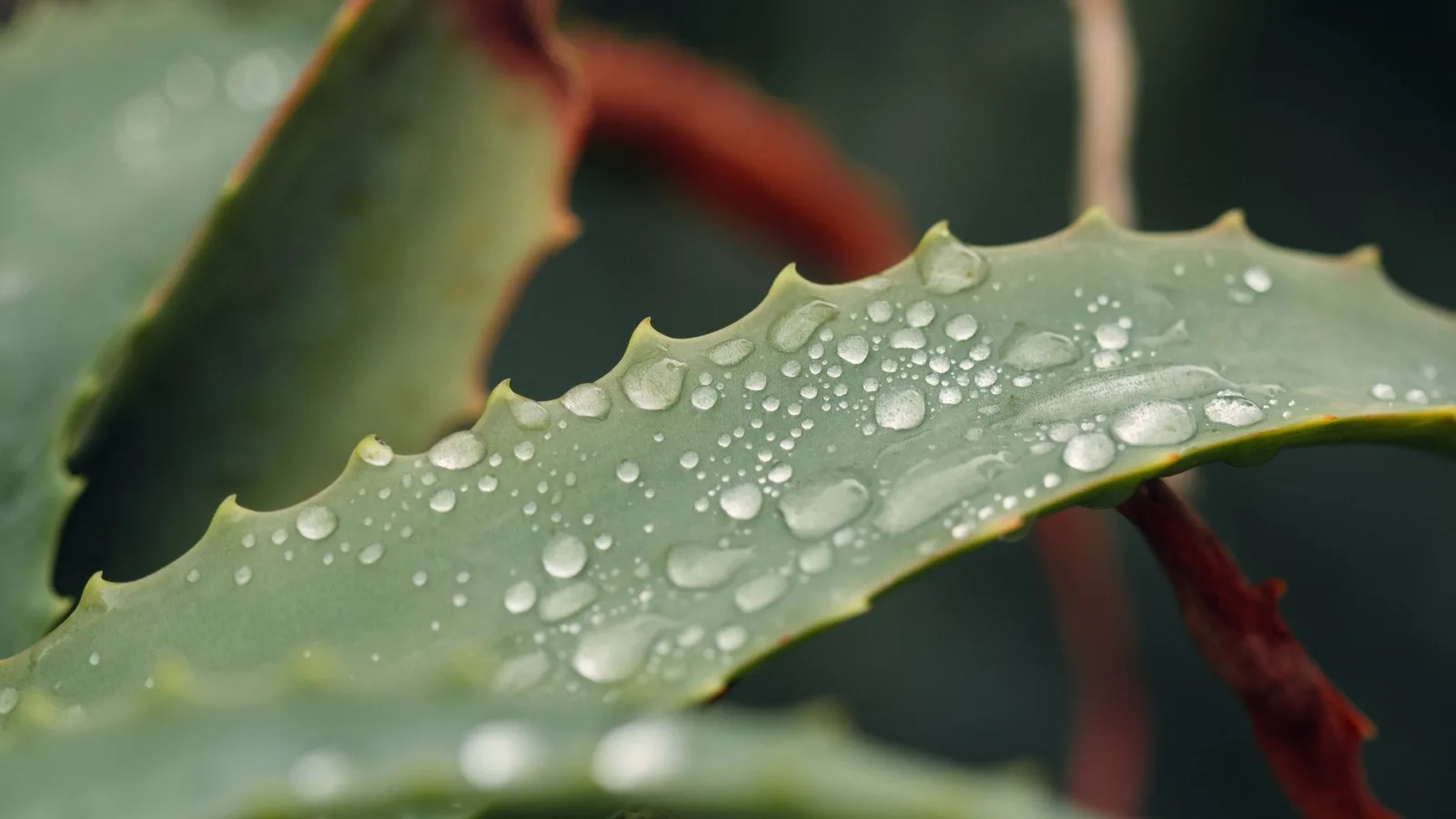
Aloe is one of the most common succulents on a Korean balcony. Cut a thick leaf, pare off the skin, and out comes the clear, slippery flesh that gets diced into gel or a drink. The part that matters most in the preparation is the skin and the yellow juice that runs just inside it. That juice carries aloin, an anthraquinone glycoside with a strong bitterness, so the flesh alone is lifted out and rinsed under running water until no yellow remains. The Donguibogam lists it in the Herb section as 蘆薈, but the entry is not about the leaf: it describes a hardened block of boiled-down resin. The text calls it congealed tree resin, black and looking like hardened taffy, and says the genuine article is the kind that dissolves when several pieces are scattered into water and then draws back together on its own. Where the old text saw the sap of a tree, botany today places aloe as a perennial succulent of the asphodel family, not a tree at all. Only a few aloe species have been treated as edible, so an ornamental one brought home from a garden centre is not cut for the kitchen.
Year-Round Calendar
- 1
- 2
- 3
- 4
- 5
- 6
- 7
- 8
- 9
- 10
- 11
- 12
- 4
- 5
- 5
- 6
- 7
- 8
- 9
- 10
Where It Grows
- Main producer This is the world's largest producing area. Cultivation is concentrated in the drylands of Veracruz, Yucatán and Tamaulipas.
- Main producer It is grown on a large scale on the dry Caribbean coast.
- Major producer The planted area has expanded rapidly in the semi-arid zones of Rajasthan and Gujarat.
- Major producer Production is centred in the warm-wintered south: Hainan, Guangxi and Yunnan.
- Major producer The growing areas are the Rio Grande Valley of southern Texas and Florida.
Its wild origin was long unclear, but the prevailing view now places it in the southern Arabian Peninsula, around Oman. Because that is a region rather than a country, no origin row has been set up here. Carried by human hands to the Mediterranean, India and the New World, today's growing areas are not the place of origin but cluster in frost-free, low-rainfall subtropical drylands. It is not a crop tracked separately in international production statistics, so the ranking above relies on industry surveys.
- Optimum
- 22~30℃
- Range
- 10~40℃
- Hardiness
- Not hardy
It is a succulent of frost-free arid and semi-arid subtropical regions. Where days are hot, nights are cool and rain is scarce, the leaves thicken; when the temperature drops below 5℃, the leaves turn mushy and collapse. Frequent rain or standing water makes the plant rot from the base.
Harvested 2–3 years after planting. Two to three years must pass after planting divisions before the leaves thicken enough to be worth cutting. Once the plants are established, the mature outer leaves are harvested several times a year, and the offsets that appear at the base are detached and replanted to keep the cycle going.
In Korea Nationwide
It cannot overwinter (survive the winter) outdoors, so wherever it is grown it must be moved into a greenhouse or indoors for the winter. Commercial cultivation centres on greenhouses in Jeju and along the south coast, where winters are mild, while households keep it in pots.
How to grow
- Light
- A bright windowsill. Filter the midday summer sun slightly or the leaves scorch red
- Soil and depth
- Free-draining succulent mix. Cut it about half with coarse grit and put larger grit in the base of the pot
- Spacing
- One plant per pot. When offsets appear, separate them in spring and pot them on
- Watering
- Soak it only once the soil has dried right through. Cut back to once or twice a month in winter. Frequent water rots it from the base
- Feeding
- A weak liquid feed once a month in spring and autumn. Fed often, the leaves go soft
- Harvest
- Take the outer, fully grown leaves first, cutting close to the base. Stand the cut leaf cut-side down for about half an hour to drain the yellow juice before preparing it. Do not cut several leaves at once
What makes the difference. To lift the flesh, trim the toothed edges first, pare the skin from both faces, then rinse thoroughly under running water. Refrigerate the prepared flesh and use it within a day or two
Why this one is harder. It has no cold tolerance. Bring it indoors before the temperature drops below five degrees, and carry it through winter nearly dry. Left outside through a frost, the leaves collapse into mush
Common problems
- Scale insects You will see White wool or brown scabs at the leaf base and in the axils What to do Wipe them off one at a time with a cotton bud dipped in rubbing alcohol. Never spray a pot you eat from
- Rot from overwatering You will see The base goes soft and black and the leaves collapse What to do Stop watering and cut away only the sound leaves. Repot into fresh mix and lengthen the interval between waterings
This page describes how a crop is grown and used. It does not claim health effects for any food, nor is it intended to prevent or treat disease. Component and study notes are references only and do not mean the same result occurs in people. Consult a medical professional about health concerns.
Health Benefits
The old record — nohoe (蘆薈). The Donguibogam lists it in the Herb section as 蘆薈. It sets down a cold nature, a bitter taste and no toxicity. On provenance it says the material comes from Persia, and on appearance that it is congealed tree resin, black and like hardened taffy. The genuine article was judged by scattering several pieces into water: the kind that dissolves and then draws back together on its own. It also records that the material was ground separately before use. What the entry describes is not the leaf but a block of boiled-down resin. This is a historical medical record and differs from modern judgment.
Compositional differences between parts. Polysaccharides such as acemannan are reported in the leaf flesh, while anthraquinone glycosides such as aloin are reported in the yellow juice just under the skin. The result is that composition differs by part within a single leaf, and the practice of lifting out and rinsing only the flesh rests on that. This is an analysis of composition and has nothing to do with preventing or treating disease.
Nutrition
- Acemannan (reported in the leaf flesh) — a polysaccharide identified in aloe gel
- Aloin (in the yellow juice just under the skin) — an anthraquinone glycoside behind the bitterness
- Water (most of the leaf flesh) — the basis of the slippery texture
The flesh and the skin are different parts Cut an aloe leaf and yellow juice runs first from just inside the skin, with the clear flesh lying behind it. That yellow juice carries aloin, an anthraquinone glycoside, and it is strongly bitter. Lift out the flesh alone and rinse it under running water until no yellow remains. Neither the skin nor the yellow juice is a part that gets eaten.
Acemannan The polysaccharide acemannan has been reported in aloe leaf flesh. It is treated as one of the compounds behind the slippery texture of the gel. This entry stays with the compositional record.
Mostly water The flesh is largely water, so it carries few calories for its bulk. It also spoils quickly: refrigerate prepared flesh and use it within a day or two. To hold a cut leaf whole, stand it cut-side down until the yellow juice has drained, then wrap it and refrigerate.
If bitterness remains Bitterness in prepared flesh means the yellow juice has not fully drained. Rinse again, and if it persists, pare another thin layer off the surface. Covering the bitterness with sugar is no substitute for the preparation.
Pairings
○ Honey and lemon — Prepared aloe flesh has almost no flavour of its own, so honey or lemon usually goes with it. Diced into yogurt works as well. Get the bitterness out before adding anything sweet.
○ A cold soak — Leaving diced flesh in cold water for a short while draws off both the surface slipperiness and any bitterness left behind. Changing the water once makes it surer.
○ Sharp, sweet fruit — Blended, the slippery texture stays exactly as it is. Putting it through with apple or pineapple, fruit with clear acidity and sweetness, makes it far easier to drink.
△ Skin and yellow juice — The yellow juice running from just inside the skin carries aloin. Lift out the flesh alone, rinse it thoroughly under running water, and if any yellow remains, pare off another layer. Do not blend the leaf skin and all. Aloe is not given to anyone who is pregnant, nor to young children.
△ Ornamental aloes — The genus Aloe runs to hundreds of species and far more horticultural cultivars. The ones handled as food are a few — Aloe vera, Aloe arborescens, Aloe saponaria. An unnamed plant from a garden centre, or a boldly patterned ornamental, does not get cut for the kitchen. If you cannot identify the species with certainty, do not eat it.
△ Pots that have been sprayed — Indoor pots get sprayed for scale insects and aphids often enough. Leaves from a sprayed pot are not eaten. Keep the pot you cut from separate from the ornamental ones from the start, and never spray the one you eat from.
Varieties
- Aloe vera (plant) — Thick leaves with plenty of flesh; the species used for food more than any other. Gel and drinks come from this one
- Aloe arborescens (plant) — The tall, candelabra aloe. Narrow, long leaves, and long grown in Korea
- Aloe saponaria (plant) — Broad leaves marked with pale blotches. Also treated as edible
- Ornamental cultivars (ornamental) — Many are small-leaved or boldly patterned. Anything not known as an edible species is not eaten
Source: Donguibogam, Herb Section 蘆薈 · Korean Plant Names Index