- Type
- Trees & Vines
- Difficulty
- Moderate
- Season
- Spring·Fall
- Sowing
- Plant a sapling
Akebia (Chocolate Vine)
Akebia quinata
Natural sugars, fibre · a native vine that splits open in autumn
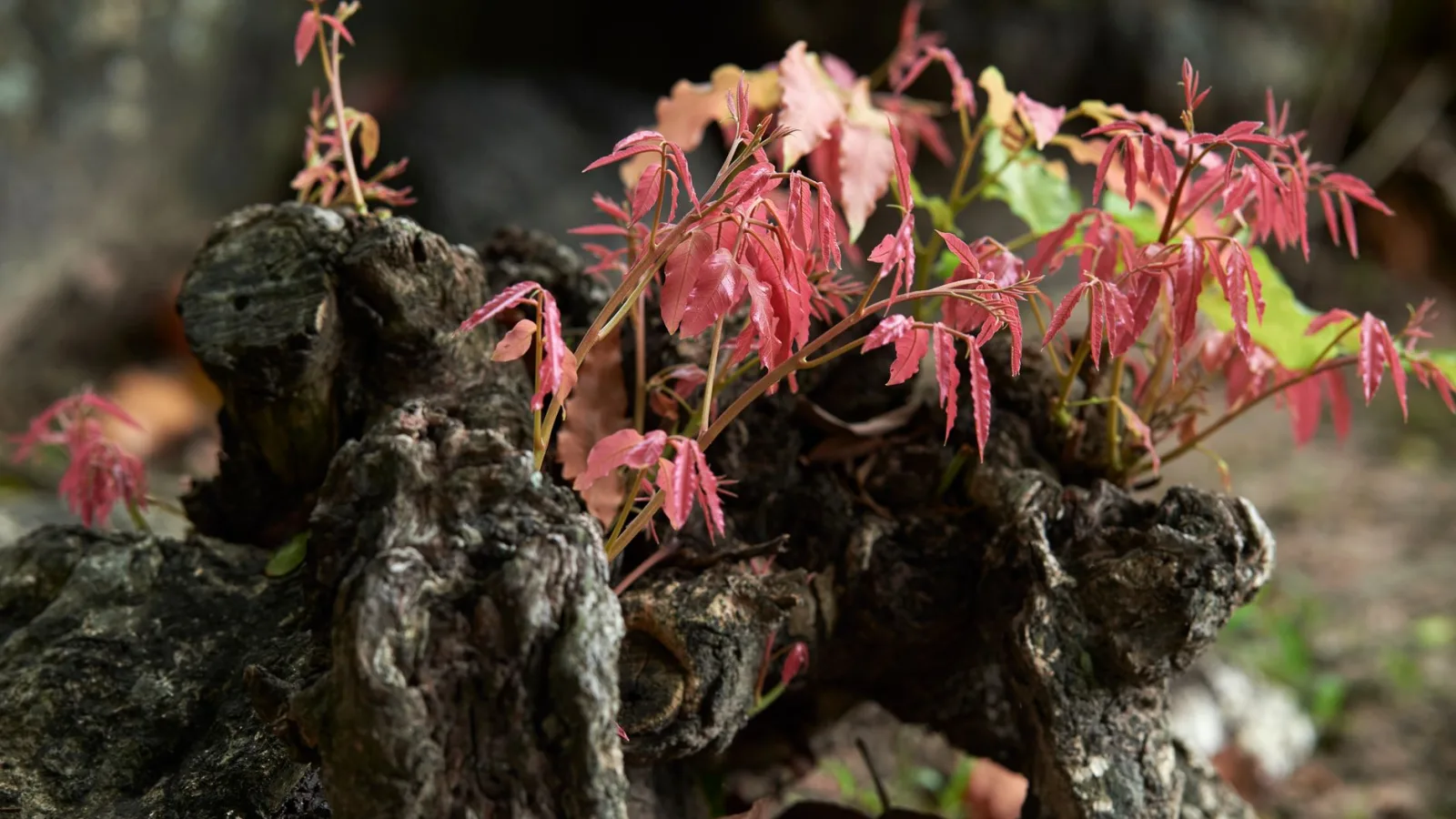
Akebia is a deciduous woody vine that grows wild on Korean hillsides. Five leaflets fan out from the end of each leaf stalk, purplish flowers open in April and May, and in September and October the fruit splits lengthwise. Inside sit white pulp and a dense mass of black seeds; the pulp is sweet. In town it is usually trained over a fence, a trellis or a pergola, and a single plant sets fruit poorly, so two or more are planted together. The Donguibogam lists it in the Herb section as 通草, giving it a neutral nature, a pungent-sweet taste and no toxicity, and describing a vine of the hills with two or three branches at every node, five leaflets at each branch tip, black seeds and white flesh inside the fruit.
Year-Round Calendar
- 1
- 2
- 3
- 4
- 5
- 6
- 7
- 8
- 9
- 10
- 11
- 12
- 3
- 4
- 11
- 9
- 10
Where It Grows
-
Main producer
This is a country that eats the fruit as a vegetable, and cultivation is concentrated in Yamagata Prefecture. Even so, the national harvest is around 60 t, so the crop itself is small in scale. Harvest September, October
- 9
- 10
-
Wild population
It grows wild across hill slopes and woodland edges from the central region southwards, and some plants are trained up walls and trellises. Harvest September, October
- 9
- 10
- Wild population It grows wild in the mountains south of the Yangtze, where the stems are harvested under the name mutong.
Its home is the temperate mountains of East Asia spanning Korea, China and Japan, and that is still its range today. Commercial cultivation is almost entirely Japanese; in Korea and China it is closer to something gathered from the wild in the mountains. It travelled to Europe and North America as an ornamental vine, but in the eastern United States it is treated as an invasive species that smothers forests, so it is not counted among the producing areas.
- Optimum
- 15~25℃
- Range
- 5~30℃
- Hardiness
- Hardy
It is a temperate deciduous vine. It drops its leaves in winter and withstands cold to around -20℃, and it needs a spell of winter cold before the flower buds break evenly the following year. It dislikes having the soil around its roots dry out in summer, so it grows well in the partial shade at the edge of woodland.
Harvested 3–4 years after planting. Three to four years must pass after seedlings are planted before they bear fruit. The month of planting and the month of the first harvest do not fall in the same year. Male and female flowers open separately and the plant sets poorly with its own pollen, so two or more plants are grown together.
In Korea Central Korea and south
It grows wild on hill slopes from Hwanghae Province southwards and becomes more common the further south you go. It is plentiful along woodland edges and streamsides that get half a day or more of sun.
How to grow
- Light
- Tolerates both full sun and part shade. For fruit, train it where it gets five hours of sun or more
- Soil and depth
- Free-draining soil with leaf mould worked in. It dislikes dry roots, so mulch the surface with straw or leaves through summer
- Spacing
- At least 2m between plants. Put the trellis or fence up first, then plant beneath it
- Watering
- Water often through the first season so the root never dries. Once established, only in dry spells after the rainy season
- Feeding
- A spade of compost around the base after leaf fall. Too much nitrogen sends out long growth and sets fewer flower buds
- Harvest
- Pick in September or October, once the rind has coloured purple and begun to crack lengthwise. Birds and insects get to fully split fruit first, so take the cracked ones and let them open indoors
What makes the difference. Male and female flowers are separate and the plant sets poorly on its own pollen. Plant two or more of different origin, and in April or May brush pollen from the male flowers onto the larger female flowers — fruit set rises noticeably
Why this one is harder. The vine puts on several metres a year and will smother a trellis and strangle nearby trees if left alone. Thin out old growth in winter and cut shoots that have fruited back to two or three buds
Common problems
- Fruit-piercing moth caterpillar (Eudocima tyrannus) You will see Leaves chewed back from the margins with a large caterpillar on them What to do Pick them off as you find them. In small numbers the vine copes, and no spray is needed
- Aphids You will see Shoot tips curl and turn sticky, with ants running up and down What to do Wash off with a jet of water; if it recurs, use an egg-yolk oil spray
- Scale insects You will see Brown scabs on older stems with sooty blackening beneath What to do Scrub them off in winter and apply a dormant horticultural oil during leaf fall
This page describes how a crop is grown and used. It does not claim health effects for any food, nor is it intended to prevent or treat disease. Component and study notes are references only and do not mean the same result occurs in people. Consult a medical professional about health concerns.
Health Benefits
What the Donguibogam records — nature, taste, form and gathering. The Donguibogam lists the plant in the Herb section as 通草. It gives a neutral nature, adding that some call it slightly cold, with a pungent and sweet taste and no toxicity. It describes a hillside vine as thick as a finger, with two or three branches at every node and five leaflets at each branch tip; the fruit is likened to a small quince, black-seeded and white-fleshed, sweet to eat, and called 鷰覆子. It also records a test — a stem with a fine bore, so that blowing into one end sends air out the other, is the good sort — and a gathering time of the first and second lunar months, drying the cut stems in the shade. This is a historical medical record and differs from modern medical judgment.
A record that separates look-alike names. The same entry notes that a different vine sold in Gangwon Province under the name 木通 is yellow in colour and bitter in taste, and states plainly that it is a separate thing, sometimes called 木防己. The name 木通 has in fact covered several plants in trade, and one of them, Manchurian birthwort, contains aristolochic acid, which has reported toxicity and is banned from use. The point is that the botanical origin, not the name, is what must be checked; this is not a statement about benefit.
Nutrition
- Sugars (fructose, glucose) (concentrated in the ripe white pulp) — the source of the sweetness
- Dietary fibre (in the pulp and the thick rind) — largely insoluble fibre
- Akebia saponins (reported from stem and root) — saponin-type compounds found in the vine tissue
- Oleic and linoleic acid (in oil pressed from the seed) — the main fatty acids of the seed oil
Sweetness of the ripe pulp As the fruit ripens the rind splits lengthwise and the white pulp is exposed. The sweetness comes from fructose and glucose; unripe fruit is astringent and flat. Black seeds are packed through the pulp, so they are either spat out or strained off. One fruit yields less edible pulp than its size suggests.
The thick rind What remains after scooping the pulp is a thick, distinctly bitter rind. Depending on the region it is stuffed and steamed, shredded and stir-fried, or pickled. Blanching or a soak in salted water draws the bitterness down. If the rind is to be used, take fruit that has had no spraying.
Seeds and seed oil Seeds make up a large share of the fruit's weight and contain oil. In earlier times the seeds were collected and pressed for lamp oil. Analyses report a fatty acid profile high in oleic and linoleic acid. The seeds are hard and do not break down when chewed, so spit them out rather than swallowing.
Spring shoots In some districts the young spring shoots are eaten as a green. They are blanched, rinsed in cold water and dressed; if bitterness lingers, rinse for longer. Taking too many shoots checks the vine for the season, so pick only the branch tips.
Pairings
○ Straight from a spoon — A fruit that has ripened and split is simplest eaten with a spoon, pulp only. The seeds have to be picked out in the mouth, so pressing the pulp through a sieve leaves a smooth result. Sieved pulp softens within a day or two in the fridge, so prepare it as you go.
○ Rind stir-fried with perilla oil and doenjang — Shred the leftover rind, fry it in perilla oil and season with doenjang; the bitterness settles down. Half an hour in salted water beforehand takes out more of it. Try one fruit's worth first before scaling up.
○ Milk or yoghurt — Freeze the picked-out pulp and blend it with milk or soy milk for a summer drink. The seeds do not break down in the blender, so strain once afterwards. Add a little honey if it tastes flat.
△ The 'mok-tong' name trap — Manchurian birthwort — The drug name 木通 has been applied both to akebia stem and to other plants. Manchurian birthwort (關木通, Aristolochia manshuriensis) in particular contains aristolochic acid, a compound with serious reported toxicity that is banned from food and herbal medicine use in Korea and many other countries. A shared name does not mean a shared plant. Do not brew anything sold as 'mok-tong' without a confirmed botanical origin.
△ Unripe fruit and hard seeds — Fruit picked before it splits is astringent and not sweet. The seeds are hard and do not break down when chewed, so spit them out. For small children, an adult should sieve the seeds off and serve the pulp alone.
△ Avoid stem decoctions in pregnancy and while breastfeeding — The old records place this material among the items to avoid in pregnancy. Eating a little ripe fruit and brewing the stem or root are two different things. Anyone pregnant or breastfeeding should skip the decoction, and when in doubt the safer choice is not to take it.
Varieties
- Akebia quinata (sapling) — The five-leaflet type. Grows wild across the country
- Three-leaf akebia (sapling) — Three toothed leaflets. Slightly smaller fruit
- Eight-leaf akebia (sapling) — Treated as a line between the two above. Leaflet counts vary
- Stauntonia (meolgul) (sapling) — An evergreen vine of a different genus, grown in the south. Its fruit does not split
Source: Donguibogam, Herb Section 通草 · Rural Development Administration (Nongsaro) · Korea National Arboretum