

- Type
- Trees & Vines
- Difficulty
- Hard
- Season
- Fall
- Sowing
- Plant a sapling
Acorn
Quercus acutissima
Tannins and starch — the nut gathered under autumn oaks
Acorns are the nuts of the oaks, the sawtooth oak above all. From September into October they lie on the ground under oaks on any low hillside. A freshly gathered acorn is harshly astringent, and that astringency comes from tannins, a family of polyphenols. Shell the nuts, dry them, grind them, then change the water again and again: the tannins leach out and the white sediment that settles is the raw material of dotorimuk, acorn jelly. The acorn starch powder sold in shops is that same sediment, dried. Sawtooth and cork oak acorns ripen in the autumn after flowering, taking two years, while Mongolian and konara oak acorns ripen the same autumn. Acorns are also winter food for squirrels and wild boar, and gathering them is prohibited by law in national parks and protected forest. The old rule is to take only what has fallen, never to beat the tree.
Year-Round Calendar
- 1
- 2
- 3
- 4
- 5
- 6
- 7
- 8
- 9
- 10
- 11
- 12
- 3
- 4
- 9
- 10
Where It Grows
-
Main producer
The practice of grinding acorns and cooking them into muk survives, so autumn gathering and trade continue. Sawtooth oak and oriental cork oak are common on the hills behind villages and along the lower slopes. Harvest September, October
- 9
- 10
- Wild population The sawtooth oak (Quercus acutissima) has a wide native range and is common in the mountains of central and northern China.
- Wild population Known here as kunugi, it is common in the scrub woodland of the lower slopes and is also used as bed logs for shiitake.
-
Major producer
The acorns of the dehesa grazing lands are the fruit of the holm oak (Quercus ilex) and the cork oak (Q. suber), species different from the sawtooth oak. Pigs are turned out to feed on them in autumn and winter. Harvest October, November, December, January
- 1
- 10
- 11
- 12
- Major producer Oak grazing land of the same kind, called montado, covers a wide area in the south. Here too the acorns come from a different species of oak.
The sawtooth oak is an East Asian tree, found across Korea, China and Japan and south of the Himalayas, and Korea is almost the only place where acorns are ground and set into muk (a savoury jelly) as human food. The acorns of the Iberian Peninsula come from a different species of oak and are fed to pigs rather than to people. Because this is a nut gathered in the hills rather than a crop planted and harvested in fields, there are no production figures by country.
- Optimum
- 15~25℃
- Range
- 5~32℃
- Hardiness
- Hardy
- Day length
- Not applicable
This is a tree of the warm temperate foothills. It likes open, sunny slopes and cannot grow in shade. Flowering is triggered not by day length but by spring temperatures once the tree has had its fill of winter cold, and the sawtooth oak's fruit ripens not in the year it flowers but in the autumn of the following year.
Harvested 5–10 years after planting. A planted sapling takes five or six to ten years to bear its first acorns, and longer if raised from seed. On top of that, sawtooth oak fruit ripens in the autumn of the year after flowering, so the blossom of spring and the acorns that fall that same autumn belong to different years.
In Korea Nationwide
The tree is common on sunny lower slopes and on the hills behind villages, so acorns are gathered all over the country. Some areas are closed to the gathering of forest products, however, such as national parks and recreation forests, and since acorns are also winter food for wild animals, the custom is not to strip a single spot bare.
How to grow
- Light
- It grows on open, sunny hillsides. The sawtooth oak will not tolerate shade, so it is common along forest edges and on cleared slopes
- Soil and depth
- Free-draining soil, planted deep. The taproot runs straight down, which is why the tree resents being moved
- Spacing
- A mature tree stands over 20m. Keep it at least 5m from a house or wall, and do not plant it in a small plot
- Watering
- Keep it from drying out through the first year only. Once established it carries itself on rainfall
- Feeding
- Work a spadeful of compost around the base in November or December after leaf fall. This is not a tree to feed heavily
- Harvest
- September and October. Pick up what has fallen beneath the tree; never beat the branches. A nut still gripped firmly in its cup is not ripe
What makes the difference. Float the gathered nuts and discard whatever rises. Shell them, dry them, grind them, and leach the astringency out through several changes of water. Skim off only the settled white sediment for jelly
Why this one is harder. Grown from seed, a tree takes many years to bear. It becomes a large timber tree and does not suit a small plot, which is why acorns are usually gathered on a hillside in autumn rather than planted
Common problems
- Acorn weevil (Mechoris ursulus) You will see In summer, twigs bearing acorns are cut through and lie whole on the ground What to do Gather the fallen twigs and dispose of them. The acorns inside hold eggs, and leaving them means more of the same next year
- Oak wilt You will see Leaves redden and dry abruptly in midsummer, and sawdust-like frass piles at the base of the trunk What to do Never move felled wood about. Report it to the forestry authority and follow their instructions
- Powdery mildew You will see A dusting of white spreads across the upper leaf surface What to do It worsens when damp lingers after the rainy season. Thin the branches for airflow and collect and discard affected leaves
This page describes how a crop is grown and used. It does not claim health effects for any food, nor is it intended to prevent or treat disease. Component and study notes are references only and do not mean the same result occurs in people. Consult a medical professional about health concerns.
Health Benefits
The old record — sangsil (橡實). The Donguibogam lists the acorn in the Wood section as sangsil (橡實), giving the Korean name as gulgeun dotori, the thick acorn. It records a warm nature, a bitter and astringent taste, and no toxicity. It identifies the nut as the fruit of the sawtooth oak, says it grows everywhere, and calls the cup that holds it jodu (皂斗). It notes that the nuts were gathered at any season and that shell and kernel were used together after roasting, and adds that 柞, 櫟, 杼 and 栩 are all general names for the same tree. It also records that the nut carried people through hungry years. This is a historical medical record and differs from how it is judged today.
Astringency and tannins. Compositional analysis confirms that the astringency of acorns comes from tannins. Because tannins leach readily into water, grinding the nuts and changing the water repeatedly has been handed down as the way to remove it. The compositional record is as far as this entry goes.
How starch becomes jelly. The settled acorn sediment is mostly starch, which disperses when boiled with water and sets on cooling into jelly. It relies on the way starch swells and unwinds in hot water, then re-associates as it cools. This is an account of cooking behaviour.
Nutrition
- Tannins (the source of the astringency) — a family of polyphenols that leach readily into water
- Starch (the main substance of the kernel) — the polysaccharide that sets the jelly
- Water (most of the finished jelly) — what gives dotorimuk its soft, yielding body
Astringency and tannins A freshly gathered acorn tastes harsh because of tannins, a family of polyphenols. They leach readily into water, so grinding the nuts and changing the water repeatedly draws the astringency out. Pour off the dark red water each time and keep only the white sediment. Skip the step and the jelly is too bitter to eat.
Starch and jelly Starch is the main substance of the kernel. Boil the settled sediment with water and the starch disperses, then sets as it cools into jelly. The water ratio decides the firmness, so following the ratio printed on the packet leaves less room for error. It catches easily, so stir throughout.
The jelly is mostly water Set jelly is mostly water, so it is low in calories for its bulk. That is why a composition table for the nut and one for the jelly read so differently. Check which basis a table uses before comparing numbers.
Dried acorns and acorn powder Shelled and dried, acorns keep for a long time. The acorn powder sold in shops has already been leached and settled and dried, so it only needs stirring into water and boiling. The powder takes up moisture readily, so seal it in a container and keep it somewhere cool.
Pairings
○ Seasoned soy sauce — Cut the set jelly into thick pieces and spoon over soy sauce mixed with sesame oil, chilli flakes and chopped spring onion. The jelly itself tastes faint, so the seasoning decides the dish. It weeps once cut, so cut it as it goes to the table.
○ Kimchi and greens — dotorimuk muchim — Chop sour kimchi finely, tear lettuce or perilla leaves by hand, and toss them with the jelly. Mix gently in a wide bowl so the pieces do not break up. Sesame oil and seeds go in last.
○ Anchovy stock — mukbap — Ladle anchovy and kelp stock over shredded jelly and rice, then top with crumbled laver and kimchi. Serve it cold in summer and hot in winter. The jelly dissolves if boiled, so add it to the stock and serve straight away.
△ Acorns that have not been leached — Do not chew a gathered acorn raw or grind it and cook it straight away. The tannins make the mouth violently astringent and can unsettle the stomach. Shell, dry and grind them, leach through several changes of water, and use only the settled sediment. Pour off the dark red water each time.
△ Grubby or mouldy nuts — Drop gathered acorns into water and discard the floaters. A floating acorn is hollow or has a grub inside. Throw out any with white bloom or black staining on the shell as well. Turn them once a day while drying so they do not go damp.
△ National parks and protected forest — Gathering acorns and other forest produce is prohibited by law in national parks and protected forest, and private woodland cannot be entered and stripped either. Acorns are winter food for squirrels and wild boar, so the old rule is to leave plenty behind rather than sweep one spot clean.
Varieties
- Sawtooth oak (Quercus acutissima) (species) — Thick, rounded acorns in a cup whose scales curl back. The line most often turned into jelly
- Cork oak (Quercus variabilis) (species) — Thick, corky bark. Like the sawtooth oak, its acorns take two years to ripen
- Konara oak (Quercus serrata) (species) — The smallest and most elongated acorn. Reckoned the best tasting, and sought out for that
- Mongolian oak (Quercus mongolica) (species) — Common higher up the slope. The leaf stalk is so short the leaf looks stuck straight onto the twig
Source: Donguibogam, Wood Section 橡實 · Korea National Arboretum species information system
Stories about Acorn
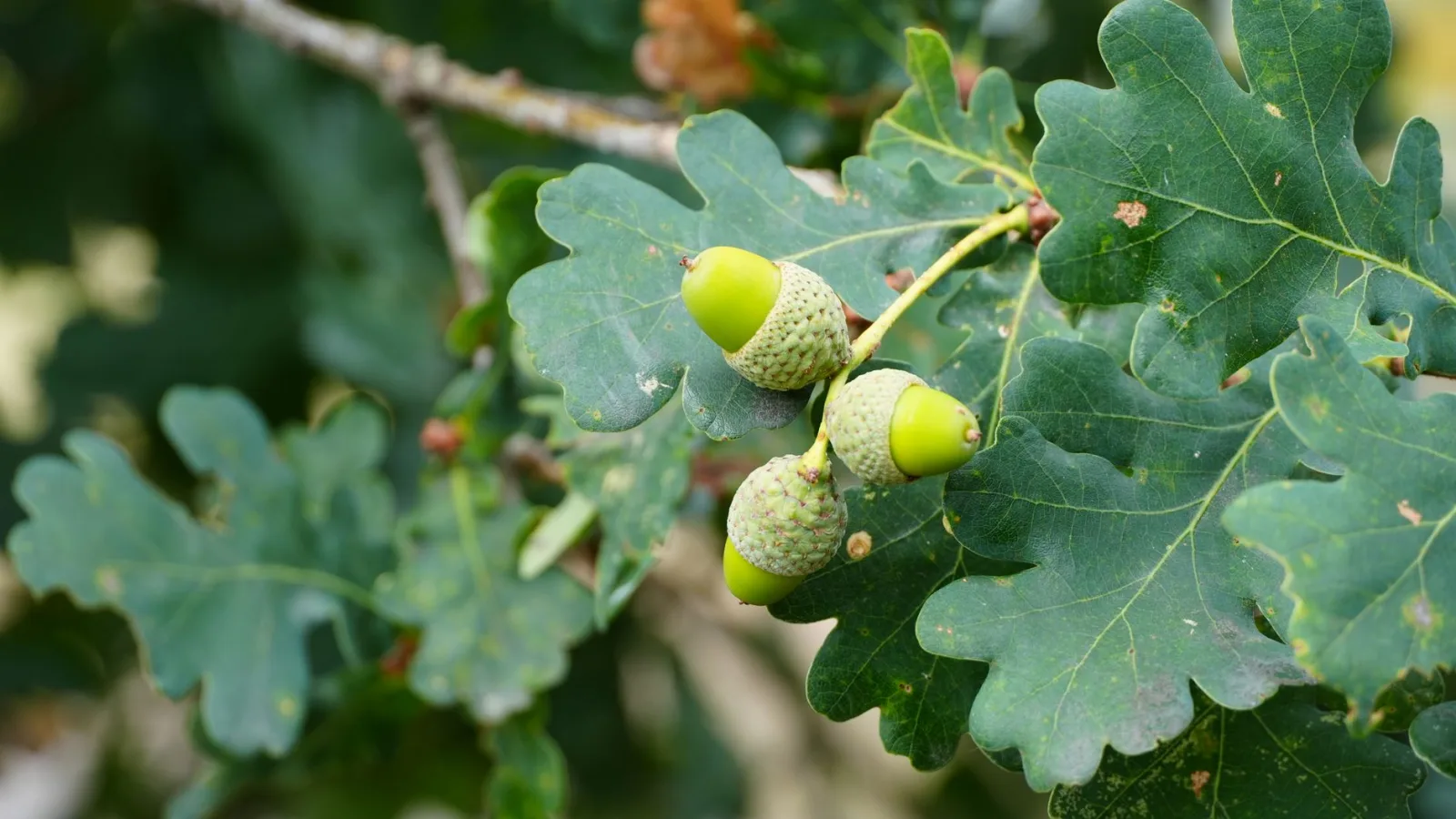
Picked Up Some Acorns? Here's How to Tell If They're Edible
Raw acorns are full of tannins, which make them harsh and puckery and can upset your stomach. Here's how to sort out the bad ones, leach out the astringency, and tell when they're ready to become Korean acorn jelly.
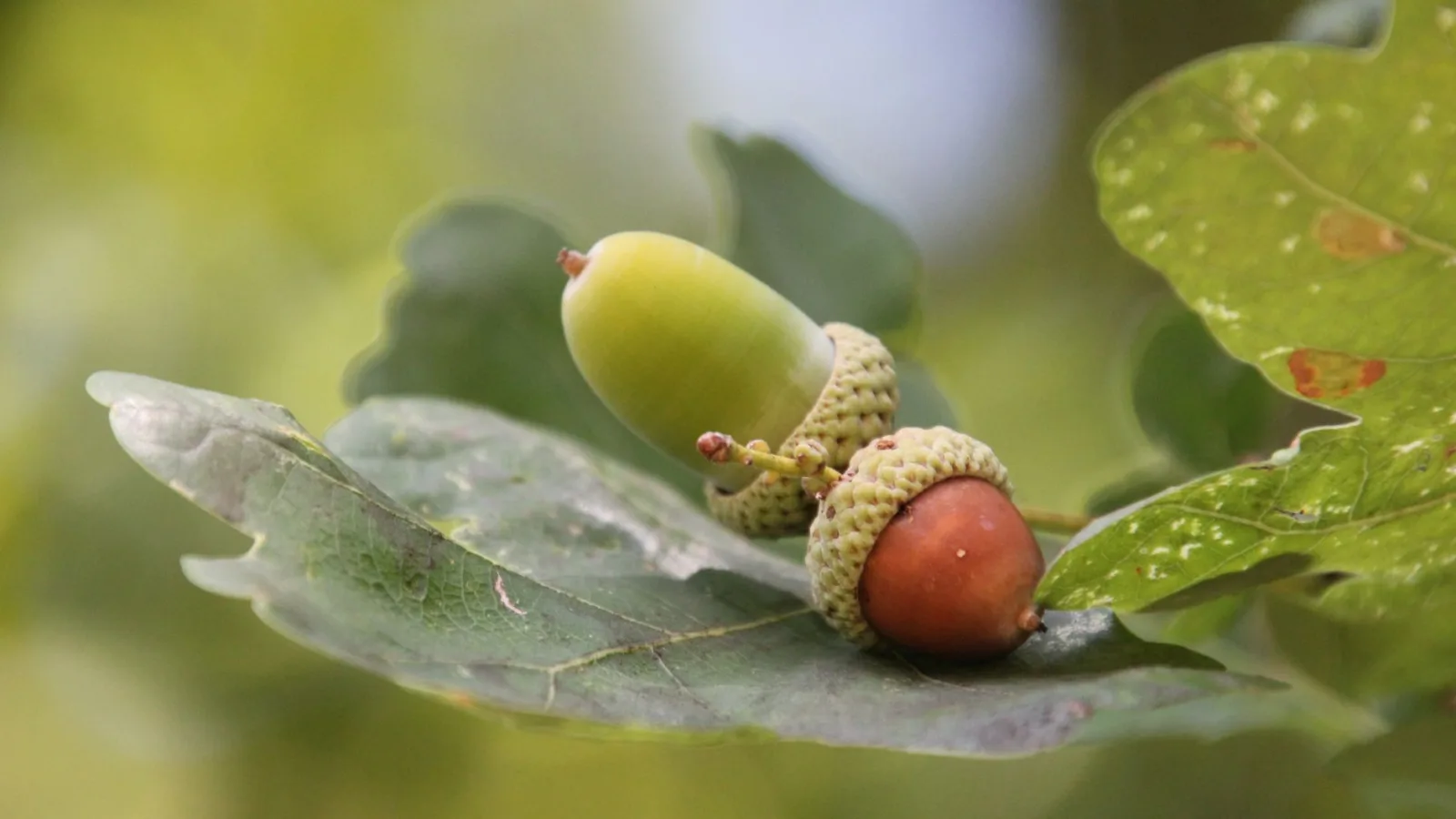
From Bitter Acorn to a Bowl of Acorn Jelly
Fresh acorns are too astringent to eat, but days of soaking draw out their tannins and leave behind a starch that sets into dotorimuk, Korea's delicate acorn jelly. Here's how it works, three ways to serve it, and how to forage with care.