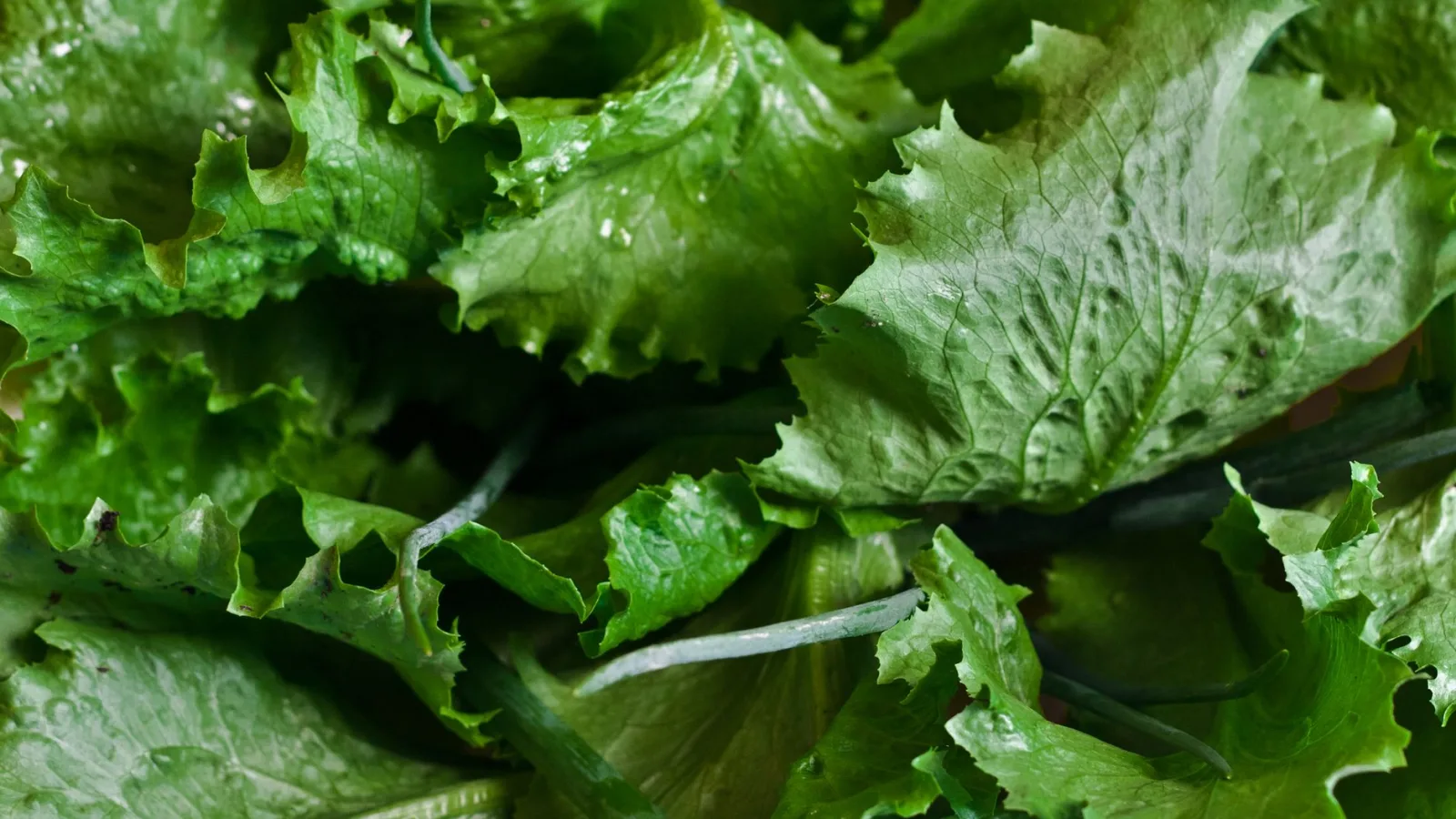
Lettuce grows fast, which makes it quick to register any shift in the soil beneath it. Harvest steadily from spring into summer and there often comes a point when the heads come in smaller, or the leaves lose some of their color. That is what a phosphorus (P) shortage looks like. Phosphorus is a mineral nutrient tied up in cell division and energy transfer, and even when there is plenty of it in the soil, growth slows if the plant can only take up a small share of it. In gardens that use little or no synthetic fertilizer, a phosphorus deficit often builds quietly, with nothing obvious showing above ground. A 2026 study published in Frontiers in Plant Science confirmed that humic substances extracted from leonardite — an oxidized lignite, or brown coal, mineral — improve how efficiently lettuce takes up phosphorus.
What a phosphorus shortage does to lettuce
When the phosphorus supply drops, top growth slows and chlorophyll content falls — hence the smaller, paler leaves. The roots do the opposite: they tend to grow longer as the plant reaches for more phosphorus. Total phenolic compounds and antioxidant capacity both rise, a protective response in plant cells under nutrient stress. Short on phosphorus, lettuce puts its energy into lengthening roots rather than filling out leaves.
What humic substances do in the roots and the leaves
In the study, humic substances were applied two ways — as a drench at the roots and as a foliar spray on the leaves — and both improved top growth. Phosphorus acquisition efficiency (PAE) and phosphorus utilization efficiency (PUtE) rose together, and acid phosphatase activity increased as well. That enzyme converts phosphate locked into organic matter into a form the plant can actually absorb.
Root structure changed too. In the foliar-sprayed plants, root volume and diameter increased even under low phosphorus. More root touching more soil means more surface area working to pull phosphorus in. The phenolic makeup of the leaves shifted as well. Foliar spraying raised the levels of particular phenolic compounds, while the root drench raised total phenolics and antioxidant capacity together. Lettuce is already a polyphenol-rich vegetable, and those figures ran higher still under humic treatment.
What to take from this in your own garden
Research conditions are not backyard conditions, so it is worth borrowing the principle rather than copying the exact numbers. Humic substance products are widely sold as horticultural fertilizer supplements. In the study, the root drench proved more effective where phosphorus was already plentiful, while under low phosphorus the drench and the foliar spray produced similar results.
Even soil you have composted generously can take up phosphorus poorly. If soil pH runs too low or too high, phosphate binds to soil particles where roots cannot reach it, and in that situation adding more fertilizer may barely move uptake at all. For lettuce, holding soil pH between 6.0 and 7.0 keeps phosphorus available. A humic supplement is one way to shore up uptake once those conditions are in place. If your lettuce is coming along more slowly than expected this summer, start by checking the soil's pH and its phosphorus supply.
Source: Frontiers in Plant Science, 2026, PMID 42293000