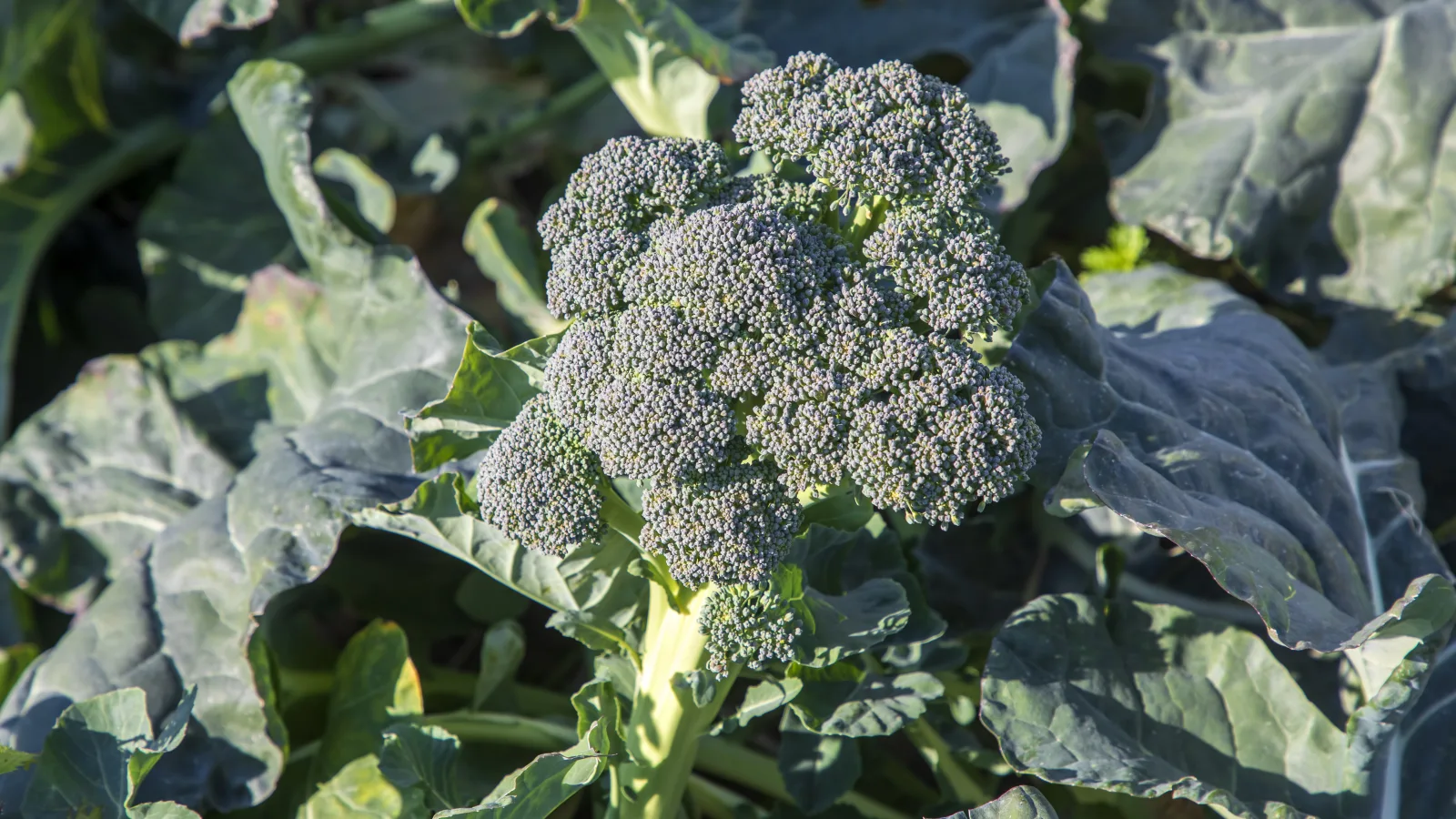
Harvest broccoli from the garden and what you carry inside is one fist-sized head. The thick stalk and the broad leaves below it stay out in the bed. By weight, you leave behind more than you bring in. Most of it ends up in the compost bin.
Different parts, different compounds
Broccoli contains a family of sulfur compounds called glucosinolates. Chew or cut a leaf or a stem and an enzyme inside the tissue snips those compounds apart, turning them into the substances behind broccoli's peppery bite and its distinctive smell. Within that family, the indoles — glucobrassicin and methoxyglucobrassicin — collect mostly in the head. The leaves, meanwhile, test higher on markers of antioxidant activity.
A recent study measured the 'Parthenon' variety, sorted by plant part and stage of growth. What drove the numbers was which tissue it was and how far along it had matured. Leaves, stems, and heads from the same plant came back with sharply different values. That spread is precisely why broccoli byproducts have been so awkward to use as a food ingredient: if the leaves and stems in one sack are all over the map, there's no honest way to state how much of what is in there.
Harvest timing moves the numbers too
Young leaves differ from fully grown ones, and a head differs depending on whether it has filled out to market size or is still short of it — or past it. When the study scored each part-and-stage combination across several markers together, heads at market maturity took the highest overall score. Isolate the antioxidant markers, though, and the leaves came out ahead. One rises as the other falls. So what you keep depends on what you're after.
The same logic holds at garden scale. Cut a head before it fills out and you harvest it with less indole content built up; leave the side shoots too long and they flower, and the tissue turns tough. The newer leaves up top are more tender and generally test higher than the older ones down at the base.
Screening with light
The researchers also tried shining ultraviolet, visible, and near-infrared light through the extracts, then estimating composition from the absorption pattern alone. On a test-tube marker — how much the extract dampens an enzyme involved in blood-pressure regulation — prediction accuracy reached 0.81. Antioxidant and indole compounds landed around 0.7. These are test-tube numbers, so they don't mean that eating broccoli lowers your blood pressure. Read them as one more reason to eat a range of vegetables.
The part that's actually useful in a home garden lies elsewhere. For some markers, a simple calculation using nothing but plant part and maturity matched the light-based prediction, or beat it. No instruments required: note which part you cut and when you cut it, and you can generally guess the difference.
Getting leaves and stems to the table
Pick the leaves young, blanch them for 30 seconds to a minute, and dress them as namul, a simple seasoned side dish. Fully grown outer leaves are tough, but strip out the thick midrib and they soften right up. Peel the stem, slice it thin, and stir-fry it — or pack it into jangajji, soy-brined pickles. The enzyme that cuts those compounds loose is heat-sensitive and gives out during a long boil, so a short blanch or a quick sauté beats simmering things soft. Blanching water pulls some of the compounds out with it, so put it to work as broth.
Harvested leaves wilt in a day. Shake off the water, wrap them in a damp cloth, and refrigerate them; they'll hold three or four days. Cut stem ends dry out fast, so it's best to trim and prep them the day you harvest.
Next time you cut a head, use the shears one more time and bring two or three of the leaves below it, plus a length of stem, in with you.
Reference — Food Chemistry, 2026, spectroscopic screening of broccoli byproducts.