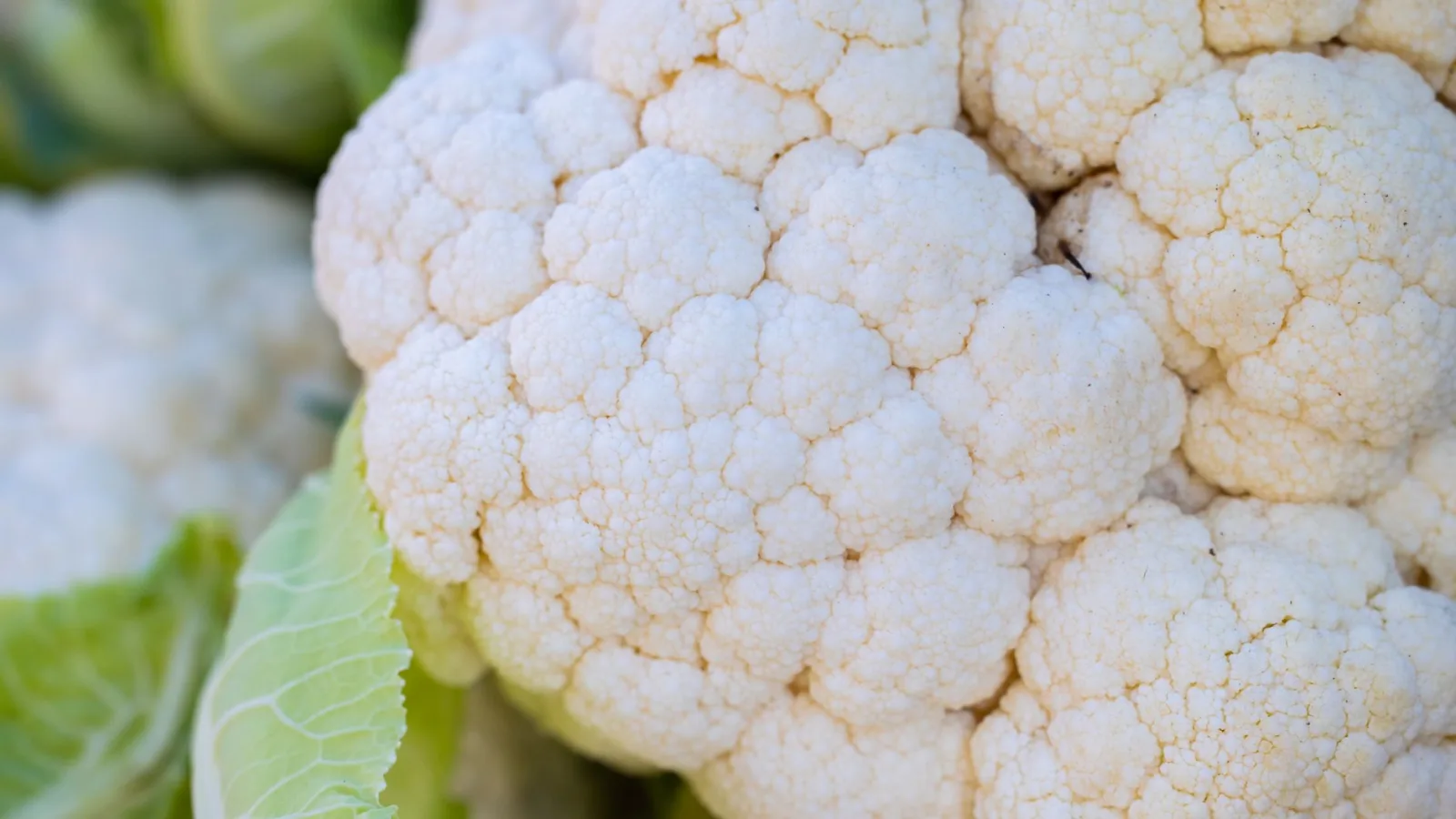
When you harvest a cauliflower, your hands go straight for the pale, tightly packed head in the center. The big outer leaves usually get cut off and tossed in the compost bin — they're bulky, they look tough, and it's easy to assume they aren't worth eating. But there's a fair amount of protein in those leaves.
What's Actually in the Leaves
Cauliflower leaves do the photosynthesis that feeds the developing head. Along the way, protein, dietary fiber, vitamin C, calcium, and iron all accumulate in the leaf tissue. The leaves keep growing for months before the head matures, which gives those nutrients plenty of time to build up. We've simply gotten so used to eating only the head that no one had much reason to look closely at what the leaves contain.
The catch is that leaf cell walls are on the thick side. Blanching or sautéing will get you the fiber and the vitamins, but the protein stays trapped behind those cell walls, and your body absorbs less of it. So even though the leaves are perfectly edible, you're not getting the full benefit of the protein in them.
Opening the Cell Walls with Ultrasound
A research team at RMIT University in Australia found that applying ultrasound to cauliflower leaves breaks open the cell walls and releases the protein bound inside. Because the method needs no high heat and no harsh chemical treatment, the study also confirmed that the protein undergoes very little denaturation. The researchers reported that protein extracted this way is good enough to serve as an ingredient in food manufacturing.
Today, most food-grade protein comes from crops like soy, peas, and oats. If a practical way to pull protein from the leaves and stems left over after a vegetable harvest catches on, it would cut down on wasted raw material and open up a new protein source at the same time. The researchers see the approach as applying well beyond cauliflower, to other post-harvest vegetable parts that normally get discarded.
Save the Leaves from Your Own Garden
Installing ultrasound equipment in a home kitchen isn't happening. But once you know there's real nutrition in the leaves, you start treating them differently at harvest time. Cooked cauliflower leaves are genuinely good eating. Young leaves work blanched, as ssam (leaf wraps for rice and grilled meat) or as namul, a seasoned side dish of greens. Fully grown leaves go into doenjang (fermented soybean paste) soup or a stir-fry. They're best used right after harvest, while they're still fresh.
So the next time you cut a head of cauliflower from the garden, set aside a leaf or two from the outside. Blanch them briefly in salted water, then toss with sesame oil and ground perilla seed, and you've got a side dish. The stems work too — peel them and use them in a stir-fry or a soup. If you end up with a lot of leaves, blanch them, squeeze out the water thoroughly, and freeze them; pull out a handful whenever you're making soup or a stir-fry. Something that was headed for the compost bin makes it to the table with one pot.
Source RMIT University, research on ultrasound protein extraction from cauliflower leaves, 2025.