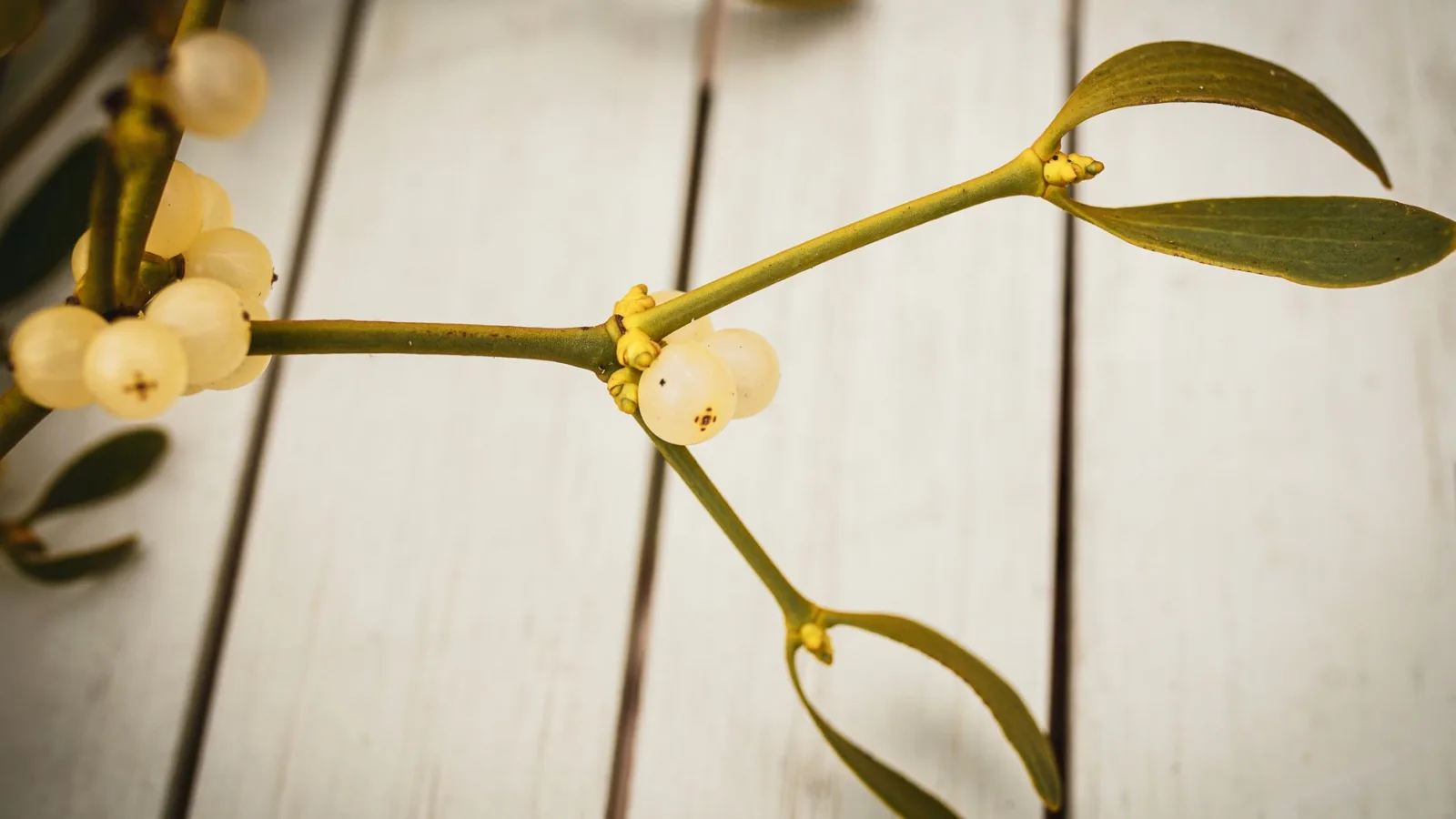
Once the last napa cabbage is pulled from the plot, there is less to do in the garden and more to look up at. When the oaks beyond the fence drop every leaf, green clumps appear, clustered high in the branches. Mistletoe is wintering there with its leaves still on. Because it grows up in the trees, it hides behind the canopy all summer and stands out from a distance only between December and February. Readers in the Southern Hemisphere will see the same clumps between June and August. Those clumps are what the Donguibogam, Korea's great medical compendium of 1613, recorded as a medicinal herb.
It Grows Its Own Leaves and Takes Its Water from the Tree
Mistletoe puts out its own leaves and photosynthesizes, but it draws water and minerals from the xylem of the tree it lives on. A root-like organ pushes into the branch and reaches the water-conducting tissue, which is why botanists call it a hemiparasite. In Korea it is most often found on oaks, though it also grows on chestnut, pear, and mulberry. Its scientific name is Viscum album var. coloratum, a variety native to Korea, China, and Japan. It is the same species as European mistletoe, but its berries are yellow rather than white.
Inside each yellow berry is a sticky polysaccharide mucilage. When a bird eats the fruit and wipes the leftover seed on a branch, or lets it fall in its droppings, this mucilage dries and glues the seed in place. It is the reason a mistletoe seed takes hold on a branch rather than in soil.
The Donguibogam Chose Only What Grew on Mulberry
In the Donguibogam's section on trees, mistletoe is listed as sangsanggiseng, "the parasite on the mulberry," with its Korean name recorded as mulberry mistletoe. Its nature was said to be neutral, its taste bitter yet sweet, and it carried no toxicity. The text describes it growing on old mulberry trees, with leaves thicker and softer than a tangerine's and stems that are thick and snap easily. It also notes yellowish-white flowers in the third and fourth lunar months, followed in the sixth and seventh by yellow berries the size of an adzuki bean.
This entry was particular about the tree. Mistletoe grows on every kind of tree, it says, but only the kind from mulberry goes into medicine, and the stems and leaves are to be gathered on the third day of the third lunar month and dried in the shade. Because mulberry mistletoe is very hard to come by, the text adds a test: cut the stem and choose pieces with a deep yellow interior and berries that hold a sticky juice. Why it had to be mulberry, the entry does not say. The original text and commentary for the sangsanggiseng entry can be read in Homiclub's Donguibogam archive.
Modern Analysis Says It Differs with Every Tree
Modern compositional analysis has picked out two groups of proteins in mistletoe. One is the lectins, sugar-binding proteins also known as Viscum agglutinins. In 1981, H. Franz and colleagues reported in the Biochemical Journal that they had isolated three distinct lectins from European mistletoe. The other group, the viscotoxins, is a family of small peptides. Alongside these, analysts have confirmed the flavonoids and phenolic acids common to many plants, as well as the mucilaginous polysaccharides of the berry.
The amounts are hard to pin to a single figure. Mistletoe: The Genus Viscum, a 2000 reference volume edited by A. Büssing, summarizes the finding that lectin and viscotoxin content varies with the species of host tree and the season of harvest.
Here the old record and the new one overlap. The Donguibogam's choice of tree and harvest date, and today's analysis alike, treat which tree and which season as the conditions that matter. They part ways, too. The old text settled on one tree, the mulberry. Modern analysis only notes that each tree yields something different, and it ranks none of them as better. Both the old record and the compositional analysis are accounts of what mistletoe is, not of which illnesses it treats. The mistletoe crop guide gathers its components and pairings in one place.
In the Garden, You Don't Plant It. You Stick It to a Branch
In a home garden, mistletoe is grown by attaching it to the oak, pear, or mulberry branches around the edge of the plot. Between December and February, pick a ripe yellow berry and press it onto the bark of a young, finger-thick branch. Expect a year or two before the first leaves show, and several more before it becomes a clump you can see from a distance. Since mistletoe shares the tree's water, limit it to one or two spots per fruit tree, and check each spring that it isn't spreading.
The dried stems and leaves are what you simmer to drink. The berries are for sticking to branches. At home, start with these amounts.
- Pour 1 L of cold water over 20 g of dried mistletoe and bring it to a boil together. Once it boils, lower the heat and let it simmer gently for about 30 minutes. When the water turns a pale yellow, strain out the solids. A longer, stronger brew is not a better one.
- The first things you taste are bitterness and astringency. Split two jujubes (Korean dates) and add them for the last 5 minutes, and a touch of sweetness makes it easier to drink.
- If the bitterness is too much, simmer a spoonful of roasted barley or dunggulle (dried Solomon's seal root) along with it. The toasty, grain-like aroma covers the astringent finish.
Once it cools, keep it in the refrigerator and finish it within a day. If you take any medication or are pregnant, talk with a health professional before drinking it.
The Donguibogam told readers to cut the stem to see whether the inside was yellow and to feel whether the berry juice was sticky. Put into today's words, it means this: before you drink, first ask which tree it came from.
Sources: Donguibogam, Section on Trees, sangsanggiseng entry · Franz H. et al., Biochemical Journal 195 (1981) · Büssing A. (ed.), Mistletoe: The Genus Viscum (2000)