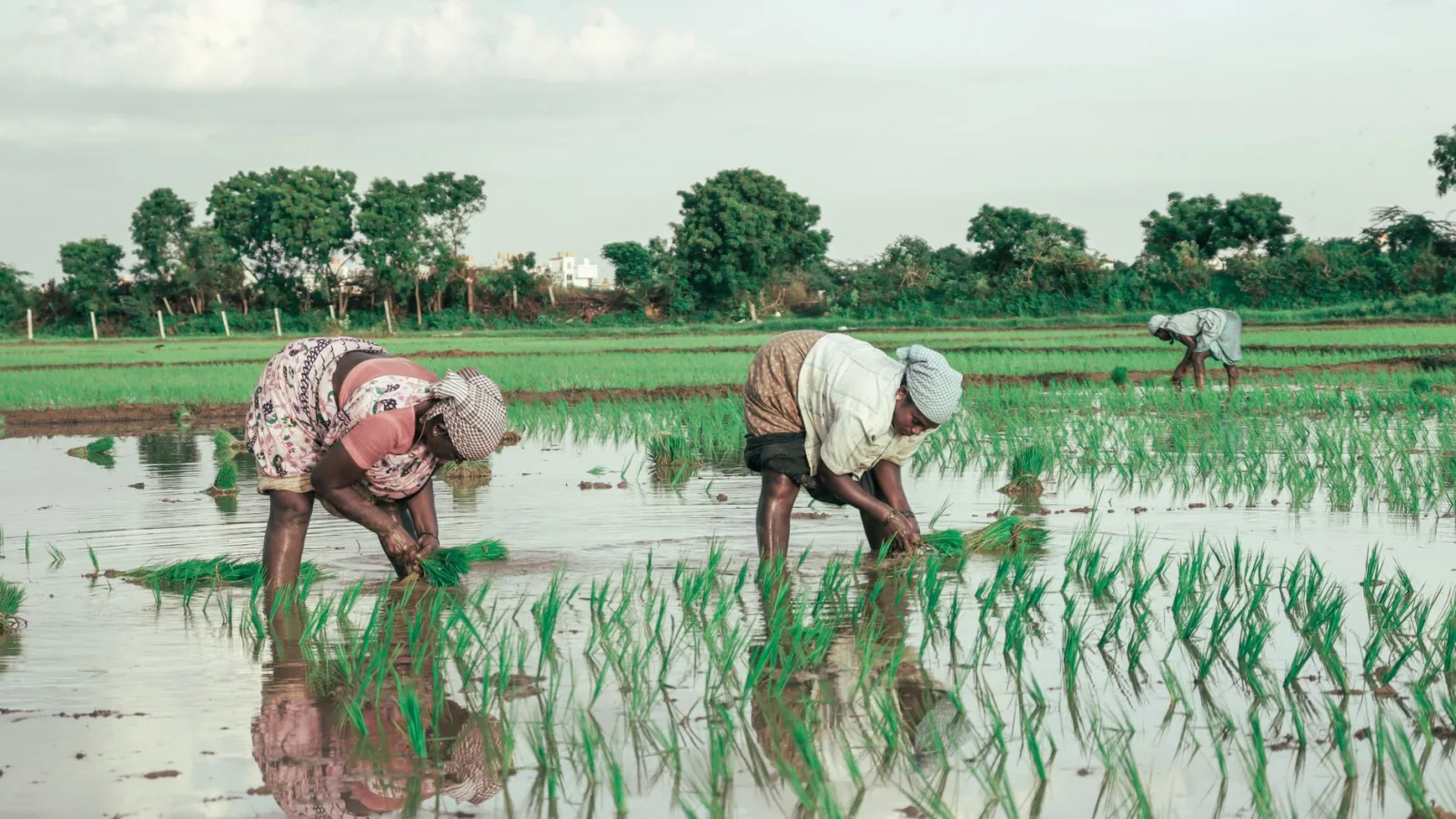
Fill a 20-liter (about 5-gallon) bucket with soil and water, tuck in three or four rice seedlings, and in a little over four months you can harvest a few golden, ripe heads of grain. One bucket doesn't give you much rice, but the same crop feeds more than 3.5 billion people around the world every day. How did a grass that once grew wild in wetlands end up on so many tables?
From Riverside Wild Rice to Crop
Most of the rice eaten worldwide is Asian rice (Oryza sativa). Archaeological sites along the lower Yangtze River in China show that people were harvesting and planting wild wetland rice starting about 9,000 years ago. In a 2009 paper in Science, a team led by archaeobotanist Dorian Fuller of University College London showed how grains that stay on the plant when ripe, instead of dropping off on their own, slowly became more common over several centuries.
Exactly where rice was first domesticated is still debated. In a 2012 genomic study published in Nature, researchers at the Chinese Academy of Sciences concluded that japonica (short-grain, sticky rice) was first cultivated in the Pearl River basin of southern China. They proposed that indica (long-grain, less sticky rice) arose when this rice spread into South and Southeast Asia and crossed with local wild rice. That conclusion differs from the view centered on the Yangtze, where most of the archaeological sites are found. Africa has its own separately domesticated species, African rice (Oryza glaberrima). In a 2018 paper in Current Biology, researchers at the French National Research Institute for Sustainable Development (IRD) estimated that it was domesticated about 3,000 years ago in the inner Niger Delta of West Africa.
How Rice Traveled With People
Asian rice spread to the Korean Peninsula, Japan, and Southeast Asia, and westward through India and Persia all the way to the shores of the Mediterranean. Sometime around the 8th to 10th centuries, rice paddies appeared in the eastern Iberian Peninsula by way of the Arab world, and the paddies around Valencia, Spain, still grow rice for paella (a rice dish cooked in a wide, shallow pan).
In the late 17th century, large-scale rice farming took hold in what is now South Carolina. In the 2001 book Black Rice, geographer Judith Carney argued that this agriculture depended on the growing know-how of enslaved people brought from West Africa. Some historians have pushed back on that argument.
IR8, released in 1966 by the International Rice Research Institute (IRRI) in the Philippines, was a short variety that rarely toppled over. Given plenty of fertilizer and water, it yielded far more than traditional varieties, and it was soon planted in paddies across Asia. According to UN Food and Agriculture Organization figures, about 90% of the world's rice still comes from Asia.
Growing Bucket Rice and Cooking It at Home
A number like 3.5 billion tells you how many people eat rice, and not much else. If you plan to grow rice and cook it at home, the first things to think about are what soil you plant it in and how you cook it.
- Choosing soil: Rice growing in flooded soil takes up more arsenic. That makes it safest to avoid soil from roadsides or from around former factory sites.
- Planting: Fill a 20-liter bucket two-thirds full with a half-and-half mix of garden soil and potting mix, and keep the water about 3 cm above the soil surface. Once nighttime temperatures no longer drop below 15°C (59°F), plant 3–4 seedlings together in one spot, and set the bucket somewhere that gets more than 6 hours of sun a day.
- Harvesting: Cut the stalks 40–50 days after the heads emerge, when about 90% of the grains have turned golden. Draining the water about 10 days before harvest lets the soil dry out and makes cutting easier.
- Cooking: The US Food and Drug Administration advises that boiling rice in 6 to 10 parts water to 1 part rice and then pouring off the excess water cuts inorganic arsenic by 40–60%, depending on the type of rice. For 150 g of rice, that means 0.9 to 1.5 L of water. Keep in mind, though, that with enriched rice (rice with added nutrients), iron and B vitamins drain away too.
Brown rice keeps its bran layer, so it has more dietary fiber than white rice. According to USDA food composition data, 100 g of cooked brown rice contains about 1.6–1.8 g of fiber, compared with about 0.4 g for white rice. Fiber may help soften the spike in blood sugar after a meal, but how much depends on what you eat alongside it and how much you eat. The bran layer also holds on to more arsenic, so if brown rice is a regular part of your diet, try the boiling method above as well.
Every place that took up rice found its own way to cook it, but many share a fondness for the crust that forms on the bottom of the pot. Think of Korea's nurungji (scorched rice), the socarrat on the bottom of a Valencian paella pan, and Iran's tahdig, the rice at the bottom of the pot that's deliberately crisped until golden.
Sources: UN Food and Agriculture Organization statistics; International Rice Research Institute; US Food and Drug Administration guidance on arsenic in rice; USDA FoodData Central; Fuller et al. 2009, Science; Huang et al. 2012, Nature; Cubry et al. 2018, Current Biology; Judith Carney 2001, Black Rice