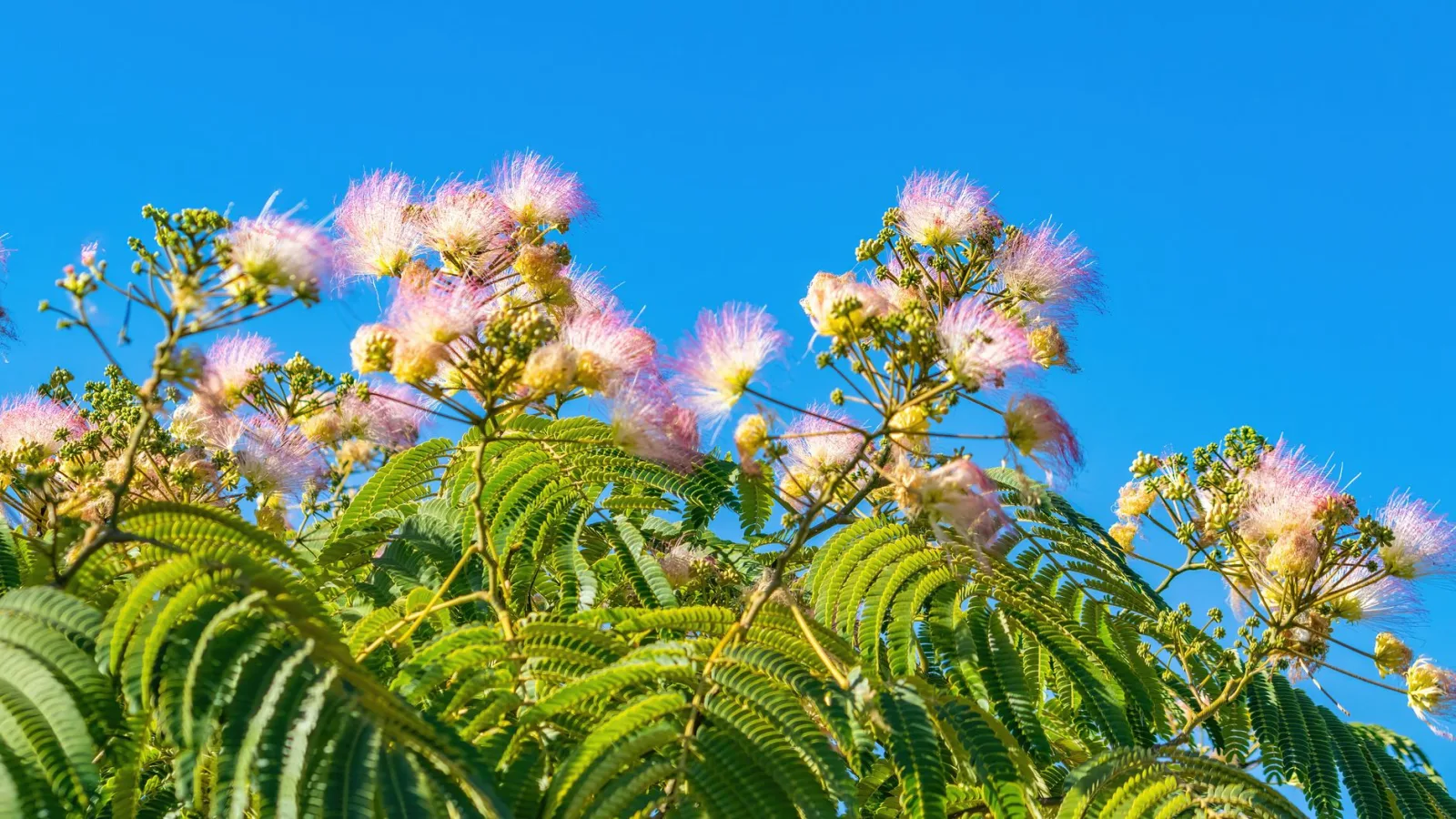
Its leaves are gone now, and flat brown pods hang in clusters from the bare branches of the silk tree. When the wind picks up, the thin seeds inside knock against one another with a dry rattle. All summer this tree was covered in pink blossoms. This time of year, only the bark and the pods are left. The bark is the part the Dongui Bogam recorded as a medicine.
Haphwanpi, Listed Among the Trees
The Dongui Bogam, Heo Jun's 1613 compendium of Korean medicine, lists silk-tree bark as haphwanpi (合歡皮) in the tree section of its materia medica volume. It describes the bark as neutral in nature, sweet in taste, and nontoxic. The tree itself, the text says, resembles a paulownia and has remarkably supple branches. Its leaves are compared to those of the Japanese honey locust or the pagoda tree, but they are finer and so densely set that they intertwine.
Because the leaves press together each evening, the tree was called haphon (合昏), or "joined at dusk," and the text also gives the alternate name yahappi (夜合皮), "night-closing bark." The flowers open in the fifth lunar month, which usually falls around June on the modern calendar, and the book describes them as yellowish white. Pods form in autumn and hold seeds that are very thin and small. Bark and leaves, it notes, could be gathered in any season. The full entry and its commentary are laid out in the haphwanpi entry of Homiclub's Dongui Bogam.
Setting the Old Record Beside Modern Analysis
The old medical texts used the stem bark, and modern chemical analysis has also focused mainly on the bark. Researchers have isolated triterpene saponin glycosides from the stem bark of plants in the genus Albizia. Those found in the silk tree were named julibrosides, after its scientific name, Albizia julibrissin. Saponins foam when dissolved in water, which explains the froth that rises when the bark is simmered. Reference guides also list flavonoids, astringent tannins, and the volatile aromatic compounds behind the faint, sweet scent of the flower tea.
The two accounts don't always line up. The old record calls the taste simply sweet, but the modern list of constituents includes tannins, which are astringent. The flower color differs as well. The Dongui Bogam describes yellowish-white blossoms, while the flowers we see in gardens today have slender stamens that are white at the base and deepen to pink toward the tips. The saponin studies identify what compounds the bark contains. They don't confirm the uses recorded in the old texts, and they don't show any effect in preventing or treating disease. The bark was handled as a medicinal material in its day, so at home the sensible approach is to stick to enjoying the flowers as tea.
The old record and modern botany do agree on one thing: the evening movement of the leaves. At sundown the small leaflets fold together in pairs, a movement known as nyctinasty, or sleep movement. It is common throughout the legume family. Botanists explain that cells in the pulvinus, a small joint at the base of the leaf stalk, take in and release water. As those cells swell and shrink, the leaves fold. The silk tree's pulvini have long been studied in plant-physiology research on this movement. The old name haphon describes the very same thing.
Bringing One Into the Garden
The silk tree is native to a range stretching from western Asia to East Asia, and today it is also grown as an ornamental in North America and southern Europe. It is deciduous and typically reaches 6–12 m (about 20–40 ft) at maturity. Choose a spot along the edge of the garden where it won't cast shade over your vegetable beds. It likes full sun and well-drained soil, and because it is a legume, it does fairly well even in poor, dry ground. Growing details are collected in the silk tree entry in our Crop Guide.
In the Northern Hemisphere, sow the seeds in March or April. Once the tree is established, it blooms in June and July. The seed coat is hard, so soak the seeds overnight in warm water the day before sowing. Plant them two to three times as deep as the seed is thick, and they'll come up evenly. One word of caution: the seeds spread easily. In the southeastern United States, silk trees that have escaped into forest edges are managed as an invasive species.
Picking the Flowers and Brewing Tea
For tea, pick the flowers on a day when they are fully open, after the dew has dried. Spread them out in the shade right away and they'll keep their pink color. If you dry them while they're still damp, they'll turn black.
Put a pinch of dried flowers in a teapot. A pinch is the amount you can lightly gather between your thumb, index finger, and middle finger. Pour in 200 ml (about 7 fl oz) of water at around 90°C (195°F) and steep for 3–4 minutes. The aroma is delicate, so if the water is too cool, the tea will taste of almost nothing. You can steep the same flowers a second time. A little sweetness actually makes the faint floral note come through more clearly. Try slicing one dried jujube and adding it to the pot. If you prefer honey, pour the tea into your cup and let it cool a little before stirring it in.
It's worth picking the pods left on the branches before they fall. You'll find far fewer silk-tree seedlings popping up around the garden the following spring. For sowing, the seeds from a few pods are plenty. Store them in a paper bag in a cool place.
Sources: Heo Jun, Dongui Bogam, Materia Medica volume (Tangaek-pyeon), Tree Section (1613) · Zou K. et al., Carbohydrate Research (2000), isolation of saponins from the silk tree · Satter R.L. & Galston A.W., Annual Review of Plant Physiology (1981), research on leaf movements