A few white blossoms have opened on the potted tea plant now sheltered under the eaves. The tea plant (Camellia sinensis) is an evergreen that flowers in fall and puts out new shoots in spring. Pick the leaves and pan-fire or dry them, and you have tea. Each leaf holds the compounds responsible for astringency, bitterness, and umami. How much of each ends up in your cup depends on how much sun the plant received and how hot your brewing water is.
The Compounds Behind Astringency, Bitterness, and Umami
Tea's astringency comes from catechins, a group of polyphenols. The best known of these is EGCG (epigallocatechin gallate). Caffeine, an alkaloid, contributes to the bitterness, while theanine, an amino acid, supplies the savory umami note. Volatile aroma compounds round out the picture, which is why each tea has its own scent.
Of tea's effects on the body, the best known is caffeine's ability to make you feel less drowsy. If you're a sensitive sleeper, try cold-brewed tea or tea blended with roasted brown rice in the late afternoon.
Shade-Grown Leaves Are Richer in Theanine
Theanine is made in the roots and travels up into the leaves. When the leaves are exposed to sunlight, the plant uses some of that theanine to build catechins. In 1968, the Japanese researcher Kito and colleagues published findings in the journal Phytochemistry showing that theanine serves as a raw material for catechins. Japanese growers put this to work when they cover their plants for about 20 days before picking leaves for gyokuro, a prized shade-grown green tea, and for matcha. Leaves grown this way contain more theanine and taste less astringent than leaves grown in full sun.
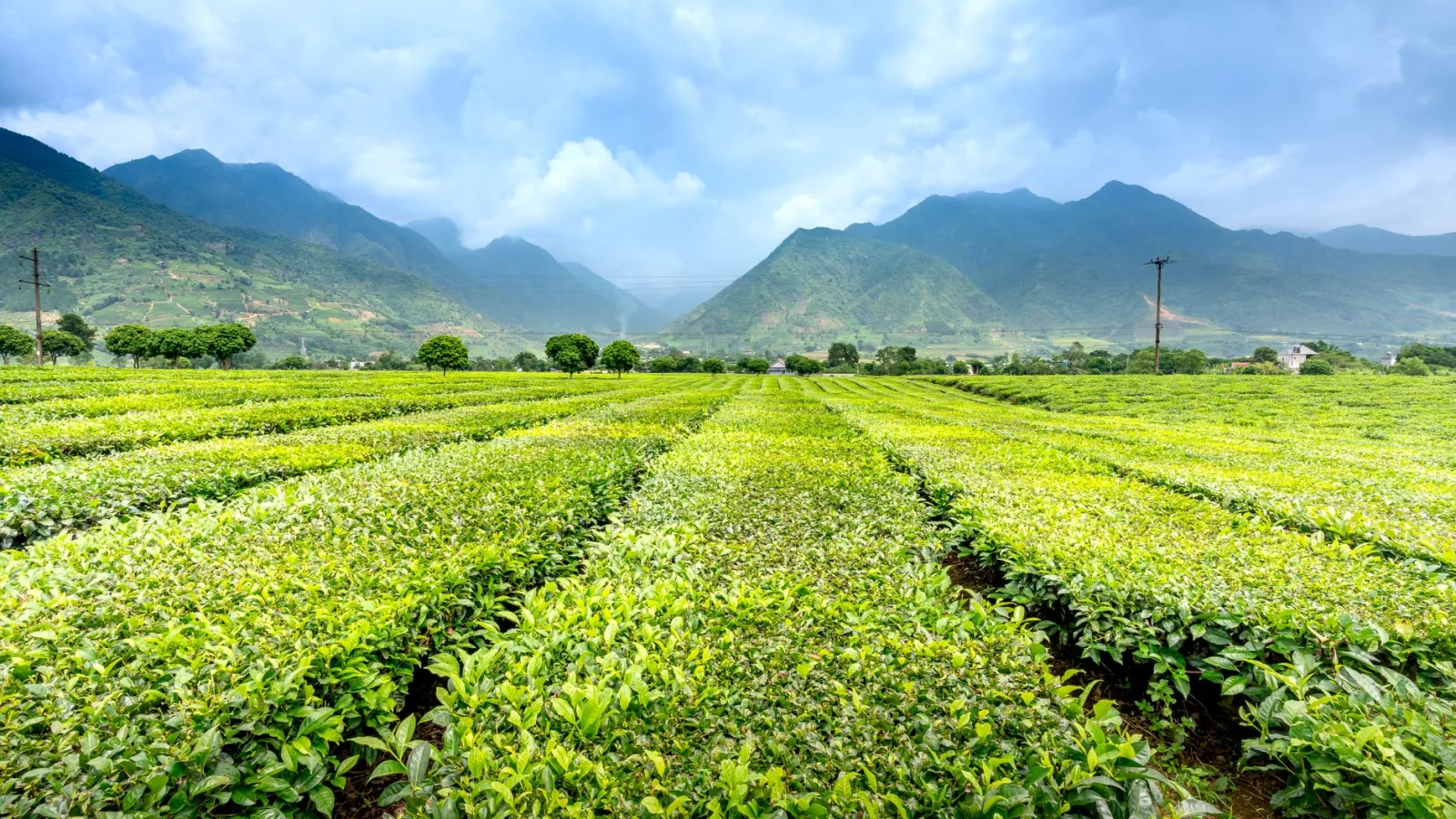
If your tea plant lives in a pot, move it into partial shade or drape it with shade cloth two to three weeks before you pick the first flush. Field guides also note that new shoots grow especially tender on misty mountain slopes where the sunlight comes in filtered.
Where It Grows and When to Pick
Tea plants thrive in warm, rainy places. They do best with an average annual temperature of 13°C or higher and around 1,500mm of rain a year, and they grow most vigorously between 18 and 25°C. They prefer well-drained, acidic soil (pH 4.5–5.5). If temperatures stay below −10°C for long, the leaves suffer cold burn. China, India, and Kenya are the leading producers, and Sri Lanka, Türkiye, and Vietnam grow a great deal as well. In Korea, tea is planted in open ground in the milder southern regions, such as Boseong, Hadong, and Jeju Island.
If your winters are colder than that, grow tea in a pot and let it spend the winter indoors or under the eaves. An acidic potting mix made for blueberries makes it easy to get the pH right. In the Northern Hemisphere, transplant seedlings in March or April, and pluck the new shoots from late April through June. Field guides rate tea as "difficult" to grow, but as long as the soil acidity and winter temperatures are right, it doesn't need much fussing.
Choose Your Flavor with Water Temperature
Catechins and caffeine are drawn out readily by hot water and much less so at lower temperatures. To tone down astringency, try cold brewing. Add about 10g of dried tea leaves to 1L of water, leave it in the refrigerator for 6 to 8 hours, then strain out the leaves. It's a perfect summer use for leaves picked from your own garden.
For a hot cup, start with 2 to 3g of tea leaves per 150ml of water. Bring the water to a boil, let it cool to 70–80°C, and steep for 1 to 2 minutes. Mixing roasted brown rice with the tea leaves 1:1 adds a toasty, nutty aroma, and because each cup uses fewer tea leaves, it also has less caffeine. With this blend you can raise the water temperature slightly, to 80–90°C. Nibbling a little tteok (steamed rice cake) or dasik (a small molded confection of grain flour bound with honey) before you sip makes the astringency less noticeable.
What the Donguibogam Recorded About Tea
The Donguibogam, Korea's classic 17th-century medical encyclopedia, lists tea in its chapter on trees (Mokbu, 木部) under the entry gocha (苦茶, "bitter tea"). It describes tea as slightly cold in nature, sweet and bitter in taste, and nontoxic. These are classifications from traditional medicine and should be read on their own terms, not as modern medical findings. The text says the tree is small, resembling a gardenia, and puts out leaves in winter, and it gives tea's names as cha (茶), ga (檟), seol (蔎), myeong (茗), and cheon (荈). Young buds, likened to a sparrow's tongue and a grain of barley, were called jakseol (雀舌) and maekgwa (麥顆), and the entry describes picking the buds, pounding them, and pressing them into cakes. The same entry names nine teas known for their flavor, each called after its place of origin, among them Longjing (Dragon Well), Lu'an, and Lushan Yunwu.
The entry also distinguishes early-picked tea, cha (茶), from late-picked tea, myeong (茗). The first flush of late April and the leaves of June may come from the same tree, but their ratios of theanine to catechins differ, so they likely taste different too. Long before anyone could measure that difference, the old medical text had already marked it with a name.
Sources: Donguibogam, Mokbu (木部), Gocha (苦茶) · Nongsaro, Rural Development Administration of Korea · Korea Biodiversity Information System, Korea National Arboretum · Kito et al., Phytochemistry (1968)