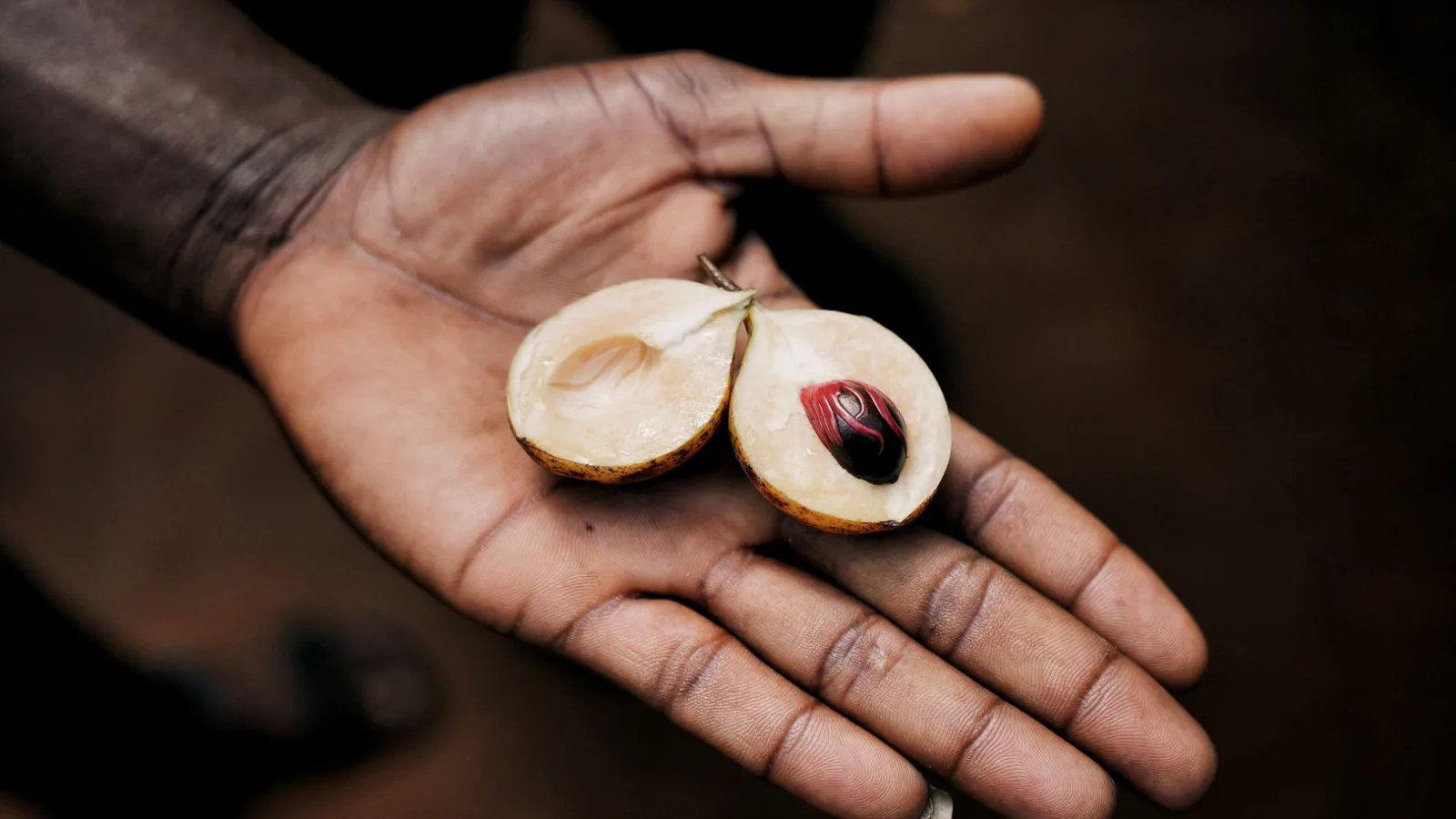
Once the frost arrives and the garden chores taper off, the oven starts seeing more use. You mash the potatoes you dug in the fall, simmer a white sauce from milk and flour, and bake a gratin. The hard seed you grate over the pot at that moment is nutmeg. Korean cooks today mostly call it by its English name, but as yukdugu the spice also has an entry in the Donguibogam, a Joseon-era Korean medical text compiled 400 years ago.
What the Donguibogam Recorded About Nutmeg
The Donguibogam lists nutmeg, yukdugu (肉豆蔲), in its 草部 (the section that gathers plant-based medicinals), along with an alternate name, yukgwa (肉果). The 【唐】 mark beside the name was the label for ingredients brought in by way of China. The text describes its nature as warm and its taste as pungent, adds that some call it bitter, and records it as nontoxic.
It describes the seed as small and round, with a purplish shell that is hard and thin, and a pungent kernel inside. The shell is removed and only the kernel is used, and the text goes on to give a preparation method: wrap the kernel in flour dough mixed with vinegar, cook it in hot ashes, then wrap it in paper and pound it to draw out the oil. It also left a prohibition: do not let it touch copper. These are the words of an old medical text classifying its medicinals, so the phrase "nontoxic" can't really be read as a modern safety judgment. The original text and commentary are in Homiclub's Donguibogam entry on nutmeg.
The Standard: An Oily-Looking Seed Is Better
The original reads '肉油色肥實者佳': seeds that are oily in color and plump count as good, while those that are dry, pale, and thin are inferior. This standard overlaps with how whole nutmeg is chosen today. A nutmeg seed is rich in a fat that is called nutmeg butter once it solidifies, so when you grate it, the cut surface glistens with oil. A dry, lightweight seed is one that has sat too long and lost its aroma.
The old grading standard appears to have come from the nature of what's inside the seed. At the store, pick a seed that feels heavy in your hand, and the first time you grate it, check whether the cut surface has a sheen.
The Aroma Compounds, and What's Been Reported When Too Much Is Eaten
Homiclub's nutmeg crop guide names myristicin as the main component of the essential oil (the volatile aromatic compounds), and notes that elemicin and sabinene are found alongside it. Myristicin gives nutmeg its characteristic aroma, and it is also the compound tied to problems reported when large amounts are eaten. Poisoning cases, with dizziness and nausea after eating the equivalent of one or two whole nutmegs at once, have been reported in several countries. Examples include a case series from a German poison information center published by Stein et al. in 2001, and a review of 2001–2011 cases at the Illinois Poison Center in the United States, published by Ehrenpreis et al. in 2014.
Set beside the old record, some points line up and others don't. The standard of choosing an oily seed fits the fact that the seed is rich in fat. The phrase "nontoxic" does not fit the cases of large-dose ingestion. The medical text used a kernel that had been cooked and had its oil removed; in today's kitchen, we grate the seed raw, oil and aroma intact. Still, the amount used in cooking is a few scrapes on a grater, a different scale from the one or two whole seeds in the case reports.
Garden Potatoes, and How to Grate Nutmeg into White Sauce
The planting-month and harvest-month fields in the crop guide are blank. Nutmeg trees grow in tropical regions such as Indonesia and are hard to raise in a temperate garden. As the 【唐】 mark in the Donguibogam shows, nutmeg was an imported ingredient in Joseon Korea, too. In the garden, grow the potatoes you'll eat with it, and buy the nutmeg as whole seeds. Pre-ground nutmeg clumps because of its starch, and its aroma compounds evaporate, so grate it fresh each time.
- Béchamel (a white sauce made from milk and flour) and cream sauces: After turning off the heat, grate in two or three scrapes. The raw-flour smell fades and the aroma stays.
- Ground meat: Mix it into the meat for hamburger steaks or meatballs along with salt and pepper. A few scrapes per plate is plenty.
- Mashed potatoes and baked goods: Add a little to mashed potatoes, and add it along with cinnamon to cookie or pound cake batter. The aroma fades during baking, so mix it in at the batter stage.
As for the prohibition against letting nutmeg touch copper, the record carried over into the crop guide gives no reason. The standard of choosing by oily sheen can be explained by the seed's high fat content, but the copper prohibition remains unexplained.
Sources: Donguibogam, 草部, entry on nutmeg (肉豆蔲) · Stein et al., Forensic Science International, 2001 · Ehrenpreis et al., Journal of Medical Toxicology, 2014