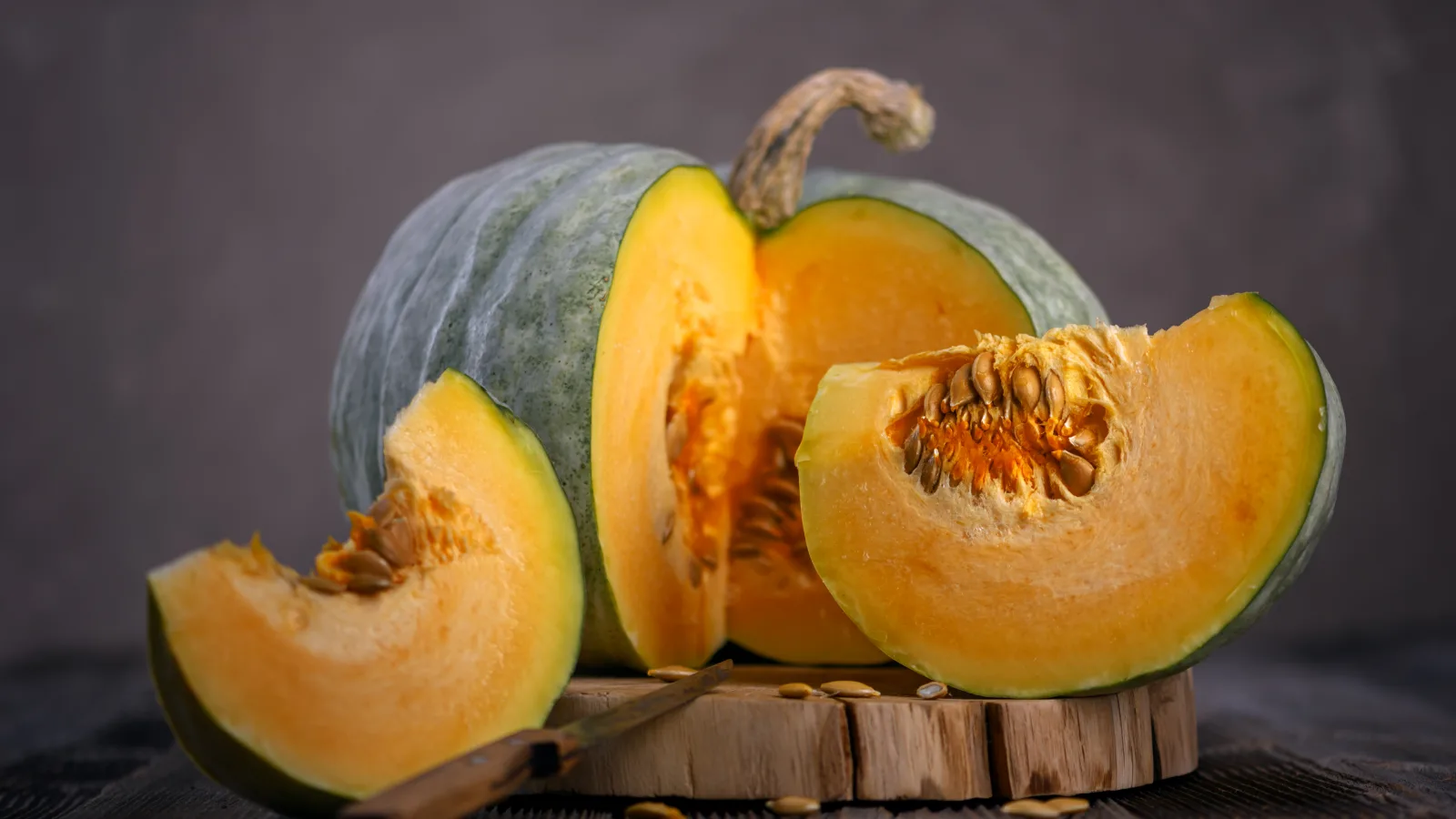
Set a freshly harvested kabocha on the cutting board and split it, and you'll see that even squash grown in the same row don't match inside. One is close to pale yellow; the one next to it comes up a deep orange. Scrape out the seeds, cut it into wedges, and the difference is starker still.
The color comes from carotenoids
How deep a kabocha's flesh runs depends on how much of a pigment group called carotenoids the fruit has stored up. A study published in 2026 sorted Korean-grown kabocha lines into three groups by fruit size — small, medium, and large. Researchers then compared six genes involved in making the pigments and, in the flesh of those same fruits, measured how much pigment had actually accumulated. Four pigments were measured: alpha-carotene, beta-carotene, beta-cryptoxanthin, and zeaxanthin.
Every line turned up single-base differences in those genes — single nucleotide polymorphisms — and the effects never stopped at just one pigment. Change a single gene, and the amounts of several pigments moved together. The markers tied to fruit length, meanwhile, were separate from the pigment genes altogether. In other words, a big kabocha isn't necessarily a deeply colored one. When you're picking out seed, the flesh color listed in the variety description tells you more than the fruit size does.
What the four pigments do in your body
- Beta-carotene — converts to vitamin A inside the body. It's what your eyes draw on to adjust in a dark room, and what helps keep skin and mucous membranes healthy.
- Alpha-carotene — also converts to vitamin A, but eat the same amount and you get roughly half the conversion you'd get from beta-carotene.
- Beta-cryptoxanthin — partly converts to vitamin A. It's the same pigment that's abundant in persimmons and mandarin oranges.
- Zeaxanthin — doesn't convert to vitamin A at all. Instead it collects in the macula, at the center of the retina. Together with lutein, it keeps showing up in reports as helpful for slowing the macular changes that come with age. It isn't a treatment, though.
The deeper a kabocha's flesh, the better the odds it's carrying a lot of all four at once. A pale-yellow one delivers less for the same weight on your plate.
How to lose less of it
Carotenoids sit most densely just under the skin. So rather than shaving off a thick layer with a peeler, scrub the squash with a stiff brush and steam it skin and all. If the skin isn't for you, steam it first and then scoop the flesh out with a spoon.
These pigments don't dissolve readily in water, so even boiling doesn't cost you much. Steaming or roasting is still the better route: heat softens the tissue, and more of the pigment ends up crossing into your body. They're fat-soluble, too, so a spoonful of perilla oil (a nutty Korean seed oil), a few walnuts and pine nuts on the side, or milk simmered into a soup will all improve absorption. Any of those beats eating the squash on its own.
Instead of cooking it the day you pick it, let it sit two to three weeks somewhere cool, shaded, and well ventilated: the starch turns to sugar and the sweetness comes up. Some lines even darken a shade inside over that stretch. Once you've cut into a squash, wrap it, refrigerate it, and use it within three or four days.
Tonight, steam half a kabocha with the skin on and dip it in salt with a little perilla oil drizzled through. Start with the deepest-colored piece, and put that one in your kid's bowl.
Reference — an analysis of carotenoid gene markers across kabocha lines, published in the journal Scientific Reports, 2026.