
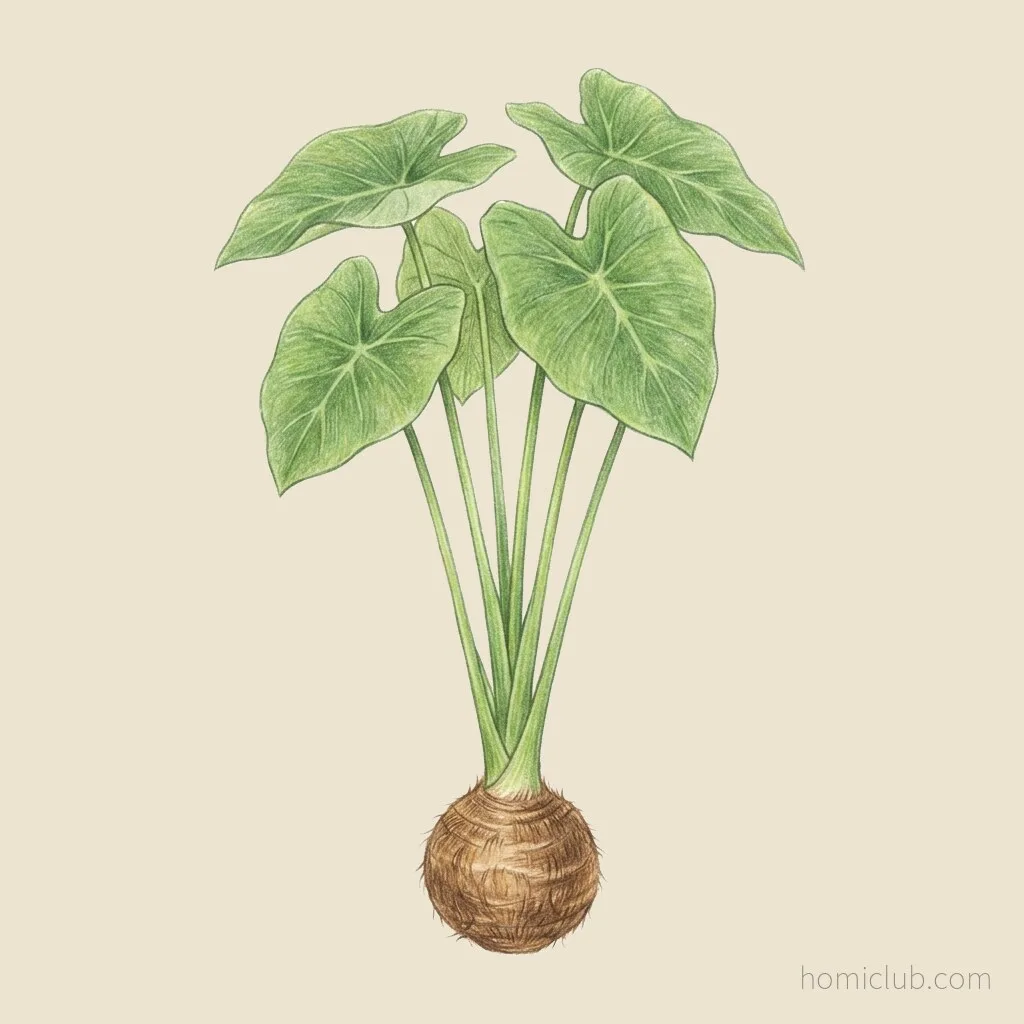
- Type
- Tubers
- Difficulty
- Moderate
- Season
- Spring
- Sowing
- Transplant
Taro (Toran)
Colocasia esculenta
Mucin and potassium - a restorative root for the Korean autumn table
Taro is a root vegetable whose slippery mucilage - made up of mucin and galactan - coats and protects the stomach, aids digestion, and helps manage cholesterol. It's rich in potassium, which supports healthy blood pressure, and it carries plenty of dietary fiber. In Korea, taro is a familiar nourishing ingredient, best known as the star of toran-guk, the taro soup traditionally eaten at Chuseok (the autumn harvest holiday). Because raw taro has an acrid, throat-tickling bite, it should be parboiled and cleaned before cooking. Plant it in spring and harvest in fall.
Year-Round Calendar
- 1
- 2
- 3
- 4
- 5
- 6
- 7
- 8
- 9
- 10
- 11
- 12
- 4
- 10
- 11
Health Benefits
Whole-food nutrition and bioactivity. A comprehensive review of taro's composition, functional properties, and health benefits highlights the versatile value of its dietary fiber, polysaccharides, and minerals. Taro is increasingly being reappraised as a functional crop rather than simply a starchy staple.
Obesity and metabolism. In an animal model, a combination of taro leaf extract and tamarind reduced obesity. The finding suggests that taro's edible value isn't limited to the root but may extend to the leaves as well.
Fermented foods. Researchers have analyzed the mineral profile and fermentation-microbe diversity of poi, the traditional Hawaiian fermented taro food. It stands as an example of a food whose nutritional and health value becomes richer after natural fermentation.
Food safety. A study evaluated ways to reduce heavy-metal contamination in taro grown near mining sites and confirmed that boiling, peeling, and changing the cooking water are effective. The work offers practical guidance for food-safety management.
Traditional medicinal use and toxicity. A review of taro's use in traditional medicine, paired with toxicity assessment of excessive intake, concluded that cooking it thoroughly and eating it in moderate amounts is the safe standard. It's a case where traditional wisdom aligns with modern safety evaluation.
Composition, functionality, and health benefits (2025 systematic review). A 2025 comprehensive review of taro confirmed that it contains resistant starch, mucilaginous polysaccharides, anthocyanins, and the lectin tarin, giving it potential for low-glycemic-index blood-sugar support, growth of beneficial gut bacteria, and anti-inflammatory, antioxidant, anticancer, and anti-obesity activity. Standardizing extraction remains a hurdle before clinical-stage work, however, pointing the way for future research.
Nutrition
- Mucilage (mucin and galactan) (the slippery component) — protects the stomach, aids digestion, helps regulate cholesterol
- Potassium (abundant) — helps control blood pressure and flush out sodium
- Dietary fiber (abundant) — supports gut health and satiety
Pairings
○ Beef and ox-bone broth — Simmering taro soup with ox-bone broth and beef is a classic restorative dish of the Korean Chuseok holiday. The collagen in the bone broth meets taro's mucilaginous polysaccharides to deliver both deep flavor and the value of a recovery food.
○ Kelp (dasima) — Taro's mucilage and the alginic acid in kelp work in synergy. The calcium in the kelp also partly neutralizes the oxalate crystals in taro, reducing its irritant bite - a nutritional bonus.
○ Perilla (deulkkae) — Taro-stem perilla soup pairs the alpha-linolenic acid of perilla seed with taro's dietary fiber. A established autumn delicacy, it lets plant-based omega-3s and mucilaginous polysaccharides work together to benefit both the stomach and the cardiovascular system.
○ Yukgaejang — Dried taro stems are a classic ingredient in yukgaejang, a spicy beef-and-vegetable soup. The fiber and slight stickiness of the taro stems temper the heat of the fiery broth and add a pleasing texture.
○ Soy sauce, garlic, and ginger — Adding soy sauce, garlic, and ginger to braised or steamed taro is a basic Korean seasoning approach. The warming nature of garlic and ginger balances taro's neutral character, while the savory depth of soy sauce rounds out the flavor.
△ Raw taro + milk or cheese — The oxalic acid in raw taro can bind with calcium and raise the risk of kidney stones. Cooked taro is a different story—heat breaks down the oxalate crystals—so the golden rule is simple: always cook taro before eating it.
△ History of kidney stones — If you've had kidney stones before, it's wise to go easy on taro. Oxalic acid can accumulate and raise the risk of stones recurring, so keeping portions moderate is the safer bet.
△ Sensitive stomachs — Taro's sticky, mucilaginous texture can be hard on a weak stomach, so eat smaller portions and pair it with ginger. Ginger's warming nature balances taro's neutral character and eases the digestive load.
Source: Food and Nutrition Information