
- Type
- Root Vegetables
- Difficulty
- Easy
- Season
- Spring·Fall
- Sowing
- From seed
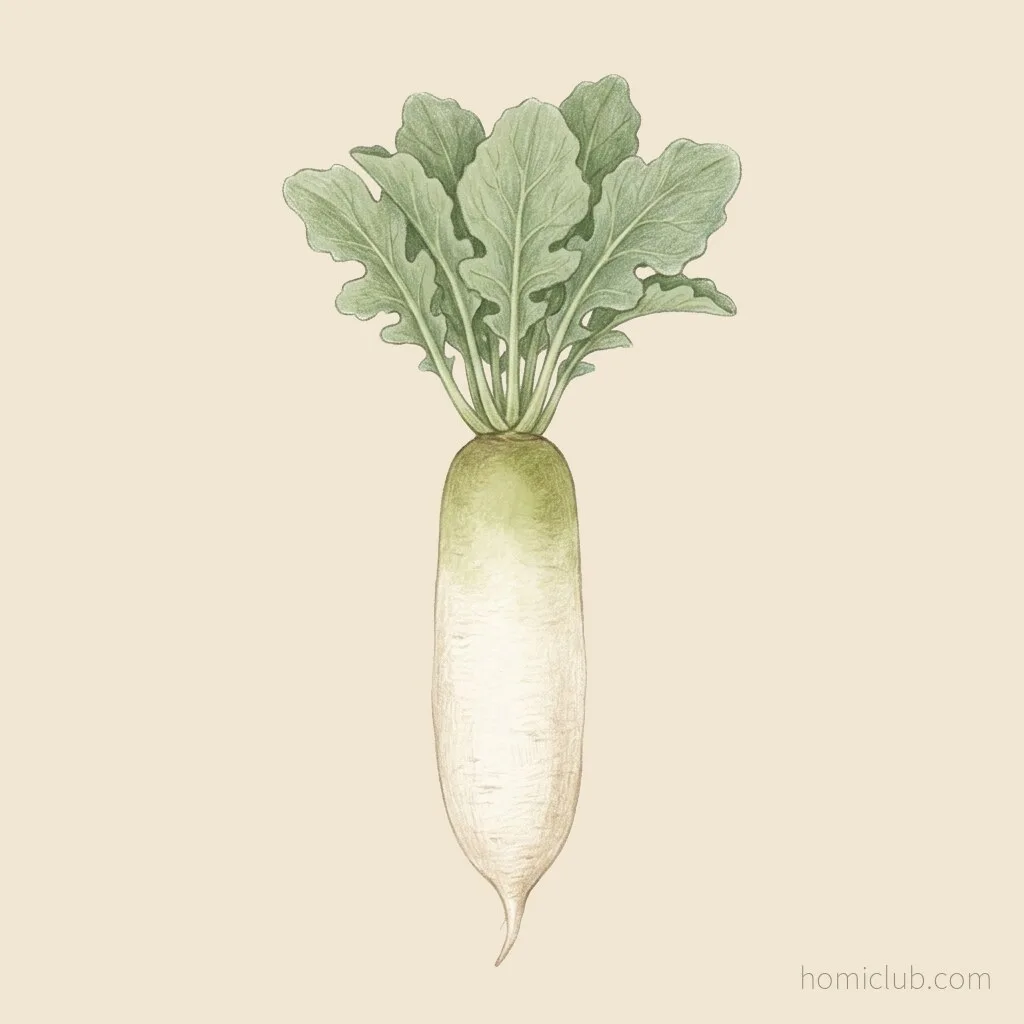
Korean Radish (Mu)
Raphanus sativus
Loaded with diastase — the root vegetable that helps you digest.
Korean radish (mu) is packed with digestive enzymes like diastase, which break down starches and help settle the stomach. It's rich in vitamin C for immune support, and don't toss the leafy tops (mucheong) — they're loaded with nutrients in their own right. Eating it raw keeps the enzymes active, making it even easier on digestion. Direct-sow in spring or fall; cool-season fall radishes are especially sweet and firm.
Year-Round Calendar
- 1
- 2
- 3
- 4
- 5
- 6
- 7
- 8
- 9
- 10
- 11
- 12
- 4
- 8
- 9
- 6
- 11
Health Benefits
Antioxidant & anti-cancer. A study analyzing the relationship between glucosinolates and antioxidant activity in brassica seeds found that radish seed ranked among the most active in the family. The results show that not just the radish root but also the seed (known as nabokja in Korean herbal medicine) is a rich source of pharmacological activity.
Obesity & metabolism. In animal studies, a glucosinolate extract from radish seed reduced high-fat-diet-induced obesity and modulated the gut microbiome. This is an emerging research area being evaluated for its potential as an adjunct therapy for metabolic disease.
Digestion & gut health. Researchers have mapped how the organosulfur compounds in radish microgreens are activated as they move through gastrointestinal digestion, and confirmed that microgreens (radish sprouts) contain far higher glucosinolate concentrations than mature radish. It's a striking reminder that young sprouts can be more nutrient-dense than the mature vegetable.
Genetics & crop improvement. Hybrids with elevated glucoraphanin content have been developed by inserting the radish GRS1 gene. As a case of plant breeding that concentrates the isothiocyanate precursor whose health benefits are well established, it illustrates how functional-food science is being applied in agriculture.
Radish greens & root bioactives (review). A 2025 comprehensive review of the bioactive compounds in radish greens found that the leaves contain significantly higher levels of polyphenols, flavonoids, polysaccharides, and dietary fiber than the root. The review highlighted radish greens as a functional-food source with potential to ease metabolic disease, improve gut health, and offer anti-cancer benefits — giving modern nutritional backing to the Korean tradition of using mucheong in dishes like siraegi (dried radish greens) and mucheong kimchi.
Nutrition
- Diastase (amylase) (Digestive enzyme) — Aids carbohydrate digestion and eases the stomach
- Vitamin C (Abundant) — Immune support & antioxidant
- Dietary fiber (Abundant) — Gut health
Pairings
○ Rice cakes & wheat-based foods — Because radish's diastase helps break down starch, adding radish to tteokguk (rice-cake soup) or serving grated radish alongside dumplings has long been a Korean tradition. The reasoning: it provides a natural enzyme boost that lightens the digestive load of heavy carbohydrates.
○ Rich & fatty foods, meat — Radish helps the body digest fat and protein — which is exactly why it's an essential ingredient in galbitang (beef short-rib soup) and other meat broths. Its fiber and enzymes work together to lighten a heavy meal.
○ Fish — Radish tames the fishy smell of seafood and aids detoxification. That's why a chunk of radish is a staple in Korean braised fish dishes — the pungent sulfur compounds in radish neutralize the substances that cause the fishy odor.
○ Honey — Combining radish juice with honey is a traditional home remedy for a dry cough. Radish's cooling nature soothes heat in the throat, while honey coats and protects the mucous membranes to ease irritation — a complementary pairing.
○ Asian pear — Drinking the blended juice of radish and Asian pear is a Korean folk remedy for respiratory wellness. Both ingredients are high in water and have a cooling nature, so the combination relieves dryness and heat in the throat at the same time.
△ Ginseng — The Donguibogam (a classic Korean medical text) explicitly classifies radish and ginseng eaten together as antagonistic (sang-o). Radish is said to disperse ginseng's qi-tonifying effect, so the traditional advice is to avoid raw radish for one to two hours before and after taking ginseng tea or red ginseng.
△ Tonic herbal medicines such as rehmannia, fo-ti, and horny goat weed — While taking traditional Korean tonic medicines, it's recommended to avoid raw radish and radish seeds. This follows the traditional view that radish's qi-lowering (descending) action works against the strengthening effect of tonic herbs.
△ Pork + large amounts of raw radish (disputed) — Some herbal texts in the Donguibogam tradition consider pork with large amounts of raw radish a poor match, but at everyday dietary levels it's perfectly fine. Modern nutrition science, in fact, suggests radish actually helps digest the fat in pork—worth keeping in mind alongside the traditional view.
Varieties
- Joseon mu (Korean radish) — Fall kimjang radish; firm and dense
- Chonggak mu (altari) — Used for chonggak kimchi (ponytail radish kimchi)
- Yeolmu — Young summer radish; used for yeolmu-kimchi, a refreshing summer kimchi
Source: Rural Development Administration · Food and Nutrition Information