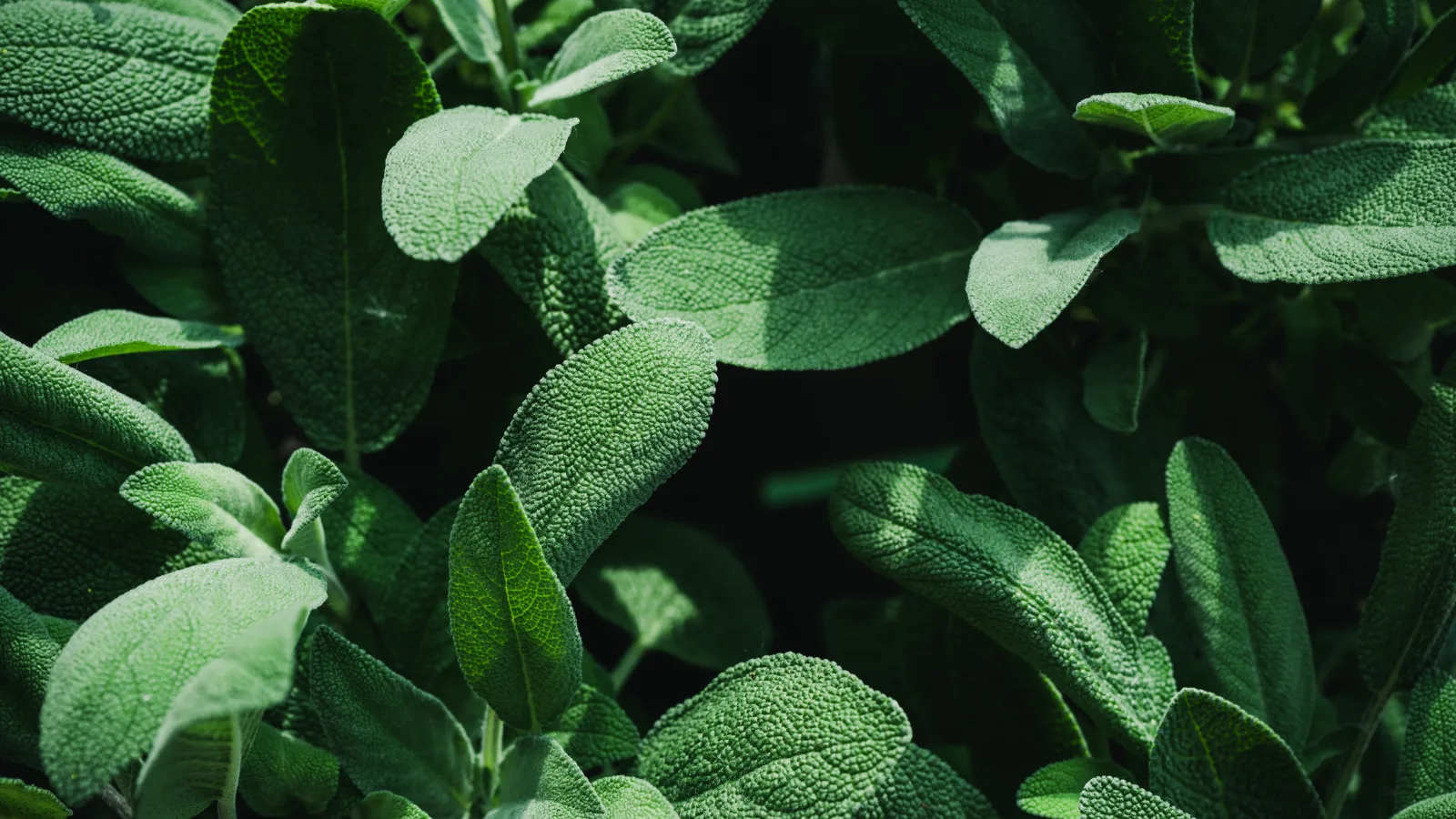
By July, the sage in the garden has thickened up, its leaves gone a deeper gray-green. Rub one between your fingers and the smell hangs on for a while — piney, with something cool underneath it. What you're smelling is the essential oil held in tiny glands on the surface of the leaf.
One extra step before distillation
Sage essential oil is made by boiling the leaves with water and collecting the aromatic compounds that ride out on the steam. The catch is that leaf cell walls are tough, so whatever sits deeper inside never fully comes out.
A study published in Scientific Reports in 2026 tested soaking the leaves first, before distillation, in a natural deep eutectic solvent — NADES for short. It's a liquid made by combining choline chloride with a natural acid such as malic or citric acid, and it softens cell walls without any toxic organic solvent.
Leaves treated with the malic acid blend gave up 2.53% essential oil. The ones soaked in plain water gave 2.31%. But the more striking change wasn't the amount — it was the composition. With the citric acid blend, the share of oxygenated monoterpenes climbed to 78%. That's the group of compounds that tends to score high in antioxidant and antimicrobial testing.
How far has this actually been shown?
In assays that measure antioxidant capacity, the solvent-treated oil came out ahead of the water control. When the oil was added to human neuroblastoma cells growing in a dish, the cells declined as the concentration went up. Keep in mind, though, that these are results from cells in a dish. It doesn't follow that the same thing happens when a person drinks the oil or rubs it on their skin.
The researchers also ran computer simulations to see which compounds were doing the work. Beta-caryophyllene, one of the components of sage oil, docked well with a regulatory protein that switches on the body's antioxidant defenses, and with an enzyme that receives the signal to build new blood vessels. Across a 100-nanosecond simulation, the binding held. That's binding calculated on a computer, not an effect confirmed in a human body.
The shift in the aroma profile is a measured fact, confirmed on instruments. The health effects are still sitting at the cell-and-simulation stage. Read it as a possibility that's been flagged, and no further.
Using the sage from your own garden
Setting up a still at home isn't realistic. But there are still ways to lose less of what's in the leaf.
- Harvest just before the flower stalks go up, in the morning once the dew has dried. That's when leaf oil content measures highest.
- Dry the leaves in the shade. Direct sun and high heat blow the aromatic compounds right off.
- Those compounds dissolve readily in oil and butterfat. Steep the leaves in olive oil, or warm them briefly in butter, and the scent moves over into the fat.
- Cover the pot when you're brewing it as tea. As long as steam is rising, the aroma is leaving with it.
Sage also contains thujone. The amounts you'd use in cooking aren't a problem, but if you're pregnant or nursing, it's worth skipping the habit of a strong cup of sage tea every day. Swallowing undiluted essential oil isn't a good idea either.
Tonight, pick four or five sage leaves, warm them in butter for about 30 seconds, and spoon them over boiled potatoes. The scent settles in best at a temperature where the leaves don't scorch.
Reference — Scientific Reports, 2026, study on sage essential oil extraction