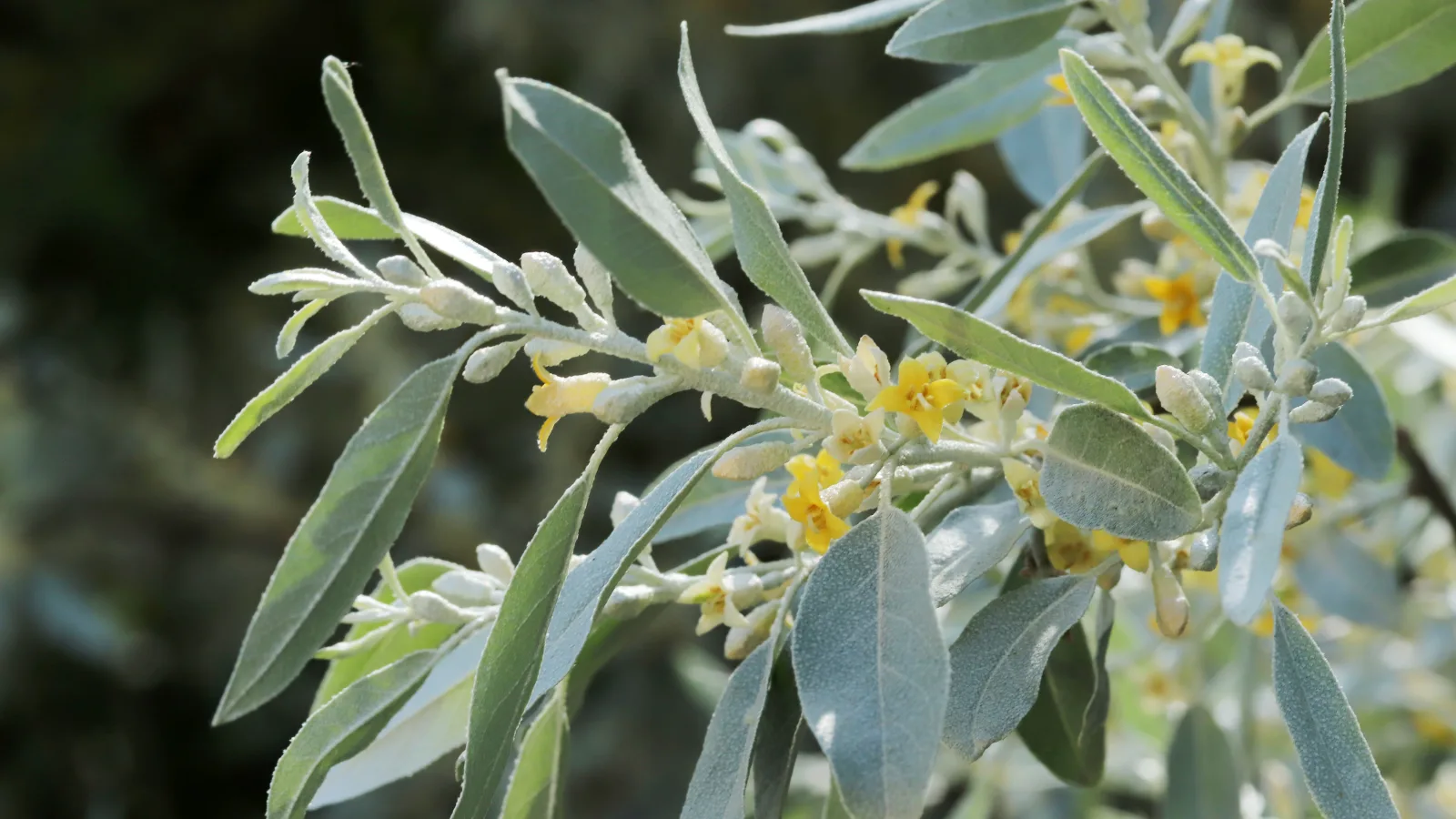
If you keep a Russian olive tree (Elaeagnus angustifolia) in a corner of your garden, you've probably paid close attention to when its buds begin to form. An Iranian research team took extract from those very flower buds, used it to create silver nanoparticles, and confirmed their antimicrobial, antioxidant, and anticancer potential at the laboratory level. It's a case where a traditional medicinal plant meets nanomedicine.
How plant compounds turn silver into nanoparticles
Making nanoparticles from plant extract alone, with no chemical reagents, is known as green synthesis. The phenols, flavonoids, and tannins in Russian olive flowers reduce silver ions and form a stable coating around the surface of each particle. The silver nanoparticles produced this way measure about 6.6 nanometers in diameter, and their zeta potential registered at −32.68 mV — meaning they stayed dispersed for over a month. In other words, the particles hold steady on their own instead of clumping together.
How strong are the antimicrobial and antioxidant effects?
When the agar well diffusion method was applied to Staphylococcus aureus, the zone of inhibition measured 12 millimeters. That's smaller than the 24 millimeters produced by the antibiotic gentamicin, used as a benchmark. Against Escherichia coli, the same method showed no inhibitory effect, but in a liquid broth test the nanoparticles suppressed growth at a concentration of 37.5 μg/mL. The researchers believe the difference in cell wall structure between the two bacteria affects how well the nanoparticles can penetrate.
In the antioxidant test, the nanoparticles scavenged about 55% of DPPH radicals at a concentration of 160 μg/mL. That's not a powerful antioxidant effect, and how the results change under different extraction conditions or concentrations will need further verification.
Anticancer potential seen in cell studies
In the lab, when prostate cancer cells (PC3) and stomach cancer cells (AGS) were treated with the nanoparticles for 72 hours, the concentration that cut each cell line's survival in half came out to 7.49 μg/mL and 5.33 μg/mL, respectively. Because these are results from the cell-study stage, it's too early to claim any therapeutic effect. Only after animal studies and clinical trials can we start talking about actual medical applications.
Spectroscopic analysis also confirmed that the nanoparticles bind strongly to calf thymus DNA (ct-DNA) and human serum albumin (HSA). This binding strength serves as baseline data for evaluating whether the particles could work as a drug delivery vehicle.
The Russian olive is best known for its fruit, but its flowers are also rich in bioactive compounds like phenols and flavonoids. Research showing that these compounds can be used to synthesize nanoparticles invites us to take another look at the full range of chemical resources a plant holds. If you have a Russian olive in your garden, try noting down when it comes into bloom.
Reference: Bioinorganic Chemistry and Applications, 2026, PMID 42306284