- Type
- Trees & Vines
- Difficulty
- Moderate
- Season
- Summer
- Sowing
- Plant a sapling
Korean Plum (Maesil)
Prunus mume
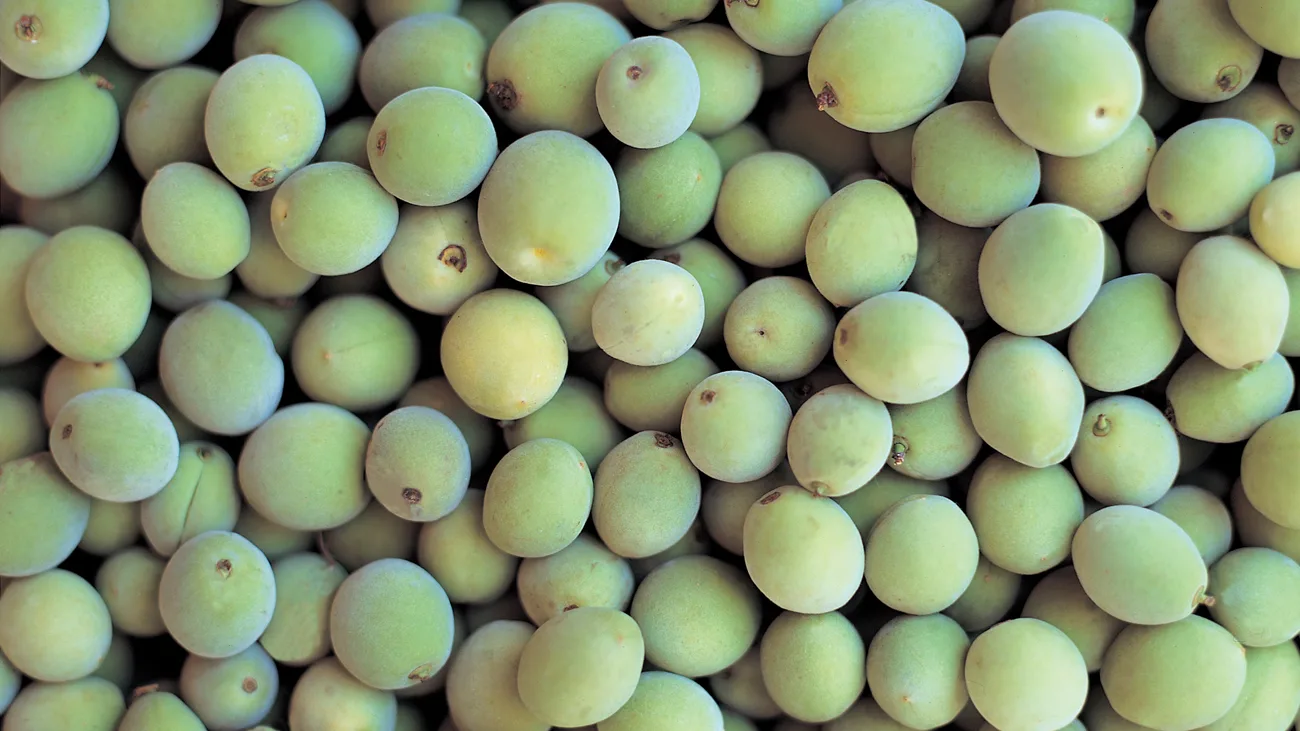
An early-summer green plum, harvested for syrup and pickles
The Korean plum (maesil) is a fruit tree well suited to a backyard or a large container. Its blossoms open in March or April, ahead of the leaves, and by June you can pick the firm green plums. Note that maesil is never eaten raw: unripe green plums and their pits contain amygdalin, so they must always be processed—into maesil-cheong (plum syrup) or jangajji (pickled plums)—before eating. A young tree takes more than three years to bear fruit, and because it needs a different variety nearby to act as a pollinator, it's best to plant at least two trees together from the start.
Year-Round Calendar
- 1
- 2
- 3
- 4
- 5
- 6
- 7
- 8
- 9
- 10
- 11
- 12
- 2
- 3
- 11
- 12
- 6
- 7
Where It Grows
- Origin It originated south of the Yangtze basin and still yields most of the world's crop. Guangdong, Zhejiang and Fujian are the growing regions.
-
Main producer
Wakayama Prefecture is the center, where large-fruited varieties for pickling are grown. Harvest June, July
- 6
- 7
-
Main producer
The growing regions are in the south: Gwangyang and Suncheon in South Jeolla, Hadong in South Gyeongsang, and Sunchang in North Jeolla. Harvest June
- 6
- Major producer
It originated south of the Yangtze River in China and reached Korea and Japan long ago, settling into a different use in each. Production is overwhelmingly Chinese, and the rest is concentrated in the warm-temperate belt of East Asia, so the list of growing regions is short. The custom of never eating the fruit raw, but pickling or steeping it instead, survives in all three countries.
- Optimum
- 15~25℃
- Range
- 5~32℃
- Hardiness
- Half-hardy
Warm areas with an annual average temperature of 12~15℃ suit it best. The flowers open ahead of the leaves in February and March, so they take the full force of the early-spring cold snap and any late frost, and where the winter minimum drops below -15℃ the flower buds and branches freeze.
Harvested 3–5 years after planting. Three to five years must pass after a sapling is planted before it bears fruit, and two trees of different varieties are needed for pollination. The planting months (November~March) and the harvest month (June) do not fall in the same year.
In Korea Southern Korea
Gwangyang and Suncheon in South Jeolla, Hadong in South Gyeongsang, and Sunchang in North Jeolla are the main growing regions. In the cold-winter central region and further north, the early flowers freeze and fruit set is uneven.
How to grow
- Light
- Somewhere sunny. It is a tree, so it holds the spot for years
- Soil and depth
- 50cm deep or more with good drainage. In a pot, a large one — 30 litres and up
- Spacing
- 4m between trees. One tree per pot
- Watering
- Attention the first year; after that only in a drought
- Feeding
- A base dressing in winter (December to February) and one feed after harvest
- Harvest
- June, while the fruit is still hard and green. Once it yellows it is late for syrup
What makes the difference. A single tree sets poorly. Plant two of different varieties so they can pollinate each other
Why this one is harder. Almost no crop for the first three or four years. Start knowing it is a tree that holds the ground for a long time
Common problems
- Aphids You will see New shoots curl and turn sticky What to do Watch the new growth in spring. Wash off or use a soap spray
- Scab You will see Black spots appear on the fruit What to do Thin the branches before the rains so air moves. Clear fallen leaves and fruit
This page describes how a crop is grown and used. It does not claim health effects for any food, nor is it intended to prevent or treat disease. Component and study notes are references only and do not mean the same result occurs in people. Consult a medical professional about health concerns.
Health Benefits
What the Donguibogam records - 梅實. The Donguibogam lists maesil (梅實) in its Fruit section, giving it a neutral nature, a sour taste and no toxicity (性平 味酸 無毒). The same entry treats the fruit not as it comes but in two prepared forms: baekmae (白梅), sun-dried and stored sealed or else salted, and omae (烏梅), smoked over fire until dry. This is a historical medical record and differs from present-day judgment.
What the sourness actually is. Compositional analysis confirms that maesil's sourness comes from organic acids, citric acid foremost among them. The familiar claim that citric acid washes away lactic acid and so clears fatigue rests on a premise, that lactic acid causes fatigue, which exercise physiology no longer holds. Studies confirming a change in fatigue in people who ate maesil are also hard to find.
Why the preserves keep. Maesil syrup and pickled maesil keep because of the high concentration of sugar or salt used in packing them, together with the fruit's own acidity. That is a statement about the jar not spoiling, not a claim that eating maesil clears microbes from the body.
An old use, seen with today's eyes. From the plain experience that something sour makes the mouth water, maesil has long been served alongside a meal. It is a record of traditional use, and nothing about it has been confirmed in modern terms.
Never eaten raw. Unripe green plums and their pits contain amygdalin, so they are not eaten raw. Crushing the pit or blending the fruit whole is avoided as well. Packing them into syrup or pickles is the practice that has been kept for a very long time.
The sugar comes with it. Maesil syrup is packed with roughly equal weights of fruit and sugar. What is poured out is as much sugar water as it is plum, so it is not a drink to reach for often in the hope of a health benefit.
Nutrition
- Citric acid (The most abundant organic acid) — The main organic acid behind maesil's sourness.
- Malic, succinic, and tartaric acids (Present in varying amounts) — Together with citric acid, they create maesil's distinctive tartness.
- Potassium (Present) — A mineral found in maesil.
- Carotene (Present) — A vitamin-precursor compound found in maesil.
The organic acids behind the sourness Maesil's sourness comes from organic acids, citric acid foremost among them. Malic and succinic acids sit alongside it, and the less ripe the fruit, the sharper the acidity. That is why the firm green plums picked in early summer are the most sour.
Amygdalin and the pit Unripe fruit and pits contain amygdalin. Maesil is therefore not eaten raw, and crushing the pit or blending the fruit whole is avoided. Packing the fruit in sugar or salt and leaving it to stand is the preparation that has been kept for a very long time.
The sugar that goes in with it Maesil syrup is packed with roughly equal weights of fruit and sugar. What is poured out is as much sugar water as it is plum, so keep it to a weak dilution taken now and then.
Pairings
○ Maesil-cheong (plum syrup) — Made by layering green plums with sugar and letting them steep. Added to meat dishes, it helps tenderize and aids digestion; used in a marinade for fish, it cuts the fishy smell. It's a versatile way to add sweetness and savory depth to seasoned vegetable dishes, dressings, and chogochujang (a sweet-and-sour red chili sauce).
○ Maesil-jangajji (pickled plums) — Salt-cured into a tangy, salty side dish eaten with rice. They refresh the palate alongside oily foods and pair well with mild dishes such as rice porridge.
○ Maesil-ju (plum liquor) — Because it needs soft flesh and a strong aroma, fully ripened yellow plums (hwangmae) work better than green plums.
○ Taming the smell of meat — A spoonful of plum syrup in a marinade reduces off-odors in meat and fish while adding a touch of sweetness.
Varieties
- Nanko — A vigorous tree with a spreading, open habit. It is susceptible to black spot and bacterial shot-hole disease, and is widely used for fermenting and pickling. Often called hongmaesil (red plum).
- Baekgaga — Blooms relatively early, so it is often used as a pollinator for other varieties.
- Okyeong — A spreading variety with thick, long branches and good formation of short fruiting spurs. It has few imperfect flowers, so it shows little biennial bearing.
- Cheonmae — Blooms early and produces abundant pollen, giving it high self-fertility. The fruit weighs about 20 g and is harvested in mid-to-late June; well suited to fermenting.
- Cheongchuk — A pure green-plum (cheongmae) variety.
Source: Wikipedia (Prunus mume) / Nongsaro (nongsaro.go.kr) / K-Health (k-health.com)