- Type
- Gourds & Squash
- Difficulty
- Hard
- Season
- Summer
- Sowing
- Transplant
Korean Melon (Chamoe)
Cucumis melo
Hydration and potassium in a native Korean summer fruit
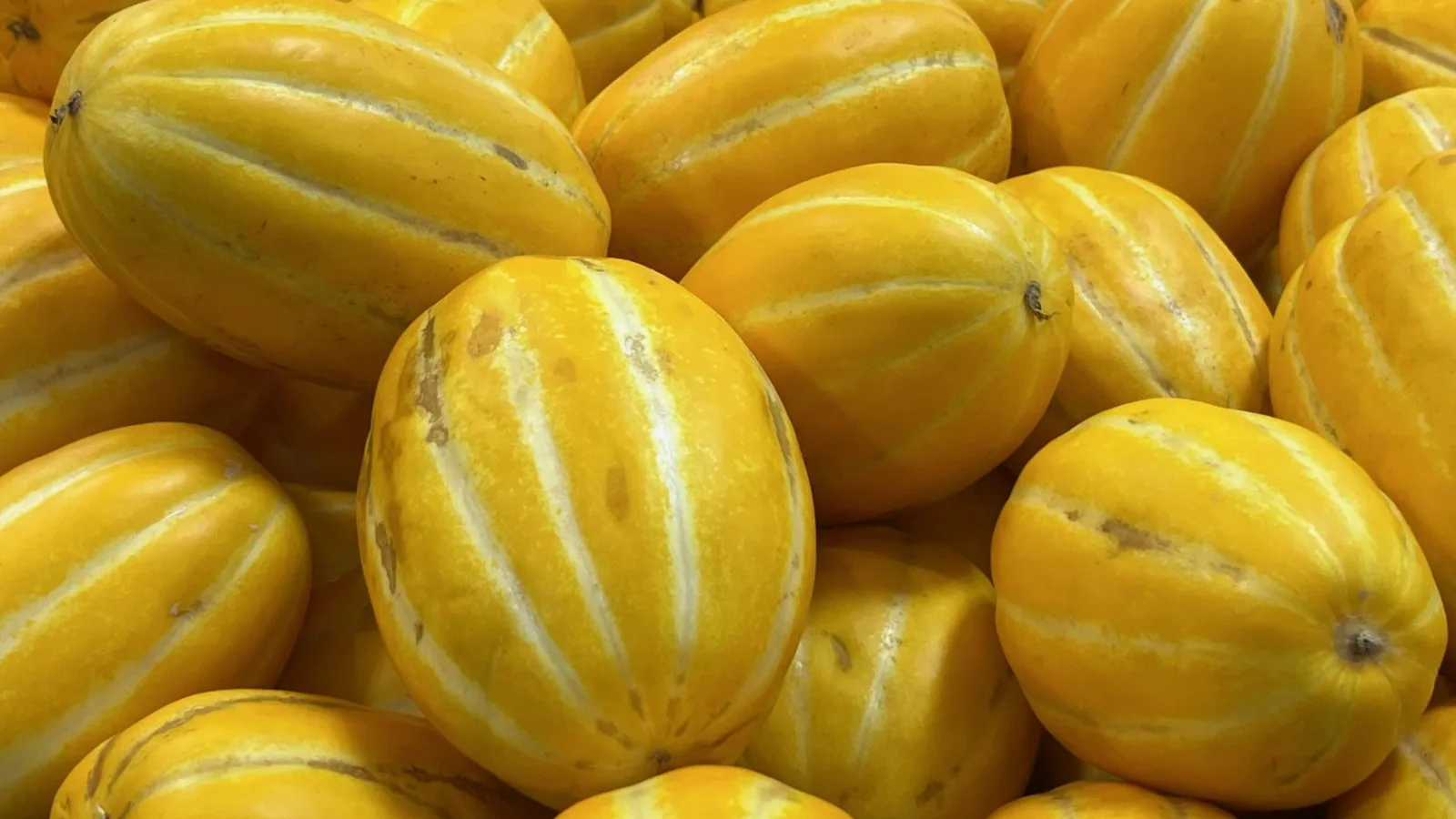
The Korean melon, or chamoe, is one of Korea's signature heirloom summer fruits, with a bright yellow rind and pale, crisp flesh. Most of its weight is water, and it supplies potassium and vitamin C. The bitter compounds of the gourd family gather at the stem end, so cut that end away generously, and spit out any mouthful that tastes strongly bitter rather than swallowing it. Set out transplants in April or May and give the plants plenty of full sun, which is what drives the sugars up.
Year-Round Calendar
- 1
- 2
- 3
- 4
- 5
- 6
- 7
- 8
- 9
- 10
- 11
- 12
- 5
- 7
- 8
Where It Grows
- Main producer This is effectively the only country growing yellow chamoe (Cucumis melo var. makuwa) on a large scale. The centre of production is protected cultivation along the Nakdong River in Seongju, North Gyeongsang.
- Major producer The same lineage is grown here under the name makuwa-uri, but on a much reduced scale.
- Major producer North China and East China grow xiangguo (fragrant melon), the same lineage. This is where melon entered East Asia and diverged into the chamoe line.
Chamoe belongs to a melon (Cucumis melo) lineage that branched off in East Asia, so it is hardly grown outside Korea, Japan and China. Melon itself is thought to have originated in Africa and India, reaching East Asia by way of Central Asia. The FAO counts chamoe, cantaloupe and muskmelon together under a single "melons" heading, so there are no statistics for chamoe on its own.
- Optimum
- 25~30℃
- Range
- 15~35℃
- Hardiness
- Not hardy
Sugar levels rise where the sun is strong and the days are hot. Growth stops below 15℃, and a frost kills the plant outright. Frequent rain as the fruit ripens lowers the sugar content and causes the fruit to split.
In Korea Nationwide
Seongju in North Gyeongsang produces most of the country's supply (press reports and statistics variously cite around 70%). In open fields, seedlings are transplanted in April and May and harvested from July to September; under cover, planting is done in winter and harvesting begins in spring. The months differ less by region than by whether the crop is grown in the open or under cover.
How to grow
- Light
- It wants a lot of sun
- Soil and depth
- 30cm deep or more with good drainage
- Spacing
- 80cm
- Watering
- Generous while growing, less as it ripens
- Feeding
- Generous base dressing plus one feed once the fruit sets
- Harvest
- When it turns yellow and starts to smell. If the stalk parts easily it is ready
What makes the difference. The fruit comes on the secondary and tertiary vines. Pinch the main stem at five or six nodes to force them
Common problems
- Powdery mildew You will see White leaves What to do Airflow
- Fusarium wilt You will see Wilts and dies What to do Avoid following other cucurbits
This page describes how a crop is grown and used. It does not claim health effects for any food, nor is it intended to prevent or treat disease. Component and study notes are references only and do not mean the same result occurs in people. Consult a medical professional about health concerns.
Health Benefits
The old record: the name 甛瓜. Old medical texts handled the Korean melon under the name cheomgwa (甛瓜), and that name has survived to the present. What can be said here stops at the fact that the old records entered the fruit under that name; it differs from present-day judgment.
What today can confirm: composition. What can be stated with confidence about chamoe is its composition. Most of its weight is water, and it supplies potassium and vitamin C. There is no research in people to support saying that eating it improves digestion or changes any particular condition.
Sweetness is built by cultivation. Research has reported that cultivar, growing conditions and the rootstock chosen when grafting influence sugar content and amino-acid composition. That is a statement about how to grow a sweeter fruit, not a conclusion about the health of the person eating it.
Nutrition
- Water and potassium (Abundant) — A summer fruit that is mostly water by weight
- Vitamin C (Present) — A water-soluble vitamin held in the flesh
- Cucurbitacin (At the stem end) — The bitter compound characteristic of the gourd family
Water content Most of the Korean melon's weight is water, which is why it settled long ago into the role of a fruit eaten to take on moisture in hot weather. That property is much of the reason it has kept its place as a Korean summer fruit.
Vitamin C and the color of the flesh The yellow of a chamoe is in the rind; the flesh runs from pale white to a light cream-yellow. Unlike orange-fleshed cantaloupe, its carotenoid content is on the low side, and what is confirmed for chamoe stops at the compositional fact that it contains vitamin C.
Potassium Chamoe is a fruit that contains potassium. Potassium is a mineral that works with sodium in the body's fluid balance, but there is no basis for saying that eating chamoe keeps the body from swelling or alters blood pressure.
Cucurbitacins Cucurbitacins, the bitter compounds characteristic of the gourd family, gather at the stem end of a chamoe and near the rind. Cooking does not destroy them, so cut the stem end away generously, and if a mouthful tastes bitter, spit it out rather than swallow it and throw the whole fruit away. Unusually bitter fruit tends to come from plants raised from home-saved seed, in which the bitter trait segregates out again, or from plants that have been through heat and drought stress.
Ethylene and aroma compounds As it ripens, chamoe gives off ethylene along with a range of aroma compounds. That scent is a signal of how far the fruit has ripened and one of the marks that separates cultivars; there is no basis for saying the aroma itself acts on the body.
Pairings
○ Summer restorative meals — Serving chamoe alongside kongguksu (chilled soybean-broth noodles) or as a dessert after naengmyeon (cold buckwheat noodles) is a Korean summer classic. It cools the body and aids digestion at once, lightening the heavy feeling that can follow a meal.
○ Yogurt and milk — A chamoe smoothie creates a synergy of protein and calcium plus vitamin C. The probiotic benefit of the live cultures meets the melon's dietary fiber to lend supporting help to gut health.
○ Honey — A spoonful of honey stirred into chamoe flesh slightly warms its cooling nature. It's a traditional home remedy for balancing the fruit so that people with a cold or weak stomach can still enjoy it.
○ Salt — The Korean habit of sprinkling a pinch of salt over chamoe heightens the sweetness while replenishing electrolytes. It's also a clever way to naturally restore the sodium lost through summer sweat.
△ Large amounts on an empty stomach — Korean melon (chamoe) is a cooling fruit, and eating a lot of it on an empty stomach can irritate the gut, causing cramps or diarrhea. A moderate portion with a meal or as dessert is gentler on the stomach.
△ Weak digestion or a cold constitution — People with weak digestion — especially those with chronically cold hands and feet or frequent loose stools — should cut back on Korean melon or skip it. In traditional terms, its cooling nature can further sap the stomach's warmth and weaken digestion.
△ Eating the stem end or lots of seeds — Cucurbitacin is concentrated in the melon's stem end and acts as a powerful emetic, so eating it in quantity must be strictly avoided. Cut away the stem end generously before eating; in traditional Korean medicine it is used only under expert supervision.
Varieties
- Yellow chamoe (standard grown type) (Transplanted seedlings) — The common market melon: yellow skin with white grooves, crisp flesh, and few failures for a first try.
- Gaeguri-chamoe (frog melon) (Transplanted seedlings) — A Korean landrace with green mottled skin. Softer flesh and gentler sweetness than the yellow type.
- Eun-cheon line (Transplanted seedlings) — The older line behind today's yellow melons. Thin skin gives strong aroma but a short shelf life.
Source: Food and nutrition references