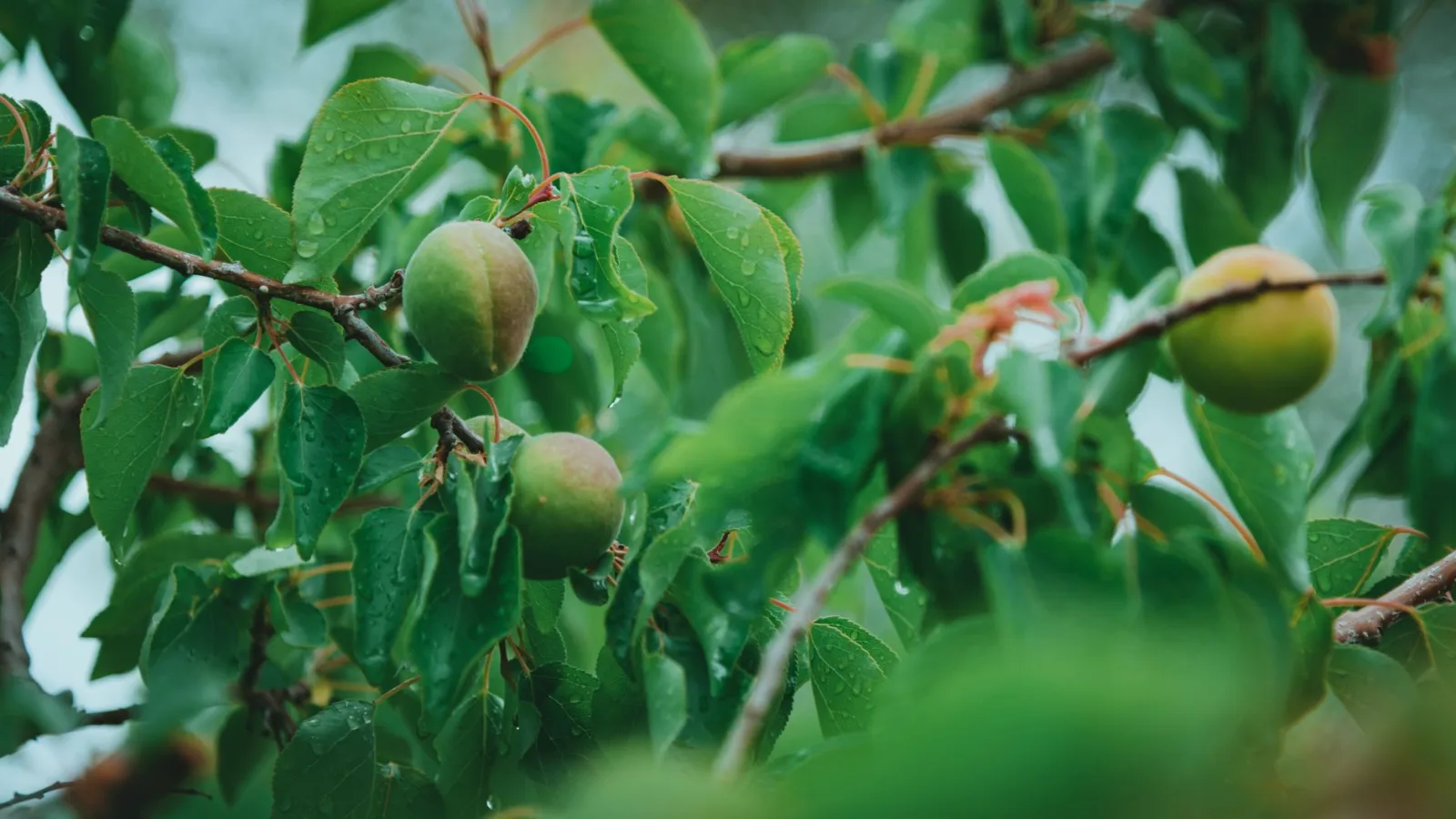
Peach season in the Northern Hemisphere runs from July through September, and every peach you pick and eat leaves one wrinkled pit in your hand. Most people throw it out. But a fair number stop first to search "Can you eat peach pits?" They find records of old medical texts that used the seed as medicine, and right beside them, warnings that eating it is dangerous. So why do the sources disagree about the same seed?
Doin (桃仁) in the Donguibogam
The peach "seed" we're talking about is the kernel inside the hard stone of the peach (Prunus persica). You get to it by cracking the stone open. It's a different part from the juicy flesh we eat in summer. Traditional East Asian medicine calls this kernel doin (桃仁) and has long used it as a medicine in its own right.
The Donguibogam, a medical classic published in Joseon-era Korea in the early 17th century, lists the seed in its fruit section (果部) under the name dohaegin (桃核仁) and explains how to prepare it. Gather the pits in the seventh lunar month (usually around August on today's calendar), crack them, take out the kernels, and dry them in the shade. Before use, soak the kernels in boiling water, slip off the skins, and pinch off the pointed tips. Pick out and discard any ssangin (雙仁), meaning two kernels sharing one shell, then grind the rest to a fine powder. The original text calls this ingredient nonpoisonous (無毒).
"Nonpoisonous" in the Old Text, "Don't Eat It" Today
Those two characters, 無毒, come up again and again from people looking into peach pits. If an old book says there's no poison, why not eat it?
The same book also warns readers to be careful. Its entry on apricot kernels, haenghaegin (杏核仁), says that double kernels can kill a person, and its instructions for peach kernels also say to throw out double kernels. The book lists each step: skin the kernels, remove the tips, sort out the doubles. That suggests even this old text saw the seed as a medicine that had to be prepared in a set way before use.
Today's answer comes from chemical analysis. Peach kernels contain amygdalin, a cyanogenic glycoside. Several food safety agencies have warned that crushing and eating the seeds can expose you to cyanide. So it's best to read 無毒 as a historical record and let modern science decide whether to eat it. Don't eat peach kernels.
What Happens When You Bite Into a Kernel
Peach kernels contain amygdalin and also an enzyme called emulsin. Emulsin is a type of β-glucosidase that breaks amygdalin down and releases hydrogen cyanide. When you chew or grind a kernel, the two mix and that breakdown begins. Cyanide also forms when amygdalin breaks down inside the body after it's swallowed.
Apricot and plum kernels also contain amygdalin. So at home, don't crack pits to eat the kernels, don't grind kernels into food, and don't take kernel powder as a health supplement. The same goes for trying the Donguibogam's peel-and-grind method.
If Someone Chewed or Swallowed a Kernel
If a child has bitten into a pit and broken the kernel, or an adult has chewed and swallowed a kernel without realizing it, don't wait for symptoms. Call emergency services or contact an emergency medical facility right away. In Korea, call 119. Elsewhere, call your local emergency number or a poison control center.
Before you call, try to have this information ready:
- The fact that what was eaten was a peach kernel
- Whether it was chewed or ground, and how many kernels were eaten
- When it was eaten, and the person's age and weight
- Any leftover pits or shells (keep them; don't throw them away)
If someone swallowed a whole pit without cracking it and you're worried, call the same people. It's safest to let medical professionals decide whether everything is okay. If you have young children at home, get in the habit of clearing away pits as soon as everyone has finished eating peaches.
The Part to Eat Is the Flesh
The part of the peach you eat is the flesh. China, Spain, Italy, Türkiye, and Greece are major peach growers. Try spooning sliced ripe peaches over plain yogurt; the tart yogurt goes well with the sweet fruit. Peaches also pair well with cured ham or aged cheese, where the saltiness of the ham and the richness of the cheese balance the fruit's sweetness.
For more on growing peach trees and cooking with the fruit, see the peach entry in the Homiclub Crop Guide.
If you ate a peach today, throw the pit away without cracking it. If you'd like to try growing a tree, keep the pit whole in its shell and plant it in November or March (Northern Hemisphere).
Source: Heo Jun, Donguibogam, Tangaek-pyeon (materia medica volume), fruit section (果部), entries for 桃核仁 and 杏核仁.