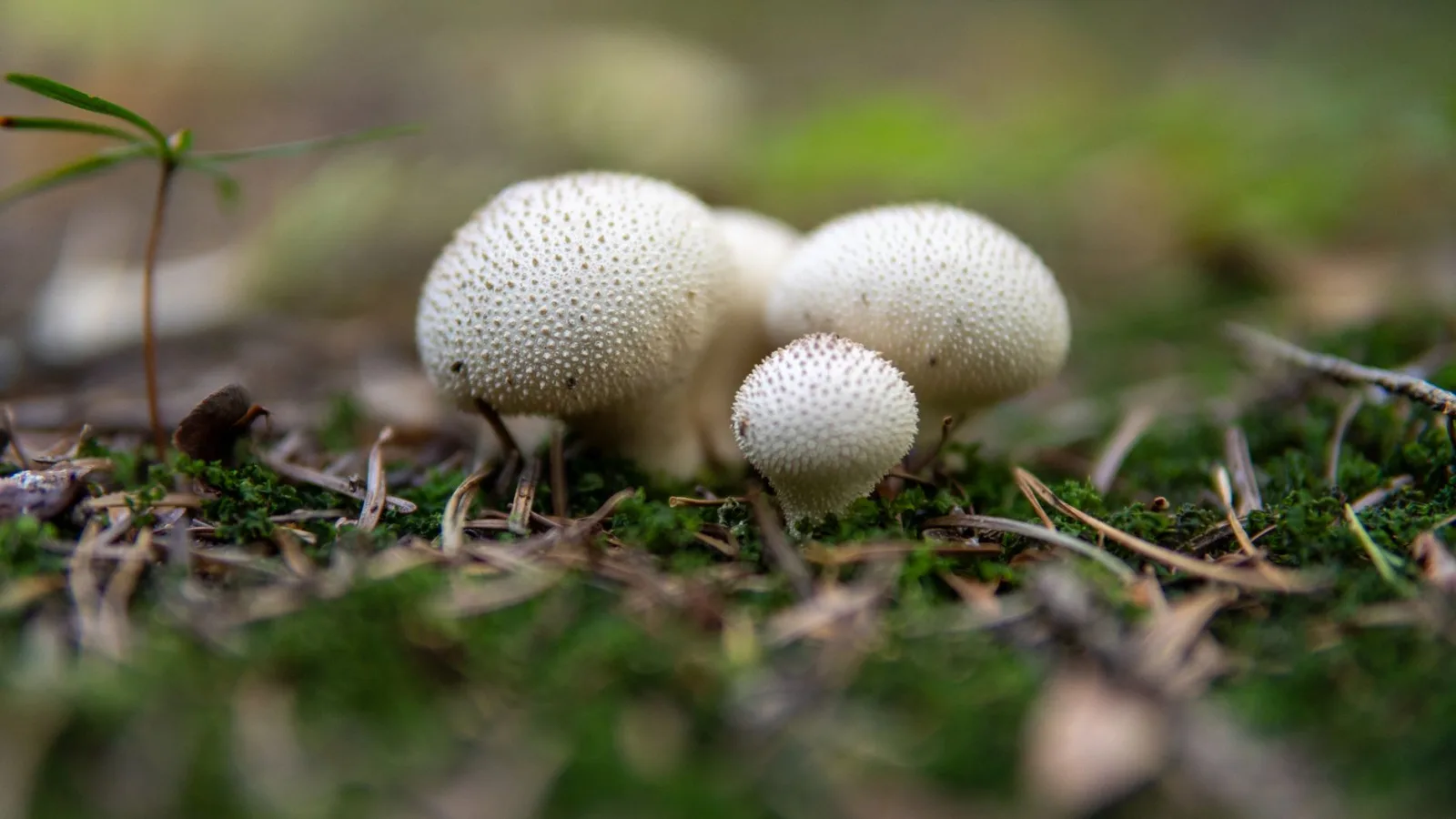
The morning after a night of rain, a few white orbs have pushed up in the grass at the edge of the garden. They weren't there yesterday when you watered. Your fingertips catch on a fine, pebbled texture, and when you press, there's no give — it's firm. That's a puffball. In the Northern Hemisphere they appear between July and October, on forest floors, in grassy fields, and around rotting wood. They grow wild in Korea, China, and Japan.
Rain sets the calendar
Puffballs aren't a mushroom you sow and raise. There's no planting date to mark. They come up within a few days of a rain, and if dry weather holds, they don't come up at all. They fruit best between 15 and 25°C, though they'll still appear anywhere from 10 to 30°C. When late summer tips over into fall and nighttime temperatures settle into that range, it's worth walking the grass and looking. If the rain never comes, a whole season can pass without a single one.
Cut it lengthwise and look inside
Only the young ones are edible. Inside, a young puffball is a uniform, unmarked white; once spores start to form it turns yellowish, and from there to brown powder. Cut one open, and if there's even a hint of yellow, don't eat it — throw it out. This isn't just a matter of flavor falling off. It means the inside is already filling with spores.
There's a far heavier reason to cut them open. The young "eggs" of Amanita species also look like white orbs from the outside. You can't sort them by appearance alone, but slice one in half lengthwise and the outline of a cap and stem shows through right away. A puffball has no such pattern inside. Anything you haven't cut open doesn't go in your mouth. That's exactly why this mushroom gets filed under difficult.
Some of it comes in on your breath
A mature puffball opens a pore at the top. Touch it then, and brown powder puffs out. Donguibogam, the Korean medical compendium compiled in 1613, noted that a purplish dust comes out when the mushroom is disturbed. That dust is what we now call spores. Medical literature records cases of coughing and respiratory irritation after someone inhaled a heavy dose of spores from mature specimens. It's a different route of harm than eating. When you set off a ripe one, keep your face back, and if children are watching, have them take a step away. Stand with the wind behind you and the powder blows away from your face rather than toward it.
What's inside a young one
The white flesh of a young puffball is mostly water. That's why so much liquid runs out when you cut thick slices and put them in a pan. Mushroom cell walls are built from polysaccharides, and beta-glucan is one of them. How mushroom polysaccharides act in the human body is still an open question under study. There's no grounds for saying a puffball cures anything.
Donguibogam lists this mushroom under the name mabal (馬勃) and records the Korean name as malbul-beoseot. It describes the nature as neutral, the taste as pungent, and the mushroom as non-toxic. It also notes that it grows on damp ground and rotting wood, and that it is hollow and soft inside. That's a record from an old medical text, and it isn't the same thing as a medical judgment today.
Cut it thick and sear it
Only the young ones you've checked on the inside come into the kitchen. They give off a lot of water, so thin slices go soggy. Cut them a generous 1.5 cm thick.
- Pan-fried in oil — high heat, short time, and salt only at the very end once the water has cooked off. Salt it early and it weeps more.
- Egg-battered jeon (Korean savory pancake) — dredge the thick slices in flour, dip them in beaten egg, and cook over low heat, turning as you go. Don't stop at browning the outside; get the middle cooked through.
- Butter and pepper — add the butter after the water has cooked away and it won't burn. A little fresh-cracked pepper sharpens the aroma.
If you spotted white orbs in the grass today, reach for a knife before you reach for the mushroom. That one lengthwise cut is where what you'll eat parts ways with what you'll leave. Keep only the ones that are evenly white inside, and set the rest back down where they stood.
Sources: Donguibogam, Herbs section (chobu), entry on mabal; species description, National Institute of Biological Resources (Korea).