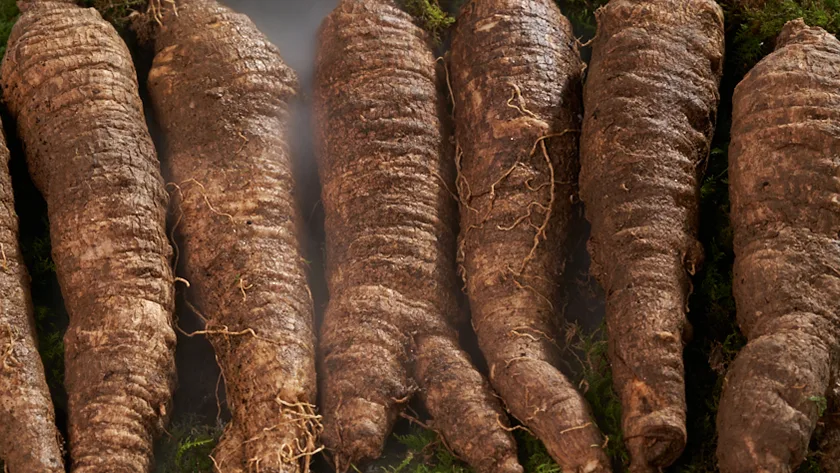
A Fragrant Root in the Corner of the Garden
Gardener friend, once you plant deodeok (Codonopsis lanceolata, a mountain root vegetable), it settles into its spot and grows thicker with each passing year. In spring its vines emerge and climb over neighboring stems, and by summer it hangs out bell-shaped flowers tinged with purple. Dig one up, and the first thing to reach you is a deep fragrance rising through the soil. When you peel the skin to prepare it, a sticky white sap clings to your fingers — and it's this white latex that sets deodeok apart from other root vegetables.
At the table you'll meet it grilled, tossed in seasonings, or as jangajji — pickles buried in doenjang (fermented soybean paste) and fished out when you want them. Its strong aroma divides opinion, but once you grow used to the taste, it becomes a root you reach for every spring and fall. Easy as it is to think of deodeok as nothing more than an ingredient, leaf through the old medical texts and you'll find this root held its own place, credentialed as medicine. So how did the Dongui Bogam record this familiar crop?
How the Dongui Bogam Saw It
The Dongui Bogam treated deodeok under the name yangyu (羊乳), "goat's milk." The name came from the white latex that flows out like a goat's milk when you cut the stem. That white sap you meet while trimming the root is the very basis for the old name.
As for its nature, deodeok was regarded as sweet and bitter in taste, neutral in character, and free of toxicity. To call its nature "neutral" means it is neither overly cooling nor overly warming, so the old texts considered it a fairly mild, easy-to-use material.
As for its uses, the Dongui Bogam recorded deodeok — like doraji (balloon flower root) — as a remedy that acts on the lungs. It was written down as a treatment for dissolving phlegm and calming coughs or throat inflammation. This root, with its deep aroma and sticky sap, was seen by people of old as something to tend the throat and lungs.
One point of confusion over names is also worth noting. The old texts sometimes recorded deodeok as sasam (沙蔘). Modern herbology, however, identifies sasam as jandae (Adenophora), distinguishing it from deodeok (Codonopsis). Both belong to the bellflower family, but they are plants of different genera, so it helps to know that names can overlap when you read old records. The way roots once lumped under a single name were later teased apart and sorted out over the centuries is part of the pleasure of reading these old medical texts with today's eyes.
Set Against Today's Nutrition Science
Among the compounds in deodeok, saponins come up often. The sticky white sap and the distinctive slightly bitter taste are thought to be tied to this compound.
Modern research has reported anti-inflammatory, expectorant, and memory-related effects from deodeok's saponins. What's intriguing is how the Dongui Bogam's record of using the root to dissolve phlegm and calm inflammation sits not so far from the direction of modern studies reporting expectorant and anti-inflammatory action. The path by which people of old came, through experience, to use deodeok for the lungs and throat, and the points today's experiments are examining, seem to meet in the same place.
Still, there's something I want to make clear. Most of this modern research remains at the level of animal or cell studies. Its effectiveness in humans hasn't been established, so rather than declaring deodeok a medicine, it's more fitting to enjoy it as an ingredient rich in aroma and nutrition. Both the Dongui Bogam's records and today's reports are best taken as a single perspective, nothing more.
From Garden to Table
When preparing deodeok, scrape off the soil with the back of a knife and peel the skin, turning the root as you go. The white sap clings to your hands and a bitter taste lingers, so a brief soak in salt water makes the root much easier to work with. Tap it lightly with a mallet to flatten it, and the fibers soften while the seasoning soaks in better.
The most common approach is deodeok-gui — the root brushed with gochujang (red chili paste) seasoning and grilled. Its lively aroma makes it a fine side dish with rice, and just as good alongside a drink. Torn into thin strips and tossed with a tangy dressing, the fresh salad (saengchae) wakes up the appetite, while jangajji — buried in doenjang or gochujang — keeps well and can be pulled out little by little over a long stretch.
It isn't a crop that calls for many special cautions, but since it's a root with a strong aroma and bitterness, I'd suggest enjoying it a side dish at a time rather than getting greedy with too much at once. Bring a single fragrant deodeok root, dug from your own garden, to the table — together with the story that the old medical texts once called it yangyu, the goat's-milk root that tended the lungs.